
While conducting a stress management program for Scope International, a BPO of Standard Chartered Bank, I asked the participants what their ideas of happiness were. The participants in the age group of 21-30 years shared that the ideas included chill-out in pubs/malls, watching a live cricket match or a movie at a multiplex or on TV. When asked how long one can watch TV on a long weekend or how would they feel after pub-hopping on a late Friday evening? The surprise for them was the subsequent days may be boring.
What is Flow:
Has it ever happened that you were drafting an article, playing an instrument, making a recipe or even completing an official assignment and you got so engrossed in your task that you were oblivious of how time flew and the few hours you spent felt like few minutes?
This phenomenon was termed as Flow by Prof. Mihaly Csikszentmihalyi who did pioneering work on the above subject for more than 25 years at the University of Chicago.
Viktor Frankl says in Man’s Search for Meaning: happiness like success cannot be chased; the more you pursue, the more it eludes. To be happy, one should be engaged in an activity which is conducted to the best of one’s abilities and which stretches your physical and/or mental capabilities.
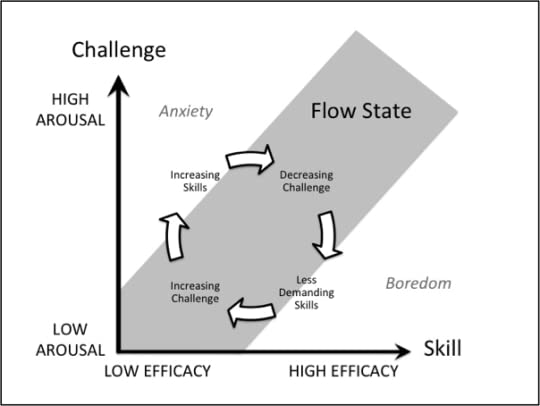
If the task is routine, and below your skills level, then you may find it boring; if it is too complex, it will be frustrating. Only when the task complexity is marginally higher than one’s abilities then the likelihood of flow is possible. (Refer the Figure)
Pleasure and Fulfillment
It will be pertinent to note two concepts Pleasure and Fulfillment.
Pleasure: is the experience one gets when one’s goals are achieved which are either set by biological needs like sex, hunger, thirst etc. or social conditioning like money, fame, power or acquiring premium objects of luxury.
Fulfillment: is an experience you get when you stretch your physical and mental limits in achieving a task and while doing so you may achieve something unexpected with a sense of novelty. The activity may not be pleasurable when you were performing it but may look satisfying in retrospect.
When asked to recollect the moments of happiness (in the Standard Chartered example indicated above) one person recollected the arduous struggle he had to undergo for three years with financial difficulties to complete his CA studies. The other person who was an IT administrator said the server in his company was down and he worked for sixteen hours at a stretch and was able to rectify the problem after having worked throughout the night. The moment the server and the entire IT network started working, he not only was relieved but also felt a sense of accomplishment. When the Sr. Management from US appreciated the wonderful job, he was indeed on cloud nine! That is fulfillment. Both these people were able to recollect these incidences vividly even after a gap of three years. On the contrary, they could not recollect the mall or the pub they had visited three weeks back.
People often misrepresent happiness for pleasure which is achieved by goals set by biological programming like homeostasis, a feeling of satiation after having a sumptuous lunch or alcohol. Social conditioning also leads to pleasure includes getting a job with a higher CTC, a senior designation, or a bigger car.
Achieving happiness by controlling Consciousness
Individual consciousness is the representation of the outside and the inner world as experienced by a person and the way she interprets the same, evaluates and takes an action. It is not the external reality per se; but the representation of the same in one’s mind.
The normal state of consciousness is chaos which is evident by the rapid and the random thoughts we have on a day-to-day basis. The normal state affects our attention and leads to distraction e.g., the tendency to look at WhatsApp every few minutes. In case of a flow experience the chaotic contents of the consciousness are rearranged in a systematic way. For example, if you are writing an important document, but every few minutes you are distracted by the notifications, WA messages, mobile calls, your mind is in a chaotic state. However, if you keep your mobile in a silent mode and keep it at a distance and concentrate fully on that document with full attention; you may get into a flow state wherein your mind may be able to appreciate the finer nuances and the complexities of the project.
Bringing Order to Chaos
Flow can be considered as bringing order to consciousness. It is relatively easy to experience flow when the external circumstances are favourable. However there are rare situations where people like Veer Savarkar or Albert Schweitzer were able to get into flow in spite of hostile circumstances.
Veer Savarkar was incarcerated in cellular Jail in Andaman Islands from 1911 to 1920. He was subjected to extreme hardship involving leg iron chains, crossbar fetters, flogging, extracting oil from coconuts, and neck-ring shackles. The tiny solitary cell of 10’x10’ was aimed at making a nervous wreck out of him. Despite such trying circumstances, with no access to paper and pen/pencil, Veer Savarkar was able to produce an exceptional quality of Marathi poetry and prose on his room walls by writing using nails and safety pins.
Dr. Albert Schweitzer was an Alsatian polymath. He was a theologian, organist, musicologist, writer, humanitarian, philosopher and a physician. He was known for setting up his medical hospitals in Lambarene, Africa. He was born in Alsace which was on the border of Germany and France. Due to some technical issue on his citizenship, he was incarcerated in a German jail. He also had a passion for Western Classical music and later obtained his Ph.D. for interpretation of Bach. To continue his music practice in jail, he used a wooden plank, in the absence of a conventional church organ.
Limits of Consciousness
It is said that at any moment, the human mind can process 7 bits of information. The shortest time to record the data in mind is 1/18th of a second. That means each second the mind can process 18 X 7 bits of information, which is 126 bits per second. It translates to 7560 bits per minute, 0.5 million bits per hour and around 185 billion bits of information can be stored in the mind for an average of 70 years. To understand a person, it requires around 40 bits/second. Now the 185 billion bits of information is stored in terms of thoughts, feelings, words and action.(1)
How do we use this information? Do we use it wisely or otherwise? 15% of our waking time is spent on daily chores, washing, eating, ablutions etc. The free time that we get we spend watching TV, reading WA, newspapers, gossip etc. Such activities do not stretch the mind. It does not allow the mind to process added information by making efforts or make the consciousness complex. (2) Can we perform the day-to-day activities with awareness? Can you focus your attention and delete the unwanted information that hits you every now and then? If you can do that by bringing order into your consciousness you are getting into flow.
When flow happens
Flow happens when there is a balance between the skills the person possesses and the challenges he faces through the external environment. If the challenges are much higher than the available skills then anxiety sets in. Whereas if the task is too simple then boredom happens. Thus, flow is a golden mean between anxiety and boredom.
The body is an excellent medium to achieve flow. Jogging, Yoga, martial arts, sports, tai-chi, meditation can help the body to achieve flow. Involving different sense organs for appreciating music, photography, painting, relishing food can help achieve flow.
It can be achieved by using intellect and includes writing or appreciation of poetry, philosophy, mathematics, physics, literature etc. An attitude of life-long learning is extremely important.
Flow can also happen by cultivating hobbies. However, a person has the maximum scope of getting flow experiences at his workplace. Most of us work to pay our bills, earn a living and the provision of security. We feel that we enjoy life more during our free time. Given a choice we prefer to have more leisure and less work. But the converse is true. People can get more flow experiences at the workplace ( provided they enjoy their work) than at leisure and as Thomas Carlyle said, ‘blessed is he who has found his work; let him ask no other blessedness.’
What you do during your work hours will determine what you have. What you do during your leisure will decide who you are. – George Eastman
Reference:
- Limits of Consciousness: Miller (1956), Orme ( 1959) on the basis of Uexkull’s ( 1957) calculations on 1/18th Second as the threshold of discrimination.
- Free Time: ESM Studies by Csikszentmihalyi , Larson and Prescott (1977)

Image source: assets.com/images/S/compressed.photo.goodreads.com/hostedimages/1550649362i/27091258._SX540_.png


 Peter Drucker was consulting for a CEO of a major bank in US. For every meeting the CEO used to assign Peter a time slot of 90 minutes. A highly effective person, the CEO was delivering consistent results for his bank year-on-year. During the one-and-half hour meeting the CEO refrained from taking any telephone calls
  Rajan Parulekar