Generally we look at curing addictions by eliminating the impact of the external environment. For example if a person is addicted to alcohol, he is persuaded to reduce the dependence on alcohol by suggestions on how alcohol is bad for health, its effect on the family, health and financial security. The patient is also exhorted to join Alcoholic Anonymous (AA) so as to reduce his dependence. These interventions work sometime but also tend to fail when a patient relapses as he is unable to resist the temptation.
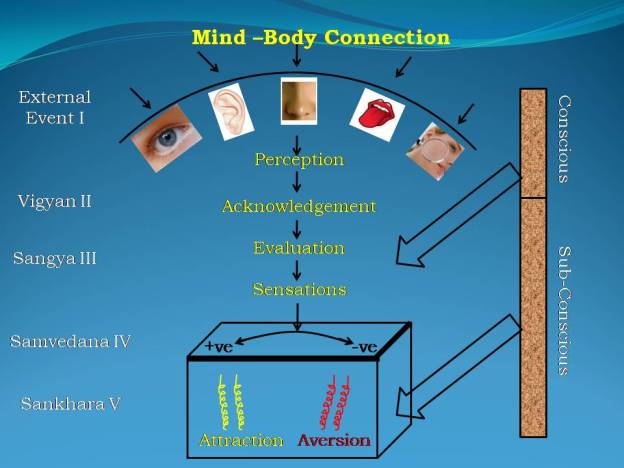
Let us look at an alternative model from the Buddhist perspective. (Refer figure). An event (stage I) that happens outside is perceived inside the body through any or a combination of the five sense organs like eyes, ears etc. Sometimes it can be only an aural input like a piece of music or a multi-sensory input like relishing delicious mutton biryani ( sight, smell, taste, partially sound )This second stage is called as perception and acknowledgement of the external event which is a MAP and not the actual event and is termed as Vigyan in Pali. (Stage II). The moment an input is perceived, it is immediately evaluated by Sangya (stage III) which compares the event with something similar in the memory bank. Based on the comparison the event is either pigeonholed as either good or bad. The comparison instantaneously produces a sensation (Stage IV)) on the body which is either a positive or a negative one. The positive sensation may be tingling, soothing or a similar sensation whereas a negative sensation can be an itching, pain or a similar sensation. So far so good. The journey up till now from an external event of tasting a morsel of mutton biryani produces either positive or negative sensations which do not exclusively depend on whether the biryani is good or bad but depending on how it is perceived and the corresponding sensation it produces on the body. For example, a person who loves spicy Hyderabadi Biryani may like the taste if it is comparable to the one prepared by his mother. (Evaluation – stage III) An American who is used to bland food may find the Biriyani quite pungent. The same food has produced two different body sensations: for the former it is positive, and for the latter it is negative.
At this juncture, the subconscious mind comes into play and depending on the type of sensation, shall either produce a bond which is either of craving/attraction or Aversion (Raaga or Dwesha Stage V). The person decides to either have the next morsel or avoids depending on the bond that is created by the subconscious mind. A simple example of biryani can be compared to Alcohol, Nicotine or any substance drug.
Myths of Addictions:
- An external event is the cause of addiction: If it were so, all people who take alcohol should have become alcoholics which are not the case. People do not become addicted to an external event or stimuli but to the sensations on the body.
- By telling what is right people can come out of addictions: When we tell the message only reaches the conscious mind. However the subconscious mind which constitutes 90% of the mind and is more habit prone refuses to acknowledge the message given to and by the conscious mind. Quite often alcoholics know the ill-effects but the thought pattern prevents them. On the contrary the subconscious mind now starts justifying the action. Like a person says he is drinking because he had abusive parents, pathetic childhood, financial problems, spouse etc. However he does not realize that the addiction is not for the alcohol but for the craving of pleasant sensations (relaxed feeling) and the aversion of the negative feeling (turkey, shivering, irritation etc.)
- Happiness and Pleasure are the same: We believe that pleasure is good and pain is bad. However any event whether pleasurable or otherwise, creates misery in the long run. Let us say a person who loves gulab-jamun feels that the sweet is the source of happiness. If it were so, irrespective of the quantity, galub-jamuns should make him happy. He may enjoy the first few very much, however if continued beyond 10 or so it may produce irritation. So the pleasure was not in the gulab-jamun but in the sensations it produced on the body.
How to Bring Change:
It should be clearly understood that the first four stages are primarily automatic on which a person does not have much control, which include the event(I), the perception & acknowledgement by the senses( II) the evaluation ( III) & the sensations on the body due to evaluation (IV) .However the reaction to the body sensations is within a person’s control. The bonds of attachment and aversion are continuously in the subconscious mind every moment. Taking an analogy of the hard disk of a computer, continuously the data is written by way of bonds (sankhara) which are habit forming.
If we stop creating new bonds, slowly the old ones will wither way and gradually the change starts happening. To bring this, awareness of the mind and body plays a very important role. It is not about concentration of the mind but a simple process of choiceless awareness which helps a person see the rapid thought process happening in the mind. Simple exercise like watching one’s breath slowly makes the mind so sharp that at one stage one is able to observe the body sensations. These sensations in a day-to-day life are generally not observable as the mind is gross.
The major trap for the mind to get into is while observing the sensations. People may start hankering after the pleasant ones and despise the bad ones. At this juncture, one has to observe the sensations with equanimity developing a clear insight that any sensation: be it positive or negative is ultimately going to create a sankhara, an impression on the mind. By developing equanimity towards any sensations; slowly the bonds get reduced in the subconscious mind. A change happens at the subconscious level which is long-lasting.
For most of us there is a gap between knowing and doing. At a cognitive level people know the terrible effects of excessive smoking, drinking. However the behaviour can change only at a subconscious level. To summarize, the sensations on the body produce the addictions and not the external event. This profound technique has been the unique contribution of Gautama Buddha. His technique of Vipassana has helped a number of people to bring a behavioural change in managing anger, fear, curing phobias or come out of addictions. Experiments were carried out on the prisoners of Tihar Jail by this technique which has amply demonstrated the efficacy of the technique.
Apart from curing addictions, the above technique of choiceless awareness which provides insights into the mind-body connect can be used in curing phobias, pain, dysfunctional anger etc. Amygdala is the seat of emotions in the human brain from where anger, fear, jealousy etc emanate. The addictions which happen at a subconscious level are very difficult to eradicate by instructing the brain at a conscious level or a cognitive level. Following examples will illustrate the change was completely or partially brought by this technique.
- Subconscious Anger: Ramesh P. aged 61 years is an engineer and has worked at quality control in different spheres of management. The last position he held was that of GM level at an Automobile company. With financial stability, considerate wife and two children, both well educated and well settled we would perceive that Ramesh is be a happy person. Being his room-mate in one of the training programs I could see Ramesh shouting and screaming in his sleep which used to happen between 12 -1 PM. For first few days, I could not comprehend what he was speaking but later on I figured out it to be a few sentences of vitriolic anger against one of his former managers. Next day when I discussed with Ramesh about the incident, he confessed that he was not aware of such an incident but when pointed about the contents of his diatribe, he said that the incident happened around 12 years ago when his company was going through a major expansion and Ramesh was going through testing times when his immediate boss put him under tremendous pressure. Now Ramesh and his boss both have retired. Whenever they meet,they exchange pleasantries and are good friends. Only when it was pointed out to Ramesh about the latent anger he could see the impact of subconscious mind. Ramesh realized that when he resisted the negative thoughts about the past incident the negative sensations were produced on the body. By denying them he was creating more bonds of aversion ( stage V) thus multiplying his misery. Instead when he decided to be aware of the incident; slowly the impact reduced. The more you resist the more it persists!
- Limitation of Chanting: Swati is a housewife from a lower-middle class family and her husband is working as a supervisor in a small private firm. Due to some reason or the other, the two could not get along well. However by sheer persistence and will Swati was able to control her frustration by regular chanting of sacred mantras, making holy pilgrimages etc. A highly religious person she had managed to keep her emotional life under control. However during the Vipassana program on the 7th day, Swati refused to continue the course. She said now the anger within her has come out so badly that she feels a great urge to kill her husband with a gun. The anger which was lying dormant was exposed, exploded and resulted in her violet behaviour. By becoming aware, she was able to peep into the subconscious mind and get out of her anger.
You will observe that by the chanting of mantras, Swati was feeling calm and serence at a conscious and a superficial level. However when she looked deep within with awareness she could see the tremendous anger.
- Sense of remorse reduces pain: Homi D. was a working as a fighter pilot for the Indian Air Force ( IAF) during the India-Pakistan war in 1971. He had shown exemplary courage in fighting the enemy. He was decorated with awards. During the war, while going out for a sortie most of the pilots in a vainglorious manner used to blabber about the number of bombs they dropped, and the number of people those were killed by their bombings. It was taken as a measure of one’s achievement. During the war Homi was injured badly, almost to be captured by the Pakistani army. He had to crawl on his wounded legs for almost 5 hours to return safely to the Indian base. His right leg had been amputated and left one was hit by few bullets. He had to undergo a number of operations but still the pain was unbearable for more than two decades. He even lost his left eye and was fitted with an artificial eye. He underwent a number of treatments, however nothing could alleviate his pain. While undergoing the meditation exercise, Homi became aware of the pain that he had caused to a number of innocent people killed due to his bombings. Till then, what he considered as his success, was nothing other than an act of barbarity. And this sense of remorse and guilt helped Homi to reduce the intensity of the excruciating pain. Now the pain even though not vanished, has been reduced by almost 50%.
From the above three examples, you may observe that the events which had happened more than a decade back were stored in the form of sensations. However due to the automatic nature of the subconscious mind whenever this sensations appeared on the mind there were repeated cycles of aversions which made the subconscious mind filled with aversion; which the conscious mind was not aware of. However by sheer mindfulness slowly the bonds of aversion ( Stage V) were reduced and the people were able to come out of their misery.
Rajan Parulekar| Bangalore | India| rajan@paradigm-info.com| +91 98450 14098







 Rajan Parulekar