Tag Archives: Training

Narrative Fallacy

During one of the client meetings, Vijay, Head of Talent Acquisition (which was earlier termed as Personnel, HR etc) was  waxing eloquent about how the right hiring and the talent management has been the crucial factor leading to the company’s phenomenal growth.

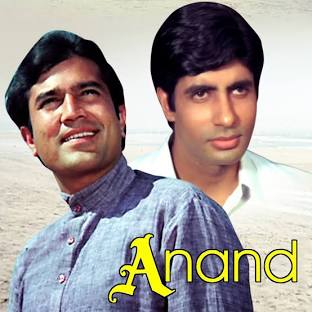
I was reading an article by a renowned Hindi film critic on similar lines. This media reporter had written about Hrishikesh Mukherjee (Hrishida as he was affectionately called), the Dadasaheb Phalke award winner having directed some of the notable films like Anupama, Anuradha, Satyakam etc. and how he selected Rajesh Khanna for the title role in Anand. The point he was trying to make was the success of the film was primarily due to selection of the right people be it the actors, music director, lyricists among others.  

Anand, made in 1970 is a story of a young man who has been diagnosed with intestinal cancer. The doctor had diagnosed that Anand will not survive for more than six months. In spite of the grim future, Anand has a cheerful disposition towards one and all and tries to keep everyone around him happy. The title role was played by Rajesh Khanna and the supporting role of Dr. Bhaskar Banerjee was played by Amitabh Bachchan.  

 But was the selection of people so logical and linear as we see in hindsight? When Hrishida first conceived of the project in 1955, the person whom he had him in mind was Raj Kapoor but both of them being busy in their own spheres; the project could not take off. By 1968 when Hrishida revived the project, Raj Kapoor was looking old for the role. Shashi Kapoor was thought of but he too was busy.

Hrishida wanted Kishore Kumar to do the role. When he visited Kishore Kumar’s house to discuss the role, the latter mistook the visitor from a distance to be someone else who had not paid Kishore Kumar’s dues. The security guard was instructed not to allow this visitor inside Kishore Kumar’s bungalow. (1)

By this time, Rajesh Khanna who was the emerging superstar got news of the project and approached Hrishikesh Mukherjee.  Anand was a low-budget film and Hrishida could not afford his fees. Those days Rajesh Khanna used to charge a princely sum of Rs 5 lakhs per film. When Hrishida expressed the apprehension, Rajesh proposed a creative solution. He said, “I will not charge a Rupee, instead can you give me the distribution rights for the Bombay territory”? This creative solution not only was accepted but also  helped Hrishida sell the film on a pan-India basis.

Amitabh Bachhan also had a wild card entry in the film. He was having a negative role  in a film called Parwana. One day Omprakash, the character actor met Hrishida and provided a strong recommendation for Amitabh who was cast in the supporting role of Dr. Bhaskar Banerjee.

The script had a role of Dr. Prakash Kulkarni, a friend of Dr. Bhaskar.  Ramesh Deo was a renowned actor in Marathi films and theatre. He was struggling to get a breakthrough in Hindi films. He had approached Hrishida a number of times in the past but could not cut much ice. Hrishida one day approached him for the role of Dr Prakash Kulkarni and had planned Nimmi for the role of his better half. Nimmi was one of the leading ladies of yesteryears who had acted in blockbusters like Aan, Udan Khatola etc.

When offered the role, she said, “The role is small; there is no heroine per se in the film and all the spot light is on Anand. Can you at least tell me  with whom am I paired with?” Hrishida: “He is Ramesh Deo, a seasoned and a successful actor in Marathi film industry.” Nimmi : “I have not heard that name. I have worked with stars like Dilip Kumar, it is below my dignity to work with such unknown people. Can I make you suggestion? Why don’t you take Raj Kumar for this role instead?” The next day, Hrishida and N.C.Sippy along with Nimmi went to Raj Kumar’s house in Worli.

After exchanging pleasantries, Raj Kumar asked Nimmi to chat up with his wife in the kitchen and said, “Incidentally I have my reservations taking up this role with Nimmi. She has the looks and the charm but that is the past.”

Apart from casting aspersion on Nimmi, Raj Kumar demanded that he needs to have at least a song on him. Hrishida dropped him like a hot potato.

Back to square one, Hrishida zeroed in on Ramesh Deo. Chess was their common interest. One day when he went to Deo’s  flat in Bandra for a game of chess, Hrishida was quite impressed with Seema, Ramesh’s wife. Seema was a leading Marathi actress even otherwise.

When Hrishida said, “Ramesh, why did not you suggest Seema for this role”? Ramesh said, “ First of all I myself was not sure of my role, how could I recommend her?” With quirk of fate, Ramesh and Seema Deo thus got the roles of Dr. and Mrs Kulkarni.

The music composer was decided as Salil Chowdhary and the lyricist as Gulzar. The film had a provision for only three songs. But when the film was completed, it had four songs: Maine Tere liye and Na Jiya Laage Na by Gulzar & Zindagi kaisi Hai Paheli and Kahin Door Jab Din Dhal Jaye by Yogesh. How did Yogesh get a wild card entry?

In the late sixties, Gulzar was an established lyricist in the mainstream Hindi cinema whereas Yogesh was a struggling one who was mainly bracketed as a lyricist for B-Grade action films. 

Circa 1967 there was a film producer called Anand Gadnis who was making a film and roped in Basu Bhattacharya as  the director and Salil Chowdhury as the music director. Gulzar was to be the lyricist. But whenever meetings for the music were scheduled, Gulzar could not make it. As the producer wanted the project to go on fast-track, he asked Salilda to look out for an alternative. Salilda knew Yogesh. This was a golden opportunity for Yogesh to get into popular mainstream cinema.  Within no time, he penned lyrics for three situations. Salilda composed the music and later recorded. Due to some unfortunate circumstances, the project was shelved. Yogesh cursed his bad luck, felt that he is destined to be with B grade films. He felt making an entry into the popular genre was not his cup of his tea. He went back to Lucknow fully dejected.

Three months later, a  producer called L. B Lachman approached Salilda for a new film called Annadata starring Jaya Bhaduri and Anil Dhawan. When the contract was signed, Salilda said that he already has three songs ready from a previous project. Lachman picked two from the lot; the deal was that the payment was to be released only after all the songs were composed and recorded.

Lachman happened to be close friends with Hrishida. When he shared the audio recordings of the two songs; Hrishida liked the songs and showed interest to purchase both. A compromise was worked out. Hrishida purchased one and that was Kahin Door Jab Din Dhal Jaye.

Next day Yogesh was called for  and Hrishida made a cheque payment of Rs 2500 to Yogesh. It was the debut of Yogesh in A grade films. Incidentally this song is based on a Bengali song, Amay Proshno Kore Neel Dhrubotara sung by Hemant Kumar and written and composed by Salil Choudhary.  

Salilda had another Bengali composition called Na Mono Lage Na sung by Lata Mangeshkar. He asked Yogesh to compose a Hindi song on similar meter for Annadata. He composed a song for Lachman’s film accordingly.

In the meanwhile, Hrishida asked Gular to compose a song on the same meter. He assumed there should no issues as it is Salilda’s composition, the music director of the film. Now there were two songs based on Salilda’s original Bengali song one for Annadata and the other for Anand. Lachman got furious and said to Hrishida, “Why did you copy this song? What will people say when they hear two Hindi songs based on the same Bengali tune?”

Salilda had another issue to settle for. He said to Hrishida: “This struggling lyricist Yogesh has already composed a song for Lachman which has to be discarded. He needs to be compensated.” Expressing his sincere apologies, Hrishida accepted the proposition and agreed to compensate Yogesh.

Next day when Yogesh went to Hrishida’s house, he refused to take the cheque. Salilda said, “You fool, you are going through tough times. Why did you not take the payment?”

Yogesh: “Any way I have not written this song for Hrishida. He has taken it from Gulzar even otherwise. Ethically it is not right for me to take payment for the work which I have not done.”

As a via media, Hrishida thought of having an extra song. And that is how the fourth song was added in the film and was to be the title song.

When Rajesh Khanna heard the song, he said, “Hrishida, this song is too good. Why keep it as  a title song? I want you to film the song on me.” And that’s how Zindagi Kaisi Hai Paheli’ got included in the film.(2)

If you were to see the events by themselves, they are all random in essence. But in retrospect we connect the dots and create a story around the random events . This is called as Narrative Fallacy. It is the human tendency to create a story or an explanation out of a chain of some random events.

When I reflect on the major personal events like admission in an engineering college, getting a job or getting a training assignment; I ask myself whether the specific event happened because of me or in spite of me? Is it merely the talent, intelligence or the hard work of a person or a combination of some fortuitous circumstances complimenting the traits? Should experience make us more confident or humble?

Two years back one of my senior trainer friends, Narayanan was sharing an incident. A public program he had scheduled had to be cancelled due to insufficient nominations. When enquired about the likely reasons for cancellation, he replied, “ Rajan, frankly speaking, I do not know. But if you were to ask me a similar question 20 years back, I would have ascribed the failure to some plausible causes like bad timing, poor marketing strategy, competition etc.” My son Aalhad then made a succinct distinction between causation and correlation leading to specific events.

Quite often the success of an organization is ascribed to the  hard work and the intelligence of the top leader. Can you recollect the debate on 70/90 hours per week some successful leaders are advocating? Is that the gospel truth or a narrative fallacy? By becoming aware of this human bias called narrative fallacy; can it make us more humble and help us come out of hubris?

John Brockman the editor of Edge Magazine says: Success = Talent + luck &  

Great Success =Little more talent + a lot of luck.(3)  What do  you think?  

References:

  1. Wikipedia
  2. Ten Classics by Anita Padhye
  3. Thinking Fast & Slow – Daniel Kahneman
Do we mean what we say?

“The Galaxy Z flip 5 is ONLY Rs 99,999/ said the salesman at the mobile counter. Being a latest product from Samsung, we can work out a special price for you with an exchange of the old mobile additional upgrade bonus and extra bank cashback…”

While the salesman was rattling off the technical specifications in his sales pitch; I got stuck at the word ONLY.  What happens when people use the word ONLY, is it something to convey or to hide?

Jacob and Isaac were two religious Jews living in an apartment complex with their balconies facing each other. They  had not fasted on the Yom Kippur day, the day of atonement. They went to the Rabbi to ask for forgiveness. The Rabbi replied that it is possible only through observing a penance.  He asked both about what they liked the most. Jacob said, “sharing the marital bed with my wife.” Rabbi said, “Jacob, for the next three weeks, you shall be sleeping in a separate bedroom.” To the same question, Isaac replied, “smoking a cigar.”  Rabbi said , “likewise you are not going to smoke a cigar for the next three weeks.”

One night, Jacob’s wife knocked on his  bedroom door. Jacob said, “Darling, it is ONLY the third day. We are not supposed to be together for the next three weeks.” His wife said, “ I ONLY wanted to tell you that Isaac is smoking a cigar.”

There are many undesirable thoughts and images which are in our subconscious mind which try to escape into the conscious mind. The way the word ONLY is used is to push back the undesirable thought coming into the consciousness. You may see that from the bottom of their hearts; both Jacob and his wife wanted to be with each other; but by using the word ONLY; were trying to repress the desire. Rationalization is a process by which a person justifies his action by hiding the real intention. As Voltaire said, ‘men use thought only to justify their wrongdoing and speech only to conceal their thoughts.’

Another example to illustrate the point: While having dinner with my mother-in-law; she said, “Rajan, is the curry over?” I replied, “No, the dal fry is still there. Do you want me to serve you?” She said, “ I ONLY wanted to see whether the fish curry is over or not.” My mother-in-law being a strict vegetarian; finds it difficult to hide her consternation of someone partaking of a non-veg dish while having her meals. You may observe the word only conveys, ‘for heaven’s sake, when will the curry get over?’

When a salesman is telling you that a product costs ONLY  Rs 99,999/- what he wants to tell you is that the mobile is economical and value-for-money (as conveyed by the management).What he wants to hide is his personal opinion of the product being expensive. If you are a seller, use ONLY during order closing;  but if you are a customer; beware of the trap laid down by the seller. 

“Sir, would you like to go for this model?” the salesman interjected. I was taken aback from my reverie of hidden meanings behind the words. “By the way, you shall also get a rebate of around Rs 30,000 on your old mobile; though for specific models.” He added a caveat. When he saw that I was using a Samsung Galaxy A12, an economy model costing only Rs. 12,000, the salesman was in a rude shock. I could see a tapestry of anger, frustration, pity writ largely on his face. “Sir I ONLY need to take this urgent call and shall be back within a minute.” I knew he would not turn back so soon.

So next time when you hear the word ONLY be careful: is your colleague trying to hide more than what he wishes to convey? As someone said, “statistics is like a bikini, it conceals more than it reveals.”

Enhancing Training Effectiveness thro’ the Law of Diffusion of Innovation

Any form of training is ultimately a change management program where the organization expects its executives to approach a problem with a different behaviour, attitude, or a skill. In a highly competitive market where customers are spoilt for choice, the main challenge for salespeople is to effectively demonstrate the value of their products and services to handle the discount issue. There are two approaches in scheduling a training program: a conventional Giving-on-a-Platter (platter) approach and a rarely practised  Earning-One’s-Stripes ( Stripes) approach. The following example will compare and contrast both the approaches.

Aristo India is a leading manufacturer of  sliding wardrobes and kitchen cabinets with HO at Bangalore.  Mr. Kuruvilla Kurian, the Sales Director had a different approach to having a Value-Selling training for his pan-India team which include:

  1. Voluntary Participation: Only those salespeople who are interested can apply for the program. In a Conventional Platter approach, attendance is compulsory as decided by the  senior management and HR.
  2. Efforts prior to Participation: Application for a training program does not guarantee enrolment. Each  applicant needs to write a 500-words essay to articulate one’s raison d’ etre. The essay was carefully evaluated by Ms. Sudipta Shetty, Head-CRM to understand the applicant’s sincerity and the originality of thought.                                  – In a platter approach, there are no efforts. Participants either click on a link to register or fill up a form for enrolment.  
  3. Post-Training Implementation: Based on their essays, a 2-day program titled Value-Selling of Premium Wardrobe Solutions was designed. During the program commencement, the participants stated the challenges which were predominantly  external factors like customers do not listen, they are price sensitive, they are interested only in discounts etc. During the training program, the participants underwent role plays simulating the  real-life situations. By the program conclusion it was shown that some of the problems had an internal locus of control for the sales team like inappropriate body language of the seller, miscommunication, lack of probing, listening etc. The videographed role plays were replayed with exhaustive debriefing.

Post training, Kuru and Sudipta decided that conducting similar role plays for each region internally  could be a better way of enhancing the learning effectiveness. Sudipta took the initiative in arranging  the same. A review session with the trainer on a virtual platform was subsequently arranged for implementation of the action plan.

  • In the platter approach, normally the program gets concluded with a standard feedback form.  

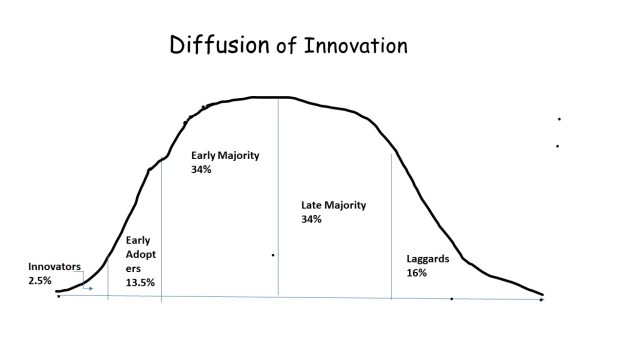
THE DIFFUSION OF INNOVATION theory describes the pattern and speed at which innovative ideas, practices, or products spread through a population which can be correlated in the present article to bringing a cultural change (in beliefs, attitude, values etc.) through training. The main players in a group are classified as innovators, early adopters, early majority, late majority, and laggards. The new ideas are adopted sequentially first by the innovators and lastly by the laggards.

  1. Innovators ( 2.5%) : They are willing to risk and accept any new ideas.
  2. Early Adopters( 13.5%) : Are already aware of the need to change and are comfortable adopting new ideas.
  3. Early Majority (34%) : They need the evidence that the innovation works before willing to adopt it.
  4. Late Majority ( 34%): They are sceptical of change and will only adopt if it has been tried by the early majority.
  5. Laggards ( 16%): Are bound by tradition and are conservative.

The characteristics of the Platter approach are:

  1. It targets the entire population irrespective of their intent and the degree of willingness to change.
  2. Being mandatory it may degenerate into an ‘event’ in  terms of food, ambience, entertainment thro fun/videos and freebies for the majority (early and late) and the laggards.
  3. A CHRO from a renowned construction company shared that their managers are interested only in branded programs from IIMs where the main motive is certification.
  4. Quite often the line managers are reluctant to nominate their reportees for the program  complaining that it affects the completion of their immediate tasks. I am not sure whether they too belong to the majority and the laggards.

How does the stripes approach differ from the platter approach? The former targets only the early adopters rather than the entire group.  It also does not link training program to certification, promotion, or increments but only to the interest and the initiative of the participant. The diffusion of training to other segments like majority and laggards is ultimately decided by the program quality and the way the early adopters spread the message.

The platter approach makes training mandatory treating all the subgroups like early adopters, late majority, laggards in the same bracket whereas the stripes approach creates a demand for training. The first batch of Value Selling program for Aristo India was targetted for the early adopters. This in turn has created so much buzz that others are willing to enrol for the second batch but only after going through the rigour of an essay and a selection process. Remember, anything that is given on a platter is never valued. The difference between the two approaches is summarized in the table below.

PLATTER VS STRIPES APPROACH

 PlatterStripes
Management ParadigmTraining is mandatoryTraining is optional
Target SegmentRandom, no specific targetEarly Adopters
EnrolmentBy DefaultSelection thro’ an  Essay
Participant MindsetReactiveProactive
Locus of ControlExternal  like certificationInternal – Job Enrichment
Efforts by HRNormalExtensive
Buy-in from the non-attendeesNot ApplicableCreates demand depending on  the program quality and the buzz.

Three Bad Habits Sabotaging Your Productivity

Clock-StressPeter Drucker was  consulting for a CEO of a major bank in US.  For every meeting the  CEO used to assign Peter a time slot of 90 minutes. A highly effective person, the CEO was delivering  consistent results for his bank year-on-year. During the  one-and-half hour meeting the CEO refrained from taking any telephone calls Continue reading

Does success in Small Value Sales a Guarantee in Key Accounts too?

This question when asked by my clients,  I am reminded of Marshall Goldsmith’s book, What Got you Here, Won’t Get you There!   One of our clients nominated his star performer, Akshay for our training program. The main reason being he was not able to reach his desired targets in selling high-value capital equipments, the way he was selling laptops and mobiles in his previous organization. It is generally believed that a great salesman can sell anything to anybody. Translated otherwise, most of us feel that a great salesman is the one who can sell a refrigerator to an Eskimo. The above statement is not true for the following reasons:There has been a paradigm shift from a Sellers’ to a buyers’ market. Today’s customers have more choices vis-à-vis their counterparts in 90s.

  1. Thanks to internet, today’s customers are knowledgeable. A person before buying a mobile or a car has done enough research on the net comparing products technically as well as commercially.
  2. If you try to sell something a customer does not need, there is possibility the customer express his anger and frustration on twitter/trip-adviser etc. and in no time the contents may go viral.
  3. In a low-value sale, generally the customer knows what he wants to buy and the interaction between the salesperson and the customer is transactional. The salesman needs to inform the product features, the price and the competitive comparison.
  4. In case of a high-value sale, or a key account sale, quite often the customer may not clearly know what he needs, he may have a vague idea. He needs a solution not a standard sales pitch. Precisely for this reason the salesman needs to be an active and empathic listener and also willing to probe deeper. He also needs to understand the customer’s business that is customer’s customer. Here the interaction is more on relationships.   You will observe that the some of these competencies can be acquired but others are natural traits like strategic thinking. This is one of the reasons why a Star Performer in Small Sale may not always succeed in high-ticket deals or Key Account Management.

 Paradigm Trainers Private Limited is having training programs on Key Account Management and Advanced Negotiation Skills in Bangalore ( 14/15th Nov.) and Mumbai ( 21/22nd Nov.) for more details : www.paradigm-info.com

Who Says customer is the King?

It was a chilly December afternoon in Bangalore. We were at the Commercial Street in Bangalore. By around 2 pm when the shopping was over, we decided to have meals. On either sides of the road, there were MNC joints, one a McDonalds and the other KFC. To save the hassle of crossing the road, we got into KFC. The menu displayed on the wall was a series of combination of chicken pieces, French fries, Pepsi. Called as mini meals, value- add meals, combo meals with various  permutations & combinations, Pepsi was a common factor among all. It was quite dreadful to have Pepsi where the glass is topped with more than 50% ice on a chilly afternoon.

After considerable efforts, we were able to figure out a possibility of ordering a La-carte. Getting drinking water by default is out of question in an MNC joint. It affects the sale of Pepsi and Coke.  After finishing the meals, we requested for water. What was served after a long delay was the ice-cold version.  It was quite a struggle drinking such cold water on a chilly afternoon. We had to drink it sip-by-sip like  hot tea.

I go to a normal Darshini, Udipi restaurant. The waiter is not trained like the ones in the MNCs. Without being asked, he serves you drinking water and then you can order a dosa or an idly with coffee/tea. Why does training makes life difficult for customers?

Another example: I drove my car in a Shell petrol bunk. To avoid taken for a ride by the attendant, one  needs to be a Zen master and get into the present –moment awareness. The conversation goes as follows:

Attendant: Shall I fill  the tank with super petrol? (Remember, it is a closed question and it is easy to answer yes. The Super petrol is expensive by Rs 10 per litre vis-à-vis the normal petrol, the guy does not take the trouble to tell you this fact.)

I: ( with a calm disposition)  Please fill in the normal petrol.( You cannot afford to mumble NO as he can claim he heard it as Yes.)Attendant: Shall I top-up the tank?

I: Please fill only for Rs. 1000.                                                                                                                                                             Having missed his target twice, he makes a last feeble attempt.

Attendant: Can I help you with routine checkup like Oil check and coolant check?

I: how much will you charge?

Attendant: No, its free.

I: wonderful, please go ahead.

Attendant: (He opens the bonnet, takes out the oil indicator slider) The oil level is low. Your engine will seize anytime and it will damage the engine if you do not fill oil now.

I: How much will it cost?                                                                                                                                                                Attendant: Rs. 785/-

I: thanks for your advice.                                                                                                                                                                             I drive out after paying for the petrol. Last three weeks my car is still working fine.                                                                         Executives from KFC or Shell go through rigorous training vis-à-vis their Indian counterparts in Kamat/Shanbhag hotels or Indian Oil/Hindustan Petroleum .

Who says the customer is king but a hapless victim ( if gullible enough) who can be conned at the drop of hat?