Category Archives: Uncategorized

Narrative Fallacy

During one of the client meetings, Vijay, Head of Talent Acquisition (which was earlier termed as Personnel, HR etc) was  waxing eloquent about how the right hiring and the talent management has been the crucial factor leading to the company’s phenomenal growth.

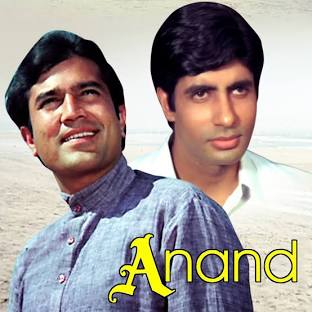
I was reading an article by a renowned Hindi film critic on similar lines. This media reporter had written about Hrishikesh Mukherjee (Hrishida as he was affectionately called), the Dadasaheb Phalke award winner having directed some of the notable films like Anupama, Anuradha, Satyakam etc. and how he selected Rajesh Khanna for the title role in Anand. The point he was trying to make was the success of the film was primarily due to selection of the right people be it the actors, music director, lyricists among others.  

Anand, made in 1970 is a story of a young man who has been diagnosed with intestinal cancer. The doctor had diagnosed that Anand will not survive for more than six months. In spite of the grim future, Anand has a cheerful disposition towards one and all and tries to keep everyone around him happy. The title role was played by Rajesh Khanna and the supporting role of Dr. Bhaskar Banerjee was played by Amitabh Bachchan.  

 But was the selection of people so logical and linear as we see in hindsight? When Hrishida first conceived of the project in 1955, the person whom he had him in mind was Raj Kapoor but both of them being busy in their own spheres; the project could not take off. By 1968 when Hrishida revived the project, Raj Kapoor was looking old for the role. Shashi Kapoor was thought of but he too was busy.

Hrishida wanted Kishore Kumar to do the role. When he visited Kishore Kumar’s house to discuss the role, the latter mistook the visitor from a distance to be someone else who had not paid Kishore Kumar’s dues. The security guard was instructed not to allow this visitor inside Kishore Kumar’s bungalow. (1)

By this time, Rajesh Khanna who was the emerging superstar got news of the project and approached Hrishikesh Mukherjee.  Anand was a low-budget film and Hrishida could not afford his fees. Those days Rajesh Khanna used to charge a princely sum of Rs 5 lakhs per film. When Hrishida expressed the apprehension, Rajesh proposed a creative solution. He said, “I will not charge a Rupee, instead can you give me the distribution rights for the Bombay territory”? This creative solution not only was accepted but also  helped Hrishida sell the film on a pan-India basis.

Amitabh Bachhan also had a wild card entry in the film. He was having a negative role  in a film called Parwana. One day Omprakash, the character actor met Hrishida and provided a strong recommendation for Amitabh who was cast in the supporting role of Dr. Bhaskar Banerjee.

The script had a role of Dr. Prakash Kulkarni, a friend of Dr. Bhaskar.  Ramesh Deo was a renowned actor in Marathi films and theatre. He was struggling to get a breakthrough in Hindi films. He had approached Hrishida a number of times in the past but could not cut much ice. Hrishida one day approached him for the role of Dr Prakash Kulkarni and had planned Nimmi for the role of his better half. Nimmi was one of the leading ladies of yesteryears who had acted in blockbusters like Aan, Udan Khatola etc.

When offered the role, she said, “The role is small; there is no heroine per se in the film and all the spot light is on Anand. Can you at least tell me  with whom am I paired with?” Hrishida: “He is Ramesh Deo, a seasoned and a successful actor in Marathi film industry.” Nimmi : “I have not heard that name. I have worked with stars like Dilip Kumar, it is below my dignity to work with such unknown people. Can I make you suggestion? Why don’t you take Raj Kumar for this role instead?” The next day, Hrishida and N.C.Sippy along with Nimmi went to Raj Kumar’s house in Worli.

After exchanging pleasantries, Raj Kumar asked Nimmi to chat up with his wife in the kitchen and said, “Incidentally I have my reservations taking up this role with Nimmi. She has the looks and the charm but that is the past.”

Apart from casting aspersion on Nimmi, Raj Kumar demanded that he needs to have at least a song on him. Hrishida dropped him like a hot potato.

Back to square one, Hrishida zeroed in on Ramesh Deo. Chess was their common interest. One day when he went to Deo’s  flat in Bandra for a game of chess, Hrishida was quite impressed with Seema, Ramesh’s wife. Seema was a leading Marathi actress even otherwise.

When Hrishida said, “Ramesh, why did not you suggest Seema for this role”? Ramesh said, “ First of all I myself was not sure of my role, how could I recommend her?” With quirk of fate, Ramesh and Seema Deo thus got the roles of Dr. and Mrs Kulkarni.

The music composer was decided as Salil Chowdhary and the lyricist as Gulzar. The film had a provision for only three songs. But when the film was completed, it had four songs: Maine Tere liye and Na Jiya Laage Na by Gulzar & Zindagi kaisi Hai Paheli and Kahin Door Jab Din Dhal Jaye by Yogesh. How did Yogesh get a wild card entry?

In the late sixties, Gulzar was an established lyricist in the mainstream Hindi cinema whereas Yogesh was a struggling one who was mainly bracketed as a lyricist for B-Grade action films. 

Circa 1967 there was a film producer called Anand Gadnis who was making a film and roped in Basu Bhattacharya as  the director and Salil Chowdhury as the music director. Gulzar was to be the lyricist. But whenever meetings for the music were scheduled, Gulzar could not make it. As the producer wanted the project to go on fast-track, he asked Salilda to look out for an alternative. Salilda knew Yogesh. This was a golden opportunity for Yogesh to get into popular mainstream cinema.  Within no time, he penned lyrics for three situations. Salilda composed the music and later recorded. Due to some unfortunate circumstances, the project was shelved. Yogesh cursed his bad luck, felt that he is destined to be with B grade films. He felt making an entry into the popular genre was not his cup of his tea. He went back to Lucknow fully dejected.

Three months later, a  producer called L. B Lachman approached Salilda for a new film called Annadata starring Jaya Bhaduri and Anil Dhawan. When the contract was signed, Salilda said that he already has three songs ready from a previous project. Lachman picked two from the lot; the deal was that the payment was to be released only after all the songs were composed and recorded.

Lachman happened to be close friends with Hrishida. When he shared the audio recordings of the two songs; Hrishida liked the songs and showed interest to purchase both. A compromise was worked out. Hrishida purchased one and that was Kahin Door Jab Din Dhal Jaye.

Next day Yogesh was called for  and Hrishida made a cheque payment of Rs 2500 to Yogesh. It was the debut of Yogesh in A grade films. Incidentally this song is based on a Bengali song, Amay Proshno Kore Neel Dhrubotara sung by Hemant Kumar and written and composed by Salil Choudhary.  

Salilda had another Bengali composition called Na Mono Lage Na sung by Lata Mangeshkar. He asked Yogesh to compose a Hindi song on similar meter for Annadata. He composed a song for Lachman’s film accordingly.

In the meanwhile, Hrishida asked Gular to compose a song on the same meter. He assumed there should no issues as it is Salilda’s composition, the music director of the film. Now there were two songs based on Salilda’s original Bengali song one for Annadata and the other for Anand. Lachman got furious and said to Hrishida, “Why did you copy this song? What will people say when they hear two Hindi songs based on the same Bengali tune?”

Salilda had another issue to settle for. He said to Hrishida: “This struggling lyricist Yogesh has already composed a song for Lachman which has to be discarded. He needs to be compensated.” Expressing his sincere apologies, Hrishida accepted the proposition and agreed to compensate Yogesh.

Next day when Yogesh went to Hrishida’s house, he refused to take the cheque. Salilda said, “You fool, you are going through tough times. Why did you not take the payment?”

Yogesh: “Any way I have not written this song for Hrishida. He has taken it from Gulzar even otherwise. Ethically it is not right for me to take payment for the work which I have not done.”

As a via media, Hrishida thought of having an extra song. And that is how the fourth song was added in the film and was to be the title song.

When Rajesh Khanna heard the song, he said, “Hrishida, this song is too good. Why keep it as  a title song? I want you to film the song on me.” And that’s how Zindagi Kaisi Hai Paheli’ got included in the film.(2)

If you were to see the events by themselves, they are all random in essence. But in retrospect we connect the dots and create a story around the random events . This is called as Narrative Fallacy. It is the human tendency to create a story or an explanation out of a chain of some random events.

When I reflect on the major personal events like admission in an engineering college, getting a job or getting a training assignment; I ask myself whether the specific event happened because of me or in spite of me? Is it merely the talent, intelligence or the hard work of a person or a combination of some fortuitous circumstances complimenting the traits? Should experience make us more confident or humble?

Two years back one of my senior trainer friends, Narayanan was sharing an incident. A public program he had scheduled had to be cancelled due to insufficient nominations. When enquired about the likely reasons for cancellation, he replied, “ Rajan, frankly speaking, I do not know. But if you were to ask me a similar question 20 years back, I would have ascribed the failure to some plausible causes like bad timing, poor marketing strategy, competition etc.” My son Aalhad then made a succinct distinction between causation and correlation leading to specific events.

Quite often the success of an organization is ascribed to the  hard work and the intelligence of the top leader. Can you recollect the debate on 70/90 hours per week some successful leaders are advocating? Is that the gospel truth or a narrative fallacy? By becoming aware of this human bias called narrative fallacy; can it make us more humble and help us come out of hubris?

John Brockman the editor of Edge Magazine says: Success = Talent + luck &  

Great Success =Little more talent + a lot of luck.(3)  What do  you think?  

References:

  1. Wikipedia
  2. Ten Classics by Anita Padhye
  3. Thinking Fast & Slow – Daniel Kahneman

 The Sound of Silence

The other day I was conducting a training program on Sales Effectiveness. In one of the group role plays it was observed that sellers were dominating the conversation vis-à-vis the customers which was in the ratio of 80% to 20%. While debriefing, one of the participants said the reason to be people being uncomfortable with silence.

The next day I was travelling from Peenya to Silk Institute station by Bengaluru Metro. Lucky to get a seat immediately after boarding the train, I was listening to the announcements which went as follows:

  1. The next station is Mahalakshmi and the doors will open on the left.
  2. Now you are arriving at Mahalakshmi station. Please be careful while deboarding and maintain a safe distance between the train and the platform.
  3.  (After the door closed) Please do not lean against the door.
  4. There are some seats reserved for pregnant ladies, senior citizens, specially-abled people and lady with a child. Please provide a seat for them. If not there will be a fine of Rs 500.
  5. The compartments are monitored with CCTV cameras.
  6.  Please take care of your Saree, Dupatta, Panche, Dhoti, Bags etc while travelling. (I was happy to note that trousers, churidars and skirts were not added to the list.)

In a journey lasting 51 minutes spanning 21 stations, there were a staggering 169 announcements in English and Kannada.  Silence was conspicuous by its absence.

When I narrated the above details to my friend, he said, “Rajan, you claim the above data from your mindfulness meditation carried out during the journey. Isn’t it distracting to listen to such messages all the time?”

I was reminded of a  meditating disciple who was getting irritated due to external disturbance.He said to his master, “ I cannot focus on my meditation, the croaking of a frog is quite disturbing.” The master replied, “ It is  otherwise, your behaviour is a hindrance to the frog’s meditation.”

The incessant announcements per se were not affecting me. As if this was not enough, most of the passengers were busy with their mobiles. A few among them had the temerity to watch videos without headphones.

Why are we so uncomfortable with silence? Is it because we consider the passengers to be dumb and lacking any intelligence that they need to be micromanaged all the time? Ditto at the airport, you will see a guy rushing past you breaking the queue with nonchalance murmuring: “I need to rush to catch a flight to Delhi. “

Ellen J Langer, A Harvard Psychologist in her book: Mindfulness- Choice and Control in Everyday Life narrates an interesting experiment she conducted where people in an office are in a queue waiting to taking photocopies. The experiment was about the compliance in communication and the employees were subjected to the following three messages:

  1. Excuse me, may I use the photocopier?
  2. Excuse me, may I use the photocopier because I want to make copies?
  3. Excuse me,  may I use the copier, because I am in a rush?

Statements A and B are same in content, whereas B and C are same in structure which includes a reason. B and C could get away breaking the queue because attention is more to structure than reason.  

Now the same passenger is at the departure gate at the Bengaluru airport and you hear an airline official screaming, “Mr Kapoor, please board the flight 6E256 to Delhi as the gates are closing now.”

Where does this tendency to control people come from? Are the passengers not aware of the responsibility of boarding the flight? Now you get into the aircraft. Apart from the mandatory safety instructions some will be as below:

‘Please keep the luggage below, make way for other passengers.’

Depending on your destination, it may be ‘Enjoy the Kati Rolls of Kolkata or delicious  idlis in Bangalore.’ The interesting one being  ‘have you forgotten  to take your mobile, spectacles, tablet, books, and what not’

Nan-In, a fish vendor in Japan had put up a sign board which read: FRESH FISH SOLD HERE. A practitioner of Zen philosophy, one day he started questioning the purpose of the sign board:

  1. Why do I need to write FRESH as no one is going to sell stale fish?
  2. Is the word FISH really needed as it is obvious I am not selling vegetables, chicken or mutton?
  3. SOLD looks redundant too as the customers know I am not here for charity.
  4. HERE  is also irrelevant as it is not elsewhere.

The above approach may be appropriate in your inward spiritual journey but will it be so for the mundane life? Can there be a distinction between essential and redundant communication? Like which is the next station, the safety instructions or to remain seated till further notice?

The conventional communication conveys the information, the content.  Does the  lack of silence between the words  conveys the attitude of controlling the others,   garrulousness and a ploy to drive away the inner anxiety? The awkwardness with the sound of silence is not only with the service providers but also with the passengers. The flight lands and the air hostess says, “please do not get up  till the seat-belt sign is turned off and until the aircraft comes to a  complete halt.” Some passengers are so eager to exit as if the aircraft is about to catch fire or getting hijacked.

              Is there a possibility that  the sound of silence be more eloquent than words?

              P.S. The way the metro stations are named be it Goraguntepalya, Doddakallasandr or Thalaghattapura is also another way to make communication complex. ( blog article: https://rajanparulekar.in/2019/06/14/whats-in-a-name/)

Good and Great Communication

“This is our drawing room; this is the balcony and these are the wall-to -wall wardrobes.” Shantanu, a software engineer in his early 30s was explaining to his guests as I was ushered into his new 3-Bed room apartment. The Rs. 2 Cr+ plus apartment in an upmarket gated community was fitted with Italian marble, top end interiors and Alexa activated controls. As the show-around during the house-warming ceremony was taking place, I got lost in my thoughts recollecting of a person who lived a simple life in a single toom laden with books in National College, Bengaluru. H Narasimhaiah, affectionately called as HN, was a physicist, educator, writer, freedom fighter and a rationalist from Bengaluru.

Circa 2010, I was attending a training program on Effective Presentation Skills in Indian Institute of Science (IISc), in Bengaluru. There were eminent speakers and motivators which included Toastmasters who demonstrated the various facets of presentations and the techniques in using PowerPoint. There were around eleven speakers. By the time the last speaker’s name was announced; the auditorium was almost empty. It was around 5:15 PM and the last speaker was Ashis Dutta, the CEO of CCE Software Private Limited who was to speak on Developing Business in Europe. CCE Software had a good presence in Germany then. Ashish was talking in a simple conversational manner without any histrionics, voice modulation or an attempt of playing to the gallery. (There were a few listeners even otherwise in the auditorium.)  and I still recollect the last slide which said, There is no Europe. The presentation though simple to the core, conveyed a powerful message that Europe should not be taken as an entity without factoring the differences among its member countries. For exploring business opportunities, a one-size-fits-all approach may not be appropriate. Even after a decade, I still remember that presentation which was given at the fag end of the day without any fancy bells-and-whistles of PowerPoint. I do not recollect the previous speakers who were flamboyant and more eloquent vis-à-vis Ashis.

Subsequently Ashis and I became good friends. On 5th September, Ashis sent me a message about the speech which made a lasting impact on him. Thirty years back when he came to Bangalore, he heard H Narasimhaiah (HN) at the Rotary club. It was a speech straight from the heart delivered in a soft tone without any rhetoric or flamboyance. What touched him the most was HN’s simplicity, ethics and the values he lived by.  

HN, when he was 15 and being from a poor family, had to walk around 85 kms for two days from Gauribidnur to Bengaluru to take admission to National School in 1935. The next year, Mahatma Gandhi was to deliver a talk in Bangalore. The school principal selected HN to serve as an interpreter for Mahatma Gandhi to translate his talk from Hindi to Kannada. That one speech served as an inspiration for HN to adopt the Gandhian way of life.

After doing his MSc in Physics, he went to the USA and earned his Ph.D. in Nuclear Physics, came back to India and was the principal of National college from 1961 to 1972. Later on, he was the Vice Chancellor of Bangalore University. He was also known for starting the Bangalore Science Forum in 1962. He was a rationalist to the core and with Abraham Kovoor, challenged the godmen like Sathya Sai Baba, Sai Krishna and exposed their ‘miracles’. He was awarded Padma Bhushan in 1984.

What is the difference between good communication and great communication?  Normally good communication includes techniques like defining a proper structure with powerful opening, meaningful content and a memorable end to factor for the primacy and the recency effect of the human mind. The speaker also needs to have energetic voice with clear articulation, modulation, speaking rate and the right pause in emphasising a point. The body language also plays a critical role. Power Point presentation with the right font size, key points without cluttering with good contrast, animations etc are also relevant. The purpose of good communication in short is to impress the target audience and achieve the desired results; be it the closing of an order or attract funding for your business venture.  A great communication on the other hand does not have any such rules; its purpose is to express your being. Good communication is goal-based. Great communication is beyond goals and may help you find a purpose.

Good communicator knows that people forget 50% of the contents after a day and 80% after a week and thus need to use mnemonics like AIDA (Attention, Interest, Desire and Action) PPF (Past, present, Future) etc. On the other hand, Mahatma Gandhi after addressing a rally in Bengal was asked about his message. He said, “my life is my message.”

Circa 1985, after watching Attenborough’s Gandhi four Australians, quit their jobs and decided to work in the Chennai slums.

Post the training program, my participants may not remember what I said a day before. But I remember what Ashis said a decade back; he recollects what HN conveyed three decades and for HN, his one meeting with Mahatma Gandhi made all the difference for his life!

HN said, “a mediocre teacher confuses, an average teacher explains; a good teacher teaches and a great teacher inspires. “

Image Source: https://www.neskarnataka.edu.in/narasimhaiah/

Alienation and Overdependence on Technology

Last week I had a pre-training meeting with a manager from a MNC having its office in a premium co-working space in Bengaluru. The reception was automated wherein visitors had to key in the details through a tab. I was told by the receptionist that the concerned manager has neither put a request for a visitor nor his name is in the approved client list. As a result, the access gate could not be opened. I spoke with the manager over phone who later came down and escorted me to his first-floor office.

Two days later he sent me a calendar invite for the training program which was scheduled at 9.00 AM in the boardroom at the ground floor. I reached the venue at 8.30 AM. This time I could overcome the first hurdle and get past through the access point. However, the boardroom door could not open. I was told by the security officer that manager of the co-working space Geeta was yet to come. At 8.50 AM Geeta turned up and said, “This is a fully automated and a state-of-the-art co-working space and the lights with LCD projector in the board room shall get activated only at 9.30 AM for which OTP from the registered mobile needs to be shared.”  “What do I do till then?” Geeta replied, “as a special case, I shall arrange to get the board room open, without lights though; you can be comfortable there or else you can occupy any of the workstations outside.”

My purpose of reaching before time was to check the connectivity issues with TV, LCD projector etc. For 45 minutes, I literally did nothing. A few participants tried to figure out chairs in the dark room. In fact, one of them had the audacity to ask, “by the way, is it a Value-Selling program or one on meditation?” Others loitered around for a while. With the OTP and the fully automated housekeeping program meeting their desired objectives, the boardroom came to life at 9.30 AM.

At 1.15 PM as the training program was in full swing, there was a power outage for a minute. Geeta was kind enough to say, “this is as per our protocol and you may face a similar outage at 4.30 PM just for a minute; but no need to worry.”

In his book Sane Society published in 1995, Erick Fromm has said that with the increasing use of technology, human beings are prone to suffer from alienation. A feeling of helplessness may creep into people without any scope of a free will.  Alienation happens due to Commodification and Abstractification. The former is a feeling of being used as a commodity and the latter is about equating life with numbers.

There are numbers which are put around every activity to determine whether you are efficient or not. If you are meeting your KRAs/KPIs you are in the system; else you are not. Even if you come by 8.30AM, the system does not care till it gets its OTP at a designated time of 9.30 AM.

All these years; preparing for a training program at a conference hall was a simple task. The door could be opened without access control; the lights could be switched on manually and the banquet manager deputed the housekeeping people for AC and other amenities.

Erich Fromm examines man’s escape into overconformity and the danger of robotism in a contemporary industrial society. Modern humanity has been alienated from the world of their own creation. Sane Society was published in 1995 and his predictions were prophetic.

All these years my main concern prior to any training program was about an alignment between the trainer’s preparation and the participants’ expectations. Now I am more worried whether I would be able to get into the conference hall before time and what happens if I were to forget my mobile or the battery gets discharged and unable to receive and share the OTP?

Adlai Stevenson (the former US Ambassador to the UN from 1961-65) has succinctly put it, ‘We are not in the danger of becoming slaves any more, but of becoming robots.’ (Sane Society-1955). With iOT, AI, and ChatGPT bundled into a smartphone, I am wondering who is the REAL robot after all!!

Flow: The Psychology of Optimal Experience- I

While conducting a stress management program for Scope International, a BPO of Standard Chartered Bank, I asked the participants what their ideas of happiness were. The participants in the age group of 21-30 years shared that the ideas included chill-out in pubs/malls, watching a live cricket match or a movie at a multiplex or on TV. When asked how long one can watch TV on a long weekend or how would they feel after pub-hopping on a late Friday evening? The surprise for them was the subsequent days may be boring.

What is Flow:

Has it ever happened that you were drafting an article, playing an instrument, making a recipe or even completing an official assignment and you got so engrossed in your task that you were oblivious of how time flew and the few hours you spent felt like few minutes?

This phenomenon was termed as Flow by Prof. Mihaly Csikszentmihalyi who did pioneering work on the above subject for more than 25 years at the University of Chicago.

Viktor Frankl says in Man’s Search for Meaning: happiness like success cannot be chased; the more you pursue, the more it eludes. To be happy, one should be engaged in an activity which is conducted to the best of one’s abilities and which stretches your physical and/or mental capabilities.

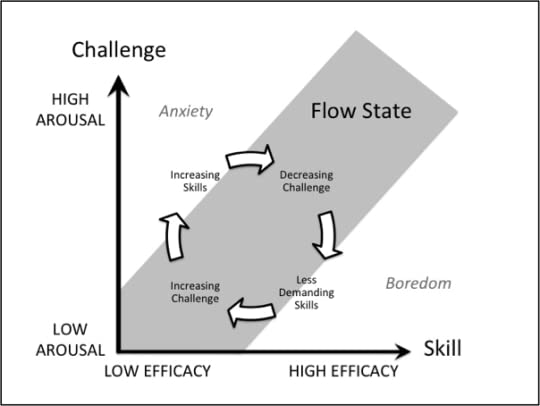
If the task is routine, and below your skills level, then you may find it boring; if it is too complex, it will be frustrating. Only when the task complexity is marginally higher than one’s abilities then the likelihood of flow is possible. (Refer the Figure)

Pleasure and Fulfillment

It will be pertinent to note two concepts Pleasure and Fulfillment.

Pleasure: is the experience one gets when one’s goals are achieved which are either set by biological needs like sex, hunger, thirst etc. or social conditioning like money, fame, power or acquiring premium objects of luxury.

Fulfillment: is an experience you get when you stretch your physical and mental limits in achieving a task and while doing so you may achieve something unexpected with a sense of novelty. The activity may not be pleasurable when you were performing it but may look satisfying in retrospect.

When asked to recollect the moments of happiness (in the Standard Chartered example indicated above) one person recollected the arduous struggle he had to undergo for three years with financial difficulties to complete his CA studies. The other person who was an IT administrator said the server in his company was down and he worked for sixteen hours at a stretch and was able to rectify the problem after having worked throughout the night. The moment the server and the entire IT network started  working, he not only was relieved but also felt a sense of accomplishment. When the Sr. Management from US appreciated the wonderful job, he was indeed on cloud nine! That is fulfillment. Both these people were able to recollect these incidences vividly even after a gap of three years. On the contrary, they could not recollect the mall or the pub they had visited three weeks back.

People often misrepresent happiness for pleasure which is achieved by goals set by biological programming like homeostasis, a feeling of satiation after having a sumptuous lunch or alcohol. Social conditioning also leads to pleasure includes getting a job with a higher CTC, a senior designation, or a bigger car.

Achieving happiness by controlling Consciousness

Individual consciousness is the representation of the outside and the inner world as experienced by a person and the way she interprets the same, evaluates and takes an action. It is not the external reality per se; but the representation of the same in one’s mind.

The normal state of consciousness is chaos which is evident by the rapid and the random thoughts we have on a day-to-day basis. The normal state affects our attention and leads to distraction e.g., the tendency to look at WhatsApp every few minutes. In case of a flow experience the chaotic contents of the consciousness are rearranged in a systematic way. For example, if you are writing an important document, but every few minutes you are distracted by the notifications, WA messages, mobile calls, your mind is in a chaotic state. However, if you keep your mobile in a silent mode and keep it at a distance and concentrate fully on that document with full attention; you may get into a flow state wherein your mind may be able to appreciate the finer nuances and the complexities of the project.

Bringing Order to Chaos

Flow can be considered as bringing order to consciousness. It is relatively easy to experience flow when the external circumstances are favourable. However there are rare situations where people like Veer Savarkar or Albert Schweitzer were able to get into flow in spite of hostile circumstances.

Veer Savarkar was incarcerated in cellular Jail in Andaman Islands from 1911 to 1920. He was subjected to extreme hardship involving leg iron chains, crossbar fetters, flogging, extracting oil from coconuts, and neck-ring shackles. The tiny solitary cell of 10’x10’ was aimed at making a nervous wreck out of him. Despite such trying circumstances, with no access to paper and pen/pencil, Veer Savarkar was able to produce an exceptional quality of Marathi poetry and prose on his room walls by writing using nails and safety pins.

Dr. Albert Schweitzer was an Alsatian polymath. He was a theologian, organist, musicologist, writer, humanitarian, philosopher and a physician. He was known for setting up his medical hospitals in Lambarene, Africa. He was born in Alsace which was on the border of Germany and France. Due to some technical issue on his citizenship, he was incarcerated in a German jail. He also had a passion for Western Classical music and later obtained his Ph.D. for interpretation of Bach. To continue his music practice in jail, he used a wooden plank, in the absence of a conventional church organ.

Limits of Consciousness

It is said that at any moment, the human mind can process 7 bits of information. The shortest time to record the data in mind is 1/18th of a second. That means each second the mind can process 18 X 7 bits of information, which is 126 bits per second. It translates to 7560 bits per minute, 0.5 million bits per hour and around 185 billion bits of information can be stored in the mind for an average of 70  years. To understand a person, it requires around 40 bits/second. Now the 185 billion bits of information is stored in terms of thoughts, feelings, words and action.(1)

How do we use this information? Do we use it wisely or otherwise? 15% of our waking time is spent on daily chores, washing, eating, ablutions etc. The free time that we get we spend watching TV, reading WA, newspapers, gossip etc. Such activities do not stretch the mind. It does not allow the mind to process added information by making efforts or make the consciousness complex. (2) Can we perform the day-to-day activities with awareness? Can you focus your attention and delete the unwanted information that hits you every now and then? If you can do that by bringing order into your consciousness you are getting into flow.

When flow happens

Flow happens when there is a balance between the skills the person possesses and the challenges he faces through the external environment. If the challenges are much higher than the available skills then anxiety sets in. Whereas if the task is too simple then boredom happens. Thus, flow is a golden mean between anxiety and boredom.

The body is an excellent medium to achieve flow. Jogging, Yoga, martial arts, sports, tai-chi, meditation can help the body to achieve flow. Involving different sense organs for appreciating music, photography, painting, relishing food can help achieve flow.

It can be achieved by using intellect and includes writing or appreciation of poetry, philosophy, mathematics, physics, literature etc. An attitude of life-long learning is extremely important.

Flow can also happen by cultivating hobbies. However, a person has the maximum scope of getting flow experiences at his workplace. Most of us work to pay our bills, earn a living and the provision of security. We feel that we enjoy life more during our free time. Given a choice we prefer to have more leisure and less work. But the converse is true. People can get more flow experiences at the workplace ( provided they enjoy their work) than at leisure and as Thomas Carlyle said, ‘blessed is he who has found his work; let him ask no other blessedness.’

What you do during your work hours will determine what you have. What you do during your leisure will decide who you are. – George Eastman

Reference:

  1. Limits of Consciousness: Miller (1956), Orme ( 1959) on the basis of Uexkull’s ( 1957) calculations on 1/18th Second as the threshold of discrimination.
  2. Free Time: ESM Studies by Csikszentmihalyi , Larson and Prescott (1977)

Image source: assets.com/images/S/compressed.photo.goodreads.com/hostedimages/1550649362i/27091258._SX540_.png

Adversity and Personal Growth

In one of the LinkedIn posts, a lady CEO had shared  that her son who is in 9th standard could not trace his Physics book, just prior to the exams. His mother was in office whom the son was desperately trying to get in touch with.  The lady who was busy in some urgent meeting did not notice his call due to some urgent preoccupation. The mother was quite worried about the pain her son went through for the three hours and had a great sense of guilt for not supporting her son during such trying circumstances.

What’s better for a child? Providing everything on the platter by eliminating all the uncertainties or learning by trial-and-error and figuring it out in life? The former may be good in the short-term but is it so in the long-term too?

Seema, a lady in her late 30s, once called me over phone (at her father’s behest) for career guidance. She has done her B.Com, MBA in HR as well as a few courses in computer  programming. She has worked in top-notch software companies as a programmer and then in HR. She wanted advice about a career in corporate training. The only child of her parents, and from a well-to-do family background, having travelled widely across the globe, she was exploring options for her professional career growth.  

Her father, BK is an eminent Marathi author of around 20 books and is an editor of a prestigious Marathi magazine which he ran for 25 odd years. He spent his childhood in a 450 sq feet house, with six family members and from a lower middle class background in Mumbai.  

BK’s father was a dedicated worker for the Communist Party in 1950-70s with no regular fixed income. BK’s mother, a teacher in a municipal school, managed the household with her meagre salary. Once BK shared with me that his father hardly knew which class the children studied while the mother rarely interfered in the children’s studies.  

BK went through challenging circumstances in his childhood as well as in his professional life. At 40, after achieving relative financial stability, he decided that he would not work henceforth only to earn a livelihood. Having detected a sense of purpose, BK decided that he would devote his life for the propagation of quality Marathi Literature. Some of his books include biographies of unknown but highly accomplished personalities. Seema having lived a comfortable childhood and adult life vis-à-vis her father, still is not able to detect a purpose of life at a corresponding age.

BK was once saying, “Quite often, I come across youngsters from well-to-do families who insist that they need to have their personal space and a me-time. What do they really want? I never had such issues in my younger days; even at our 450 sq ft tenement, six people living together.”

As poet Dylan Thomas once said, ‘There is one thing that is worse than having an unhappy childhood and that is having too-happy a childhood.’

Does it mean that children from well-educated and cultured background do not succeed? Of course, they do, in terms of good qualifications, a decent job, high CTC etc. In short they ‘settle down in life’ as per the conventional standards of society.

Some of the factors for success or achievement depends on genetics/heredity, stable family background and also getting the right opportunity, aka luck.

Such children may join the best of the schools, the premium upmarket classes to get into the premium professional colleges. Does the best of the schooling make someone a genius? Lewis Terman from Stanford University and Leta Hollingworth from Columbia university refined the Binet scale to develop the IQ scale. They began identifying children who scored exceptionally well on this IQ tests and those who scored above 130 were identified as genius. Around 1500 students were mapped for their career growth. Most of them were from privileged backgrounds and achieved career and financial success. Dean Keith Simonton in his book Creative Genius terms such students as ‘gifted children.’

Out of these 1500 children there was one person in the group who did not qualify the high IQ types whose talent was overlooked who was William Shockley, the cocreator of transistor and the winner of Nobel in physics. (1)

Francis Galton in his 1869 classic Hereditary Genius defines genius in terms of ‘enduring reputation’. By this Galton meant the opinion of contemporaries revised by posterity. People who have changed the existing paradigms of knowledge, new concepts of social order or credited with pathbreaking inventions like Newton, Darwin, Einstein, Galileo, Marx, Freud, Mahatma Gandhi can be termed as genius by the above criterion. Incidentally none of them were  exceptionally brilliant applying Terman’s yardstick.

Gifted children’s parents are well educated with at least one of them being professional like a doctor, lawyer, engineer, CA etc. They have intellectually stimulating environments like book collection, visiting museums, attending music concerts etc.

Social scientists have, however, found that very few gifted children could become geniuses. There are a number of factors beyond stable home,  infrastructure and genetics which distinguish a creative genius from a conventionally brilliant person. One such factor is whether the person has faced any adversity.

Handicaps like physical or sensory disabilities helped them to reinvent themselves. Somerset Maugham, a renowned British writer used to stammer; Edison  became almost deaf by 12. Aldous Huxley, the eminent writer of Brave New World, suffered from an eye infection which made him nearly blind. (2)

In case of adversities, the correlation of creativity with parents’ bereavement has attracted considerable attention of social scientists. In an ambitious study of 699 eminent persons, it was found that 45% of lost either or both the parents before 21 which include Boyle, Newton, Pascal, Priestly, Descartes, Russel, Sartre etc. (3) For creative writers, 55% of them had lost their parent before 15 and for the British Prime Ministers it was 63% (4)

Social scientists have postulated three hypothesis why adversities maketh a man:

  1. Bereavement Hypothesis:  states the child gets into  an act of achievement to overcome emotional trauma.
  2. Development of Robust Personality:  states the child develops an inner strength to overcome obstacles. Satish Gujral was an eminent painter, sculptor, muralist and writer who was honoured with Padmavibhushan. As a child, while crossing a rickety bridge he slipped and fell into the rapids which resulted in impaired hearing for a major portion of his life. Once an interviewer asked him about the fountain of his creativity, he said, “ maybe that I need to prove my existence on a daily basis.”
  3. Divergence Development Hypothesis: Is the tendency to give up the well-trodden path and opt for the road less travelled. A person with a settled and a comfortable background has parents, close relative or a teacher for guidance. A person going through adversity or not-so-stable a home has to  create a wider circle of influence which may include meeting strangers in trains/buses, a newspaper article, gatecrashing in a company looking out for a job etc. The urge to make new friends and acquaintances in an unknown city also rises with adversity. Apart from making one street-smart,  it also helps in enhancing conventional and tacit knowledge.

Pandit Bhimsen Joshi when he was 10, left his home in search of a guru from his native place Gadag  to different places. With monetary help from co-passengers in train, first he moved to Pune and for the next three years moved around in Gwalior, Lucknow, Delhi, Calcutta. After three years of struggle, Sawai Gandharwa took him as disciple in Dharwad. Similar stories are true for Naushad, Sudhir Phadke etc.

By providing a sanitized environment to our children not only in the physical sense but also on emotional and spiritual perspective; are we enabling for their growth or otherwise?

As Seneca said, ‘I judge you unfortunate because you have never lived through misfortune. You have passed through life without any opponent. No one can ever know what you were capable of, not even you.’

References:

1. Eyesenck H.J. (1995), The Natural History of Creativity

2. Goertzel M.G. et al (1978), Three Hundred Eminent Personalities  

3. Dean Keith Simonton, Origins of Genius, Darwinian Perspectives on Creativity, p116 ( includes around 115 examples)

4. Berrington H, ( 1974) The fiery Chariot, Prime Ministers and the Search for Love, British Journal of Political Science 4, 345-69

5. Wikipedia

Image: https://www.google.com/url?sa=i&url=https%3A%2F%2Fwww.michaelrydelnik.org%2Fdealing-with-adversity-just-hang-on%2F&psig=AOvVaw37Nblx2XncrVUpe-gB-sdC&ust=1677308544701000&source=images&cd=vfe&ved=0CA0QjRxqFwoTCJDiibLLrf0CFQAAAAAdAAAAABAH

The Ikea Effect – Customer as a Co-Creator of Value

Recently the Swedish Furniture giant IKEA opened its Bangalore store spread over 12 acres at Nagasandra in Bangalore. There was such an overwhelming response that people had to wait for three hours to get an entry. IKEA, a Swedish MNC is a $47Bn company with 458 stores in 50 countries with  225,000 staff. 

The business model of IKEA is  to make affordable and contemporary furniture on a global scale. The pain points in the existing furniture market were:

  1. Traditionally packed furniture was prone to damage during transit.
  2. The cost of transportation was high.

IKEA developed  a flat packaging mechanism. The flat boxes reduced storage space and thus the transport cost. Its target segment were the price sensitive customers.

With DIY ( do-it-yourself)  kits, IKEA helped the customers to assemble their own furniture, eliminated the intermediaries like wholesalers, retailer and thus involved the end customer directly in the value chain. It also decided to manufacture standardized products keeping in the cultural context.

The company takes care in understanding the customer needs.  E.g. ‘Kurs’ was a small bedside table with a drawer. The product did not succeed in the US even though it had a major success in the European market. The market intelligence revealed that shallow drawers with plastic slides was one of the major deterrents. IKEA reworked the design with deep drawers and  non-plastic slides. After 4 years it was a top selling product in the US.

Along with the  furniture kits, the customers are provided with  tape measures, shopping list, pencil and a writing pad. Pick up vans and mini trucks are also arranged for the last mile connectivity. 

What does Ikea do to attract customers?

  1. The company has  built  large stores where you can leave your kids for play activities.
  2. The stores are lit through electricity 24/7 without access to sunlight, a trick borrowed from Casinos; the clocks are either fake or do not tell the right time. – you lose your sense of time  and unknowingly buy more.
  3. The stores are designed in such a way that you only follow one direction you walk from one end to the other.
  4. It puts arrows on the floor to complement the maze layout of the stores. – you need not think where to go next – just follow the arrows.
  5. Impulse Buying: Placing bedsheets next to the beds, pillows next to the sofa persuades the customer in impulse buying. The customer says, “let me buy it now else I have to come once again. “
  6. 30% shoppers go there to eat. In 2017 IKEA made $2.24 Bn on selling food.
  7. Most of the stores are  located outside the city limits. Apart from getting large parcels of land at economical prices for constructing large stores, the customers also tend to think that they need to make their trip worth it. The commitment to buy make them justify the time and petrol spent. This is a cognitive bias called as sunk cost fallacy.
  8. After waiting in a long queue, a customer buys a table, goes home, assembles it;  puts it on facebook showing the efforts he has taken thus giving free publicity to Ikea. Incidentally Michael Norton of Harvard Business School, Daniel Mochon of Yale and Dan Ariely of Duke University have identified a cognitive bias called as Ikea effect where consumers place a disproportionately high value on the product they have partially created. In an experiment conducted in 2011, a group of participants were asked to assemble the Ikea furniture whereas others were shown the pre-built version of the same furniture. The subjects from group 1 ( assembled by self)  rated the price 63% higher than the group2 ( readymade)

Some of the reasons people who do self-assembly are:

  • They feel competent
  • Display the evidence that they are competent.
  • A perception of saving money and thus being a smart shopper.

            As a seller,  you can learn how Ikea has changed the paradigm of customers from recipients of value to co-creators of value. As a buyer, beware of the traps!

Blindspot and Bias

The opening slides in my Value-Selling program read as follows:
The main objective of the program is to help you improve the Top-Line and Bottom-Line performance. When the training program commenced the conversation between the trainer and the participants used to be on the following lines:
T: Is the objective clear?
P: Yes.
T: Do you need any clarification?
P: No.
T: Can I go to the next slide?
P: Yes please.
As I was getting similar responses from different batches, a few programs later, I decided to check my assumptions and asked the group:
“By the way, what do the two terms mean to you?” and most of the responses ( barring a few correct ones) were as follows:
Top-Line : meeting the top boss, closing the order, profits etc.
Bottom-Line: making a cold call, meeting a purchase executive, handling objections, achieving the targets etc.
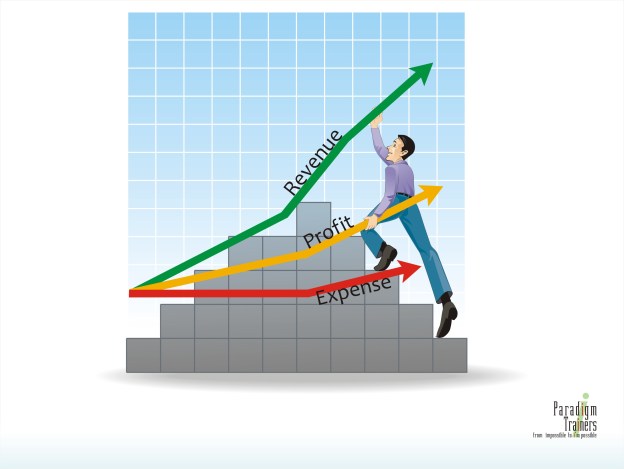
With a simple profit-and-loss statement, the discrepancy between their response and the right answer was shown. When asked about the learning from the exercise, the response was that the top-line and bottom-line correspond to revenue and profitability respectively.

Welcome to the world of human biases, which are distinctive patterns of errors people make which are systematic in nature, wherein people may be confident even when they are wrong. The above example shows that people were not only blind to a specific concept ( top/bottom line) but were blind to their blindness too. (None of them said, I do not know)

A Chennai based petrochemicals company had set an objective to achieve a top-line of Rs. 500 crores within the next five years from the existing revenue of Rs. 62 crores in 2008.
When asked, the promoters replied that they have a basket of great products, competitive pricing, good location and a rising demand. What they did not factor were poor leadership quality (lack of trust and transparency, frequent squabbles between the CEO and MD,) high attrition rate, lack of proper systems and processes etc. External factors like the market dynamics, petroleum pricing, competition strategy etc were assumed to remain constant or were not considered while setting such a target. The company which had clocked Rs. 62 crores in 2008 managed to reach around Rs 115 crores by 2015 . As Nassim Nicholas Taleb says in Black Swan, ‘what you do not know is more significant than what you know.’

Till the 70s, it was assumed that human beings are rational animals who become irrational only under the influence of emotions like anger, fear. The subsequent research in neuroscience and psychology has proved otherwise. Irrationality is an integral part of human nature and is due to the inherent design of the human cognitive processes.

Another bias which affects decision making is the Illusion of Understanding; a variation of which is Illusion of Explanatory Depth–IOED which was coined by Leonid Rosenblatt and Frank Keil.
The illusion of explanatory depth (IOED) is the belief that we know more about the world than we do. When we are asked to explain the concept, then we become aware of our limited understanding.
Fact or process knowledge has a discrete end and can thus be described. Explanatory knowledge which is about opinions and beliefs does not have a discrete end and is difficult to explain. The interesting part is even if your explanation is not sound or comprehensive you feel you understand. You convert a target question ( difficult) to a heuristic ( easy ) question.
During one of our training programs, Pradip, a die-hard Modi Bhakt made a statement: Modi is a great leader. When asked to explain the concept he said, “ because he has many followers.”
T: Are you aware of the numbers?
P: It must be at least in crores; it is difficult to state.
T: A celebrity like a cricketer or a Bollywood hero also has followers in crores. Does it make them great leaders?
P:Forget that. He has performed well in short term and long -term.
T: What is your definition of short-term and term?
P: It can be one year and five years.
T: Did Modi get that time?
P: Yes
T: What are the indicators of performance, and do they indicate a good growth of economy?
P: Frankly speaking, I do not know.
The above is not only relevant for die-hard followers but also for bashers. Taking the converse of a statement, Modi is not a good leader, the basher may also be short of arguments after similar probing. The hatred and the polarization that is happening in the society can be reduced if we can get stumped by the level of our ignorance.

Generally, it is felt that passionate people are more knowledgeable, but the converse may be also true. Passionate people who take a vehement stand on issues like CAA/NRC, Rights of Minorities, LGBTQ, Religious Freedom, abortion etc. tend to focus on only one side of the coin which is essentially to prove a point rather than explore the truth. IOED states that knowledge of a subject might be inversely proportional to your passion and the stand you take. It is easy to state a fact or a process than explaining something in depth.

There is a thin line of demarcation between confidence and hubris. In the world of VUCA ( Volatility, Uncertainty, Ambiguity and Complexity) humility is more important than hubris.
I recollect my interaction with Narayanan, an eminent trainer from Chennai. I enquired about one of his public programs. “By the way, how did it go?” He said, “the program had to be cancelled due to poor response.” What might be the reason? He said, “frankly speaking I do not know. If someone were to ask me a question for a similar situation 20 years back; I would have confidently said the problem has to do with the timing, location, pricing etc. But today being in this field for so long; I do not know why some events succeed and some do not. However, such setbacks do not deter me, it is all a question of randomness which one must factor in life.”

Socrates made a clear distinction between knowledge and wisdom. A knowledgeable person maybe knowing things; however, he may act foolish as he may be too confident in what he knows. A wise person, on the contrary, cannot act foolish as he knows his limitations. He knows what he does not know.
Socrates said, “the one thing I know is that I know nothing.” This was not out of humility, but it was an expression of reality.

Snatching Defeat from the Jaws of Victory

Abraham Lincoln had no choice but to sack one of his army generals for losing a battle during the Civil war for his sheer stupidity when victory seemed almost certain. In his witty style Lincoln said, “He has managed to wring a spectacular defeat from the jaws of victory.”

Congress was the ruling party in Punjab with 77 out of 117 seats under the CM Amarinder Singh. The alliance of BJP and Shiromani Akali Dal (SAD) had 21 seats.

The alliance partner SAD parted ways with the BJP for the latter’s high-handed approach in dealing with its allies. Moreover, discontent was brewing  for long in Punjab due to the farmers’ protests, the bulldozing of the farm-laws in the parliament by the government, the  sudden lockdown during the pandemic which forced untold miseries  on the migrant workers.

Considering the weak opposition, victory was on the platter for the congress. No doubt, Captain Singh had his follies, he was not accessible there was discontent brewing in the party. But it could have been resolved amicably. But Rahul Gandhi thought otherwise. Navjot Singh Sidhu was thrust upon the state leadership. Captain Singh was replaced by a Charan Singh Channi who did not have much following in the state politics. And AAP created history taking its tally from 18 seats to a record of 92 seats. Is this an isolated instance of stupidity on part of Rahul Gandhi? (1)

In 2004, Manmohan Singh took over as the PM leading the UPA-1.Having completed his first term as the PM, the nation was ready for the Lok Sabha elections in 2009. What were his achievements?

From 2004-2009 the economy logged a growth of 9%, the highest rate for any plan period since independence. He stood up to the manipulations of the Left and the opposition in signing the Nuclear Deal between India and the US.

Despite these splendid achievements, the party high command had doubts of winning the election. Manmohan Singh’s photo was printed on the Election manifesto as well as on the election posters. If the party were to lose, it was the PM’s defeat. Incidentally, a Senior political journalist while speaking to Ahmed Patel confided that Rahul Gandhi was ready to be the leader of the opposition and be the agent of Change and differentiate from Dr. Manmohan Singh (2)

Lo Behold! After 1962,  Dr. Manmohan Singh had become the first PM to have been re-elected with an improved margin. Congress improved the tally of LS seats from 145 to 206. ( 9 more than what Rajiv Gandhi had achieved in 1989)

But then how was this Star Performer treated by the ‘family’? Was he given a free hand to choose his team members? For example, for the finance portfolio, Dr. Singh wanted to  induct C. Rangarajan, the former RBI governor with whom he had battled the BoP ( Balance of Payment) Crisis during the Narasimha Rao regime. Sonia Gandhi offered the portfolio to Pranab Mukherjee without consulting him. Incidentally, Pranab Mukherjee was the ‘architect’ of the retrospective tax regime ( the Vodafone case of Rs. 22,100 crores on Capital Gains and Withholding Tax which the GOI lost in the International Court at the Hague)  which was one of the factors of slowing down of India’s economy  growth rate. It also impacted India’s credibility in the international business (3)

By the time the Lok Sabha elections for 1996 were announced, the P.V. Narasimha Rao-led Government  formed by Congress had delivered one of the most  spectacular performances in a 5-year period then. India was able to overcome the BoP ( Balance of Payments)  crises. ( The foreign exchange reserves rose 12 times from 1991 to 1996) License Raj was abolished, the New Industrial Policy was launched, the insurance and the banking sector was opened to the private sector and the new telecom policy was to usher in the mobile revolution. In fact,1991 is termed as a watershed year, also called as India’s 2nd Independence.

But did the Star Performer who was responsible for delivering such an outstanding performance suitably rewarded? Forget being rewarded or being acknowledged, P.V. Narasimha Rao was humiliated not only when he was alive but even after his death. But did the Congress party or Rahul Gandhi win? Congress lost power despite the best performance delivered by the Rao Government. ( A forgotten Hero or a Ungrateful Nation?)

The three incidents discussed above prove the adage that insanity is doing the same thing repeatedly and expecting different results!

There are different approaches in helping the non-performing executives in improve  their deliverables which include coaching, mentoring, reprimanding or if nothing works, the dismissal. But then how do you deal with  star performers who are already doing well and need no interference? The cost involved when such a Star is demotivated increases exponentially when one is heading a department, an organization, or the nation. In the last instance, the damage is humongous. The article is not about Rahul Gandhi and his personality per se. but more about the orientation of a toxic leader. I come across a common refrain in my mentoring sessions that people do not change the organization but their bosses.

Do  toxic leaders like star performers? The question is not about liking and needs reframing. Can toxic leaders manage the star performers? I doubt as they are afraid of being surpassed by their subordinates which might be due to a deep insecurity and a trust deficit which increases in direct proportion to the subordinate’s achievement.

A concept called Wu-Wei can be helpful for effective leaders particularly in managing the star performers. Wu-Wei is loosely translated as ‘letting-go’ as followed in Tao-Te-Ching which denotes :

  1. An attitude of genuine NON-ACTION motivated by a lack of desire to participate in human affairs.
  2. A technique by which the practitioner may get a subtle control in pushing the envelope.

Some of you might have collaborated with good bosses  who practised wu-wei can consider yourself to be lucky. And those, the less fortunate (?)  in getting the toxic bosses- were you able to realize your potential by moving elsewhere or venturing on your own?

References:

  1. The art of snatching defeat from the jaws of victory – Capt. G.R. Gopinath ( Retd.) , Deccan Herald, 16th March 2022
  2. The Accidental Prime Minister- Sanjay Baru
  3. The Lost Decade ( 2008-2018), How India’s Growth Story devolved into Growth without a Story – Pooja Mehra

Why market pulse is more critical than a superior product design?

In the early 90s, Airbus and Boeing,  the two major players in commercial aircrafts decided to come together to manufacture Very Large Commercial Transport ( VLCT). Later on both the competitors parted ways as their business strategy could not synergize. Ultimately in 1994 Airbus decided to go solo on this venture and the project was codenamed A3XX. And thus the first flight of A380, the largest commercial aircraft happened in 2007 which is a double-deck, wide body 4-engine aircraft with 6000 square feet of usable space, 40% more space than its nearest rival product Boeing B747-8. A380 could accommodate 500 seats in 3-class capacity (Economy, Business and First Class) or 850 in an all-economy class.

With several delays the project cost escalated from the initial 9 billion to 13 billion Euros.

Product Pricing and Positioning: The A380 had a seating capacity which was 5 times the Airbus A320 Neo but the price point was 4X . The List price of A 380 was $430 Million whereas A320 was $107 Million.  The product was received well after its launch. However in the last few years the customers, the airline companies are either cancelling the orders or postponing the delivery dates. The peak production which was at 30 aircrafts per year has dwindled to 12 per annum.

In spite of excellent product features, good quality (50% quieter than competition product) and the right price, why did Airbus started losing on the business for A380?  The anticipated exponential growth in passenger traffic from hub-to–hub was the cornerstone on which Airbus decided to make A380. Hub-to-hub traffic for Air India is like New Delhi–London, for Singapore Airlines it can be from Singapore to Dubai or Frankfurt etc. One aspect that was overlooked was that of the point-to-point traffic. When the traffic between two points crosses a minimum threshold, airlines can afford to have small or midsized aircrafts which is more economical than transferring through the hub.

Even though the air traffic grew considerably; instead of it growing from hub-to-hub it started increasing from point-to-point. For example 10 years back, Air India used to  have seven flights from Delhi to London and passengers were picked up from Hyderabad, Bangalore etc. Now all this airport being choc-a –block, it makes better business sense for airline companies to transport passengers directly from Bangalore to Cardiff/Manchester rather than routing through them hubs like Delhi and London. What is the learning for Sr. management from these?

  1. A technically superior product with better specifications even though necessary is not sufficient for long-term success.
  2. Appropriate price positioning even though crucial need not be a game changer.
  3. Factor X: Identify the factor x which is insignificant today but can become significant in future (that is generally overlooked) which can seriously affect your business strategy. ( In this case it was the point-to-point traffic) In case of Nano car, legend says that Shri Ratan Tata while doodling decided to launch a cheap car while seeing a family of four on a scooter. One factor which was overlooked was for majority of the Indians having a  car was more of an aspiration and a status symbol ( emotional decision) than a cheap car as a mode of safe and convenient transport.(logical decision)  Doodling can sometimes be an expensive proposition!

And last but not the least, there is nothing called as a right or wrong decision. All decisions are evaluated in posterity. Time is the best judge!

Nassim Nicholas Taleb author of books like Black Swan, Fooled by Randomness or Anti _Fragile says for most of us absence of evidence is interpreted as evidence of absence (Please read the book review: Anti –Fragile: How to Live in a world we don’t Understand) http://www.paradigm-info.com/recommended-books) Be Humble!

(Source:  Bigger is not Always Better, Business Line November 30, 2016 by K. Giriprakash)