Category Archives: Creativity

Narrative Fallacy

During one of the client meetings, Vijay, Head of Talent Acquisition (which was earlier termed as Personnel, HR etc) was  waxing eloquent about how the right hiring and the talent management has been the crucial factor leading to the company’s phenomenal growth.

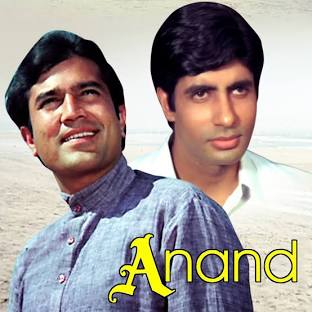
I was reading an article by a renowned Hindi film critic on similar lines. This media reporter had written about Hrishikesh Mukherjee (Hrishida as he was affectionately called), the Dadasaheb Phalke award winner having directed some of the notable films like Anupama, Anuradha, Satyakam etc. and how he selected Rajesh Khanna for the title role in Anand. The point he was trying to make was the success of the film was primarily due to selection of the right people be it the actors, music director, lyricists among others.  

Anand, made in 1970 is a story of a young man who has been diagnosed with intestinal cancer. The doctor had diagnosed that Anand will not survive for more than six months. In spite of the grim future, Anand has a cheerful disposition towards one and all and tries to keep everyone around him happy. The title role was played by Rajesh Khanna and the supporting role of Dr. Bhaskar Banerjee was played by Amitabh Bachchan.  

 But was the selection of people so logical and linear as we see in hindsight? When Hrishida first conceived of the project in 1955, the person whom he had him in mind was Raj Kapoor but both of them being busy in their own spheres; the project could not take off. By 1968 when Hrishida revived the project, Raj Kapoor was looking old for the role. Shashi Kapoor was thought of but he too was busy.

Hrishida wanted Kishore Kumar to do the role. When he visited Kishore Kumar’s house to discuss the role, the latter mistook the visitor from a distance to be someone else who had not paid Kishore Kumar’s dues. The security guard was instructed not to allow this visitor inside Kishore Kumar’s bungalow. (1)

By this time, Rajesh Khanna who was the emerging superstar got news of the project and approached Hrishikesh Mukherjee.  Anand was a low-budget film and Hrishida could not afford his fees. Those days Rajesh Khanna used to charge a princely sum of Rs 5 lakhs per film. When Hrishida expressed the apprehension, Rajesh proposed a creative solution. He said, “I will not charge a Rupee, instead can you give me the distribution rights for the Bombay territory”? This creative solution not only was accepted but also  helped Hrishida sell the film on a pan-India basis.

Amitabh Bachhan also had a wild card entry in the film. He was having a negative role  in a film called Parwana. One day Omprakash, the character actor met Hrishida and provided a strong recommendation for Amitabh who was cast in the supporting role of Dr. Bhaskar Banerjee.

The script had a role of Dr. Prakash Kulkarni, a friend of Dr. Bhaskar.  Ramesh Deo was a renowned actor in Marathi films and theatre. He was struggling to get a breakthrough in Hindi films. He had approached Hrishida a number of times in the past but could not cut much ice. Hrishida one day approached him for the role of Dr Prakash Kulkarni and had planned Nimmi for the role of his better half. Nimmi was one of the leading ladies of yesteryears who had acted in blockbusters like Aan, Udan Khatola etc.

When offered the role, she said, “The role is small; there is no heroine per se in the film and all the spot light is on Anand. Can you at least tell me  with whom am I paired with?” Hrishida: “He is Ramesh Deo, a seasoned and a successful actor in Marathi film industry.” Nimmi : “I have not heard that name. I have worked with stars like Dilip Kumar, it is below my dignity to work with such unknown people. Can I make you suggestion? Why don’t you take Raj Kumar for this role instead?” The next day, Hrishida and N.C.Sippy along with Nimmi went to Raj Kumar’s house in Worli.

After exchanging pleasantries, Raj Kumar asked Nimmi to chat up with his wife in the kitchen and said, “Incidentally I have my reservations taking up this role with Nimmi. She has the looks and the charm but that is the past.”

Apart from casting aspersion on Nimmi, Raj Kumar demanded that he needs to have at least a song on him. Hrishida dropped him like a hot potato.

Back to square one, Hrishida zeroed in on Ramesh Deo. Chess was their common interest. One day when he went to Deo’s  flat in Bandra for a game of chess, Hrishida was quite impressed with Seema, Ramesh’s wife. Seema was a leading Marathi actress even otherwise.

When Hrishida said, “Ramesh, why did not you suggest Seema for this role”? Ramesh said, “ First of all I myself was not sure of my role, how could I recommend her?” With quirk of fate, Ramesh and Seema Deo thus got the roles of Dr. and Mrs Kulkarni.

The music composer was decided as Salil Chowdhary and the lyricist as Gulzar. The film had a provision for only three songs. But when the film was completed, it had four songs: Maine Tere liye and Na Jiya Laage Na by Gulzar & Zindagi kaisi Hai Paheli and Kahin Door Jab Din Dhal Jaye by Yogesh. How did Yogesh get a wild card entry?

In the late sixties, Gulzar was an established lyricist in the mainstream Hindi cinema whereas Yogesh was a struggling one who was mainly bracketed as a lyricist for B-Grade action films. 

Circa 1967 there was a film producer called Anand Gadnis who was making a film and roped in Basu Bhattacharya as  the director and Salil Chowdhury as the music director. Gulzar was to be the lyricist. But whenever meetings for the music were scheduled, Gulzar could not make it. As the producer wanted the project to go on fast-track, he asked Salilda to look out for an alternative. Salilda knew Yogesh. This was a golden opportunity for Yogesh to get into popular mainstream cinema.  Within no time, he penned lyrics for three situations. Salilda composed the music and later recorded. Due to some unfortunate circumstances, the project was shelved. Yogesh cursed his bad luck, felt that he is destined to be with B grade films. He felt making an entry into the popular genre was not his cup of his tea. He went back to Lucknow fully dejected.

Three months later, a  producer called L. B Lachman approached Salilda for a new film called Annadata starring Jaya Bhaduri and Anil Dhawan. When the contract was signed, Salilda said that he already has three songs ready from a previous project. Lachman picked two from the lot; the deal was that the payment was to be released only after all the songs were composed and recorded.

Lachman happened to be close friends with Hrishida. When he shared the audio recordings of the two songs; Hrishida liked the songs and showed interest to purchase both. A compromise was worked out. Hrishida purchased one and that was Kahin Door Jab Din Dhal Jaye.

Next day Yogesh was called for  and Hrishida made a cheque payment of Rs 2500 to Yogesh. It was the debut of Yogesh in A grade films. Incidentally this song is based on a Bengali song, Amay Proshno Kore Neel Dhrubotara sung by Hemant Kumar and written and composed by Salil Choudhary.  

Salilda had another Bengali composition called Na Mono Lage Na sung by Lata Mangeshkar. He asked Yogesh to compose a Hindi song on similar meter for Annadata. He composed a song for Lachman’s film accordingly.

In the meanwhile, Hrishida asked Gular to compose a song on the same meter. He assumed there should no issues as it is Salilda’s composition, the music director of the film. Now there were two songs based on Salilda’s original Bengali song one for Annadata and the other for Anand. Lachman got furious and said to Hrishida, “Why did you copy this song? What will people say when they hear two Hindi songs based on the same Bengali tune?”

Salilda had another issue to settle for. He said to Hrishida: “This struggling lyricist Yogesh has already composed a song for Lachman which has to be discarded. He needs to be compensated.” Expressing his sincere apologies, Hrishida accepted the proposition and agreed to compensate Yogesh.

Next day when Yogesh went to Hrishida’s house, he refused to take the cheque. Salilda said, “You fool, you are going through tough times. Why did you not take the payment?”

Yogesh: “Any way I have not written this song for Hrishida. He has taken it from Gulzar even otherwise. Ethically it is not right for me to take payment for the work which I have not done.”

As a via media, Hrishida thought of having an extra song. And that is how the fourth song was added in the film and was to be the title song.

When Rajesh Khanna heard the song, he said, “Hrishida, this song is too good. Why keep it as  a title song? I want you to film the song on me.” And that’s how Zindagi Kaisi Hai Paheli’ got included in the film.(2)

If you were to see the events by themselves, they are all random in essence. But in retrospect we connect the dots and create a story around the random events . This is called as Narrative Fallacy. It is the human tendency to create a story or an explanation out of a chain of some random events.

When I reflect on the major personal events like admission in an engineering college, getting a job or getting a training assignment; I ask myself whether the specific event happened because of me or in spite of me? Is it merely the talent, intelligence or the hard work of a person or a combination of some fortuitous circumstances complimenting the traits? Should experience make us more confident or humble?

Two years back one of my senior trainer friends, Narayanan was sharing an incident. A public program he had scheduled had to be cancelled due to insufficient nominations. When enquired about the likely reasons for cancellation, he replied, “ Rajan, frankly speaking, I do not know. But if you were to ask me a similar question 20 years back, I would have ascribed the failure to some plausible causes like bad timing, poor marketing strategy, competition etc.” My son Aalhad then made a succinct distinction between causation and correlation leading to specific events.

Quite often the success of an organization is ascribed to the  hard work and the intelligence of the top leader. Can you recollect the debate on 70/90 hours per week some successful leaders are advocating? Is that the gospel truth or a narrative fallacy? By becoming aware of this human bias called narrative fallacy; can it make us more humble and help us come out of hubris?

John Brockman the editor of Edge Magazine says: Success = Talent + luck &  

Great Success =Little more talent + a lot of luck.(3)  What do  you think?  

References:

  1. Wikipedia
  2. Ten Classics by Anita Padhye
  3. Thinking Fast & Slow – Daniel Kahneman
What makes A Maverick stand apart?

“Shantaram, it’s high time you retire from the film industry” said Shankar Bhat, the owner of Prakash Pictures casually during a meeting of the Film Producers Guild. V Shantaram, the renowned director and the owner of Rajkamal Studios was taken aback. When asked for the reason he said, “Your last film, Zanak Zanak Payal Baje has been a blockbuster through which not only have you reached a pinnacle of success but the film is also considered as an epitome of creativity. You will never be able to repeat such a feat. Any subsequent film you make will be compared to this blockbuster.”

A few days later. G. D Madgulkar, a noted Marathi poet and writer narrated an experiment of an open prison and the rehabilitation of prisoners carried out by Maurice Frydman to Shantaram.

Maurice Frydman, a Polish Jew who came to India and was influenced by Mahatma Gandhi and guided the King of Aundh (Near Pune) draft the declaration for transfer of power from the king to the people of Aundh. It was during this process of giving self-governance to the citizens of Aundh, that a question came up about the prisoners. Frydman then took on the responsibility of taking care of the convicts in an open prison. An open prison is any jail in which the prisoners are trusted to complete sentences with minimal supervision and perimeter security and are often not locked up in their prison cells. Prisoners may be permitted to take up employment while serving their sentence. This provides an opportunity for criminals to reintegrate into society and withdrawal from their criminal behaviour. Without the constraints and stresses of typical incarcerations, criminals can discover more positive lifestyles through support and light supervision from the criminal justice system.

“It‘s a great plot, why don’t you make a preliminary draft on rehabilitation thro’ an open prison?”  Shantaram said to Madgulkar. After a few days while reading the draft, Madgulkar himself got bored and said “The story does not have enough material to convert into a full-fledged film. The subject is too drab and boring.”

Shantaram said,” But I see a great potential to make a classic film out of this narrative. No doubt we need to hone the script more.” Looking at Shantaram’s enthusiasm, Madgulkar had no choice but to accede to his demand.

The film Do Ankhein Barah Haath slowly started taking shape. The title connotes the eyes of the jailor and the hands of convicts. The storyline revolved around six hard-core criminals who have been jailed for heinous crimes like murder, arson, looting and rape. The conventional perception of the legal and the prison setup was to brand a convict as a life-long criminal without any scope for reform. The convicts were thus jailed in inhuman conditions typical of any jail. The protagonist of the film Adinath (played by V. Shantaram himself) feels that people irrespective whether they are criminals or not, are human beings first. There is a possibility of reform by putting them in normal environment like an open prison.

Adinath takes the permission from his senior, the Superintendent of Police (SP) to take these six convicts to a place with minimal monitoring. There are some challenging moments Adinath faces in this novel experiment. Once the inmates make a request to go to the nearest town. Adinath permits them with a caveat that they should return by the sunset. He goes through some anxious moments as the day comes to a close and gets relieved to see them back though a bit late.

The inmates are engaged in a daily routine of clearing the shrubs, digging well and plant vegetable. Within a few months the barren land is converted to a green area with fresh vegetables.  Adinath asks them to sell the produce at the village with nominal profit.  The local traders charging high rates till then get upset with the new competition.

The inmates do not return home in time. Adinath is perplexed about his decision on granting freedom. The inmates return late fully drunk. Adinath not only gets furious but also anxious about the outcome of his experiment. The next day he gets to know that the local trader has coaxed them in getting drunk and go berserk.Not able to digest the success of the farm, the local trader sends his goons and the bulls to destroy the crop. While making a valiant fight with the bull, Adinath breathes his last.

The SP who was initially a sceptic of this experiment, is now fully convinced of the transformation Adinath had brought about in the convicts. “You have served your sentence and are free to go back home.” Says the SP. The inmates decline the offer and decide to continue the work as inspired by their mentor, Adinath.

What made V. Shantaram take on such a challenging film? The seven types of motivators which define a creative personality are Pioneering Motivation, Self-Actualization, Altruism, Career Success, Hedonism. Security Motivation and Affiliation. (1)

Out of the above, the Pioneering Motivation, Self-actualization and Altruism need to be very high; Hedonism and Career Success need to be moderate and the security and the affiliation motivation need to be low for a creative personality.  

Pioneering Motivation: Do Ankhein Barah Hath was an off-beat, black and white movie sans glamour with no tricks of the trade like love triangle, expensive sets, or iconic stars.

Self-Actualization: When Shankar Bhatt asked him to retire after the phenomenal success of Zanak Zanak Payal Baje, Shantaram questioned himself and his own identity and the purpose of life. He decided not to rest on the past laurels.

Altruism: The protagonist Adinath believed in the inherent goodness of people He sacrifices his life to help the prisoners let go of the past.

Security Motivation: His scriptwriter told him that the plot was too mundane and there is not much drama to make into a full-fledged film. Shantaram thought otherwise. He looked at the worst case scenario. His earlier film Zanak Zanak Payal Baje  was a runaway hit. Shantaram was willing to write off even if this film were to flop at the box office.  .

Career Success: Intuitively Shantaram knew that the film will come out well and will be appreciated by the audiences. He did not get into the success trap of comparison with the  success of his preceding films. In a way he did not become a prisoner of his past success!

 Affiliation: This motivation is to tread the beaten path and need to be very low for a creative person. Madgulkar who was asked to write the screenplay got bored while narrating the first draft. Shantaram did not give up.

The film was premiered at Opera House in Mumbai on 27th September 1957. It was attended by the staff of Rajkamal Studios, friends, relatives and acquaintances of V Shantaram along with celebrities from the Bombay Film industry (now Bollywood). Even if the film were to be a disaster, audiences would make kind remarks about the film’s success out of courtesy. But the scene was quite different. Forget an applause, there was a total silence. Vijay Bhatt, a film a producer said, “You have said something different in this film.” Save this remark, there were hardly any comments. One could hear people whispering: had it not been for V. Shantaram, the film would hardly run for 5-6 weeks. The film reviews in the media were more towards criticism rather than praise. (2)

Do Ankhein Barah Haath ran for 65 weeks in Opera House and proved the naysayers wrong. The then Mumbai Police Commissioner had issued an unofficial dictum making the film mandatory for every policeman.

Ae Malik tere Bande Hum’, the prayer song was played in many schools and jails across the country and also in Pakistan. The film won the Best Film and the Best Direction award from the Govt of India. It was honoured with the best Foreign Film Award in the Berlin Film festival.

V. Shantaram wanted to acknowledge the contribution made by Maurice Frydman by including him in the film credits. Maurice flatly refused. 

The black-and-white film had no glamour, a drab subject and an idealistic protagonist.  Madgulkar the scriptwriter, the Staff at Rajkamal Studios, the celebrities of the film industry, or the media; none of them predicted a decent run for the film, leave aside the commercial success or the critical acclaim. Shantaram swam against the tide and showed what it means to be a maverick.

As someone has said, “if you can visualize the invisible, you can accomplish the impossible!”

References:

  1. The Fourth Eye – Pradip Khandwala, the seven indicators of creativity are discussed in detail. The different levels of motivation be it high, medium or low can be understood through the questionnaire. Blockages to creativity and the ways to enhance are also discussed.
  2. Ten Classics – Anita Padhye

Do we mean what we say?

“The Galaxy Z flip 5 is ONLY Rs 99,999/ said the salesman at the mobile counter. Being a latest product from Samsung, we can work out a special price for you with an exchange of the old mobile additional upgrade bonus and extra bank cashback…”

While the salesman was rattling off the technical specifications in his sales pitch; I got stuck at the word ONLY.  What happens when people use the word ONLY, is it something to convey or to hide?

Jacob and Isaac were two religious Jews living in an apartment complex with their balconies facing each other. They  had not fasted on the Yom Kippur day, the day of atonement. They went to the Rabbi to ask for forgiveness. The Rabbi replied that it is possible only through observing a penance.  He asked both about what they liked the most. Jacob said, “sharing the marital bed with my wife.” Rabbi said, “Jacob, for the next three weeks, you shall be sleeping in a separate bedroom.” To the same question, Isaac replied, “smoking a cigar.”  Rabbi said , “likewise you are not going to smoke a cigar for the next three weeks.”

One night, Jacob’s wife knocked on his  bedroom door. Jacob said, “Darling, it is ONLY the third day. We are not supposed to be together for the next three weeks.” His wife said, “ I ONLY wanted to tell you that Isaac is smoking a cigar.”

There are many undesirable thoughts and images which are in our subconscious mind which try to escape into the conscious mind. The way the word ONLY is used is to push back the undesirable thought coming into the consciousness. You may see that from the bottom of their hearts; both Jacob and his wife wanted to be with each other; but by using the word ONLY; were trying to repress the desire. Rationalization is a process by which a person justifies his action by hiding the real intention. As Voltaire said, ‘men use thought only to justify their wrongdoing and speech only to conceal their thoughts.’

Another example to illustrate the point: While having dinner with my mother-in-law; she said, “Rajan, is the curry over?” I replied, “No, the dal fry is still there. Do you want me to serve you?” She said, “ I ONLY wanted to see whether the fish curry is over or not.” My mother-in-law being a strict vegetarian; finds it difficult to hide her consternation of someone partaking of a non-veg dish while having her meals. You may observe the word only conveys, ‘for heaven’s sake, when will the curry get over?’

When a salesman is telling you that a product costs ONLY  Rs 99,999/- what he wants to tell you is that the mobile is economical and value-for-money (as conveyed by the management).What he wants to hide is his personal opinion of the product being expensive. If you are a seller, use ONLY during order closing;  but if you are a customer; beware of the trap laid down by the seller. 

“Sir, would you like to go for this model?” the salesman interjected. I was taken aback from my reverie of hidden meanings behind the words. “By the way, you shall also get a rebate of around Rs 30,000 on your old mobile; though for specific models.” He added a caveat. When he saw that I was using a Samsung Galaxy A12, an economy model costing only Rs. 12,000, the salesman was in a rude shock. I could see a tapestry of anger, frustration, pity writ largely on his face. “Sir I ONLY need to take this urgent call and shall be back within a minute.” I knew he would not turn back so soon.

So next time when you hear the word ONLY be careful: is your colleague trying to hide more than what he wishes to convey? As someone said, “statistics is like a bikini, it conceals more than it reveals.”

Flow: The Psychology of Optimal Experience- I

While conducting a stress management program for Scope International, a BPO of Standard Chartered Bank, I asked the participants what their ideas of happiness were. The participants in the age group of 21-30 years shared that the ideas included chill-out in pubs/malls, watching a live cricket match or a movie at a multiplex or on TV. When asked how long one can watch TV on a long weekend or how would they feel after pub-hopping on a late Friday evening? The surprise for them was the subsequent days may be boring.

What is Flow:

Has it ever happened that you were drafting an article, playing an instrument, making a recipe or even completing an official assignment and you got so engrossed in your task that you were oblivious of how time flew and the few hours you spent felt like few minutes?

This phenomenon was termed as Flow by Prof. Mihaly Csikszentmihalyi who did pioneering work on the above subject for more than 25 years at the University of Chicago.

Viktor Frankl says in Man’s Search for Meaning: happiness like success cannot be chased; the more you pursue, the more it eludes. To be happy, one should be engaged in an activity which is conducted to the best of one’s abilities and which stretches your physical and/or mental capabilities.

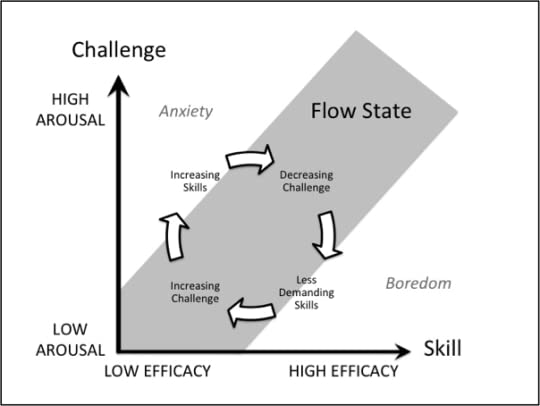
If the task is routine, and below your skills level, then you may find it boring; if it is too complex, it will be frustrating. Only when the task complexity is marginally higher than one’s abilities then the likelihood of flow is possible. (Refer the Figure)

Pleasure and Fulfillment

It will be pertinent to note two concepts Pleasure and Fulfillment.

Pleasure: is the experience one gets when one’s goals are achieved which are either set by biological needs like sex, hunger, thirst etc. or social conditioning like money, fame, power or acquiring premium objects of luxury.

Fulfillment: is an experience you get when you stretch your physical and mental limits in achieving a task and while doing so you may achieve something unexpected with a sense of novelty. The activity may not be pleasurable when you were performing it but may look satisfying in retrospect.

When asked to recollect the moments of happiness (in the Standard Chartered example indicated above) one person recollected the arduous struggle he had to undergo for three years with financial difficulties to complete his CA studies. The other person who was an IT administrator said the server in his company was down and he worked for sixteen hours at a stretch and was able to rectify the problem after having worked throughout the night. The moment the server and the entire IT network started  working, he not only was relieved but also felt a sense of accomplishment. When the Sr. Management from US appreciated the wonderful job, he was indeed on cloud nine! That is fulfillment. Both these people were able to recollect these incidences vividly even after a gap of three years. On the contrary, they could not recollect the mall or the pub they had visited three weeks back.

People often misrepresent happiness for pleasure which is achieved by goals set by biological programming like homeostasis, a feeling of satiation after having a sumptuous lunch or alcohol. Social conditioning also leads to pleasure includes getting a job with a higher CTC, a senior designation, or a bigger car.

Achieving happiness by controlling Consciousness

Individual consciousness is the representation of the outside and the inner world as experienced by a person and the way she interprets the same, evaluates and takes an action. It is not the external reality per se; but the representation of the same in one’s mind.

The normal state of consciousness is chaos which is evident by the rapid and the random thoughts we have on a day-to-day basis. The normal state affects our attention and leads to distraction e.g., the tendency to look at WhatsApp every few minutes. In case of a flow experience the chaotic contents of the consciousness are rearranged in a systematic way. For example, if you are writing an important document, but every few minutes you are distracted by the notifications, WA messages, mobile calls, your mind is in a chaotic state. However, if you keep your mobile in a silent mode and keep it at a distance and concentrate fully on that document with full attention; you may get into a flow state wherein your mind may be able to appreciate the finer nuances and the complexities of the project.

Bringing Order to Chaos

Flow can be considered as bringing order to consciousness. It is relatively easy to experience flow when the external circumstances are favourable. However there are rare situations where people like Veer Savarkar or Albert Schweitzer were able to get into flow in spite of hostile circumstances.

Veer Savarkar was incarcerated in cellular Jail in Andaman Islands from 1911 to 1920. He was subjected to extreme hardship involving leg iron chains, crossbar fetters, flogging, extracting oil from coconuts, and neck-ring shackles. The tiny solitary cell of 10’x10’ was aimed at making a nervous wreck out of him. Despite such trying circumstances, with no access to paper and pen/pencil, Veer Savarkar was able to produce an exceptional quality of Marathi poetry and prose on his room walls by writing using nails and safety pins.

Dr. Albert Schweitzer was an Alsatian polymath. He was a theologian, organist, musicologist, writer, humanitarian, philosopher and a physician. He was known for setting up his medical hospitals in Lambarene, Africa. He was born in Alsace which was on the border of Germany and France. Due to some technical issue on his citizenship, he was incarcerated in a German jail. He also had a passion for Western Classical music and later obtained his Ph.D. for interpretation of Bach. To continue his music practice in jail, he used a wooden plank, in the absence of a conventional church organ.

Limits of Consciousness

It is said that at any moment, the human mind can process 7 bits of information. The shortest time to record the data in mind is 1/18th of a second. That means each second the mind can process 18 X 7 bits of information, which is 126 bits per second. It translates to 7560 bits per minute, 0.5 million bits per hour and around 185 billion bits of information can be stored in the mind for an average of 70  years. To understand a person, it requires around 40 bits/second. Now the 185 billion bits of information is stored in terms of thoughts, feelings, words and action.(1)

How do we use this information? Do we use it wisely or otherwise? 15% of our waking time is spent on daily chores, washing, eating, ablutions etc. The free time that we get we spend watching TV, reading WA, newspapers, gossip etc. Such activities do not stretch the mind. It does not allow the mind to process added information by making efforts or make the consciousness complex. (2) Can we perform the day-to-day activities with awareness? Can you focus your attention and delete the unwanted information that hits you every now and then? If you can do that by bringing order into your consciousness you are getting into flow.

When flow happens

Flow happens when there is a balance between the skills the person possesses and the challenges he faces through the external environment. If the challenges are much higher than the available skills then anxiety sets in. Whereas if the task is too simple then boredom happens. Thus, flow is a golden mean between anxiety and boredom.

The body is an excellent medium to achieve flow. Jogging, Yoga, martial arts, sports, tai-chi, meditation can help the body to achieve flow. Involving different sense organs for appreciating music, photography, painting, relishing food can help achieve flow.

It can be achieved by using intellect and includes writing or appreciation of poetry, philosophy, mathematics, physics, literature etc. An attitude of life-long learning is extremely important.

Flow can also happen by cultivating hobbies. However, a person has the maximum scope of getting flow experiences at his workplace. Most of us work to pay our bills, earn a living and the provision of security. We feel that we enjoy life more during our free time. Given a choice we prefer to have more leisure and less work. But the converse is true. People can get more flow experiences at the workplace ( provided they enjoy their work) than at leisure and as Thomas Carlyle said, ‘blessed is he who has found his work; let him ask no other blessedness.’

What you do during your work hours will determine what you have. What you do during your leisure will decide who you are. – George Eastman

Reference:

  1. Limits of Consciousness: Miller (1956), Orme ( 1959) on the basis of Uexkull’s ( 1957) calculations on 1/18th Second as the threshold of discrimination.
  2. Free Time: ESM Studies by Csikszentmihalyi , Larson and Prescott (1977)

Image source: assets.com/images/S/compressed.photo.goodreads.com/hostedimages/1550649362i/27091258._SX540_.png

Adversity and Personal Growth

In one of the LinkedIn posts, a lady CEO had shared  that her son who is in 9th standard could not trace his Physics book, just prior to the exams. His mother was in office whom the son was desperately trying to get in touch with.  The lady who was busy in some urgent meeting did not notice his call due to some urgent preoccupation. The mother was quite worried about the pain her son went through for the three hours and had a great sense of guilt for not supporting her son during such trying circumstances.

What’s better for a child? Providing everything on the platter by eliminating all the uncertainties or learning by trial-and-error and figuring it out in life? The former may be good in the short-term but is it so in the long-term too?

Seema, a lady in her late 30s, once called me over phone (at her father’s behest) for career guidance. She has done her B.Com, MBA in HR as well as a few courses in computer  programming. She has worked in top-notch software companies as a programmer and then in HR. She wanted advice about a career in corporate training. The only child of her parents, and from a well-to-do family background, having travelled widely across the globe, she was exploring options for her professional career growth.  

Her father, BK is an eminent Marathi author of around 20 books and is an editor of a prestigious Marathi magazine which he ran for 25 odd years. He spent his childhood in a 450 sq feet house, with six family members and from a lower middle class background in Mumbai.  

BK’s father was a dedicated worker for the Communist Party in 1950-70s with no regular fixed income. BK’s mother, a teacher in a municipal school, managed the household with her meagre salary. Once BK shared with me that his father hardly knew which class the children studied while the mother rarely interfered in the children’s studies.  

BK went through challenging circumstances in his childhood as well as in his professional life. At 40, after achieving relative financial stability, he decided that he would not work henceforth only to earn a livelihood. Having detected a sense of purpose, BK decided that he would devote his life for the propagation of quality Marathi Literature. Some of his books include biographies of unknown but highly accomplished personalities. Seema having lived a comfortable childhood and adult life vis-à-vis her father, still is not able to detect a purpose of life at a corresponding age.

BK was once saying, “Quite often, I come across youngsters from well-to-do families who insist that they need to have their personal space and a me-time. What do they really want? I never had such issues in my younger days; even at our 450 sq ft tenement, six people living together.”

As poet Dylan Thomas once said, ‘There is one thing that is worse than having an unhappy childhood and that is having too-happy a childhood.’

Does it mean that children from well-educated and cultured background do not succeed? Of course, they do, in terms of good qualifications, a decent job, high CTC etc. In short they ‘settle down in life’ as per the conventional standards of society.

Some of the factors for success or achievement depends on genetics/heredity, stable family background and also getting the right opportunity, aka luck.

Such children may join the best of the schools, the premium upmarket classes to get into the premium professional colleges. Does the best of the schooling make someone a genius? Lewis Terman from Stanford University and Leta Hollingworth from Columbia university refined the Binet scale to develop the IQ scale. They began identifying children who scored exceptionally well on this IQ tests and those who scored above 130 were identified as genius. Around 1500 students were mapped for their career growth. Most of them were from privileged backgrounds and achieved career and financial success. Dean Keith Simonton in his book Creative Genius terms such students as ‘gifted children.’

Out of these 1500 children there was one person in the group who did not qualify the high IQ types whose talent was overlooked who was William Shockley, the cocreator of transistor and the winner of Nobel in physics. (1)

Francis Galton in his 1869 classic Hereditary Genius defines genius in terms of ‘enduring reputation’. By this Galton meant the opinion of contemporaries revised by posterity. People who have changed the existing paradigms of knowledge, new concepts of social order or credited with pathbreaking inventions like Newton, Darwin, Einstein, Galileo, Marx, Freud, Mahatma Gandhi can be termed as genius by the above criterion. Incidentally none of them were  exceptionally brilliant applying Terman’s yardstick.

Gifted children’s parents are well educated with at least one of them being professional like a doctor, lawyer, engineer, CA etc. They have intellectually stimulating environments like book collection, visiting museums, attending music concerts etc.

Social scientists have, however, found that very few gifted children could become geniuses. There are a number of factors beyond stable home,  infrastructure and genetics which distinguish a creative genius from a conventionally brilliant person. One such factor is whether the person has faced any adversity.

Handicaps like physical or sensory disabilities helped them to reinvent themselves. Somerset Maugham, a renowned British writer used to stammer; Edison  became almost deaf by 12. Aldous Huxley, the eminent writer of Brave New World, suffered from an eye infection which made him nearly blind. (2)

In case of adversities, the correlation of creativity with parents’ bereavement has attracted considerable attention of social scientists. In an ambitious study of 699 eminent persons, it was found that 45% of lost either or both the parents before 21 which include Boyle, Newton, Pascal, Priestly, Descartes, Russel, Sartre etc. (3) For creative writers, 55% of them had lost their parent before 15 and for the British Prime Ministers it was 63% (4)

Social scientists have postulated three hypothesis why adversities maketh a man:

  1. Bereavement Hypothesis:  states the child gets into  an act of achievement to overcome emotional trauma.
  2. Development of Robust Personality:  states the child develops an inner strength to overcome obstacles. Satish Gujral was an eminent painter, sculptor, muralist and writer who was honoured with Padmavibhushan. As a child, while crossing a rickety bridge he slipped and fell into the rapids which resulted in impaired hearing for a major portion of his life. Once an interviewer asked him about the fountain of his creativity, he said, “ maybe that I need to prove my existence on a daily basis.”
  3. Divergence Development Hypothesis: Is the tendency to give up the well-trodden path and opt for the road less travelled. A person with a settled and a comfortable background has parents, close relative or a teacher for guidance. A person going through adversity or not-so-stable a home has to  create a wider circle of influence which may include meeting strangers in trains/buses, a newspaper article, gatecrashing in a company looking out for a job etc. The urge to make new friends and acquaintances in an unknown city also rises with adversity. Apart from making one street-smart,  it also helps in enhancing conventional and tacit knowledge.

Pandit Bhimsen Joshi when he was 10, left his home in search of a guru from his native place Gadag  to different places. With monetary help from co-passengers in train, first he moved to Pune and for the next three years moved around in Gwalior, Lucknow, Delhi, Calcutta. After three years of struggle, Sawai Gandharwa took him as disciple in Dharwad. Similar stories are true for Naushad, Sudhir Phadke etc.

By providing a sanitized environment to our children not only in the physical sense but also on emotional and spiritual perspective; are we enabling for their growth or otherwise?

As Seneca said, ‘I judge you unfortunate because you have never lived through misfortune. You have passed through life without any opponent. No one can ever know what you were capable of, not even you.’

References:

1. Eyesenck H.J. (1995), The Natural History of Creativity

2. Goertzel M.G. et al (1978), Three Hundred Eminent Personalities  

3. Dean Keith Simonton, Origins of Genius, Darwinian Perspectives on Creativity, p116 ( includes around 115 examples)

4. Berrington H, ( 1974) The fiery Chariot, Prime Ministers and the Search for Love, British Journal of Political Science 4, 345-69

5. Wikipedia

Image: https://www.google.com/url?sa=i&url=https%3A%2F%2Fwww.michaelrydelnik.org%2Fdealing-with-adversity-just-hang-on%2F&psig=AOvVaw37Nblx2XncrVUpe-gB-sdC&ust=1677308544701000&source=images&cd=vfe&ved=0CA0QjRxqFwoTCJDiibLLrf0CFQAAAAAdAAAAABAH

Have you found your niche?

“Charles, you care for nothing but shooting dogs and rats; you will be a disgrace to not only yourself but to your family too.” This was a father’s prophecy about his son. The father wanted his son to be a doctor like him. Charles entered Edinburgh University for medicine at his father’s behest, found it unattractive, later joined Cambridge, and earned an undistinguished bachelor’s degree in theology. He had no firm idea what to do. Charles was an aimless youth at 22. He wanted to do something different. He loved flora and fauna but did not know whether that love could be transformed into a livelihood.

Captain Fitzroy on his ship HMS Beagle was looking out for a naturalist. Charles asked for his father’s permission. His father refused but with a caveat, “If you can find any man of common sense who advises you to go on the discovery, I shall give my consent.” Neither the father, nor the captain were ready to grant permission to Charles.

There are two approaches of developing one’s career, the conventional approach and the niche-based approach.

  1. The conventional way of selecting a profession for self or for others is primarily decided by the demand for that profession, coupled with tangibles like salary and perks. No wonder Medicine, Engineering and MBAs among others make the cut.
  2. A niche-driven approach on the other hand is decided by differentiating oneself from the crowd by focussing on a niche . It is defined as a comfortable or a suitable position in life or employment. Alternatively, it also means a shallow recess especially in a wall to display something of value – a statue or other ornament. (please refer the image). Let us see what happened to Charles, the aimless youth discussed earlier?

When Charles approached Captain Fitzroy, the physiognomist in Captain Fitzroy said, “I doubt anyone having a nose like yours can possess sufficient energy and determination for the long voyage.”

His uncle drove thirty miles to convince Charles’ father to grant him permission to undertake the assignment on HMS Beagle as a naturalist.

The Beagle Voyage which included the circumnavigation of globe would be the making of the 22 year-old Darwin. Five years of physical hardship of mental rigour imprisoned within the ship’s walls, offset by the wide-open opportunities in the Brazilian jungles and the Andes Mountains, were to Darwin an eye opener in finding his muse. It took him 22 years to publish his theory of Evolution by Natural Selection in The Origin of Species.

Is it necessary to be a school or a college topper or those in the top percentile rankings to find one’s niche? Quite often the converse is true as ‘brilliant’ students have the best choices in selecting the conventional options in career and institution.

What can happen when one selects a career in a conventional way but is at the bottom of a pyramid in a specific career stream? Getting a job may look easy but one may be competing with a very large number of aspirants. For example: Rakesh had scored 100/100 in Sanskrit in SSLC. Having felt he had a flair for Sanskrit he decided to pursue his college education in that direction. He completed his BA in Sanskrit from Ruia College in Mumbai.

At this juncture he had two choices in further studies – to continue his studies in Sanskrit or look out for a qualification which is marketable in the job market. He decided to pursue a MBA in Finance instead. After spending around Rs. 8 lakhs in fees itself what can be the likely scenario when he passes out two years later?

For a person who wishes to do a M. Tech in Structural Engineering, a minimum qualification of B.E Civil is necessary. Likewise for a M.S. in surgery, a basic qualification of MBBS is mandatory. So, when a person pursues a MBA in Finance with Sanskrit as graduation the basic competency level expected of the student is that of Class 12th, as a MBA is agnostic to one’s field of graduation.

Conventional wisdom says that one has a wide range of job opportunities after doing a MBA. The opportunities are large but so is the competition. Annually about 360,000 students graduate from 4000 B-Schools of which 61% are unemployable due to skill gaps and low work experience.

Keeping those depressing numbers aside, can Rakesh compete with students from Premier Institutes or those with Engineering and Commerce backgrounds? It is not impossible, but it is a Herculean task.

What would happen if he were to pursue Sanskrit for his PG? In the absence of clear data let us assume that the number of students opting for Sanskrit may be 1% of MBA students that is around 3600. For Rakesh it would have been much easier to be in the 95th percentile after his MA and in the 99th percentile with a Ph.D. A lot of research happens in Sanskrit in US and German universities. By differentiating himself and finding a niche, Rakesh could have had a sense of purpose too.

From a financial perspective too, the cost of pursuing a MA in Sanskrit would have been at less than 10% the cost of a MBA. In case of a Ph.D. he could have explored UGC fellowships or opportunities in US or German universities where considerable research in Sanskrit is possible.

An example of a niche-based career is of my friend, Christopher Jayakaran who passed PUC, third class in 1962. With hardly any worthwhile career options, his father’s friend suggested him to take up a course in Geology. He completed his M.Sc in Geology at Presidency College in Madras by topping in the University. He worked for an NGO called ‘Action for Food Production’ for 7 years and for more than 25 years in different countries in Africa which include Uganda, Kenya, Tanzania, Sierra Leone etc. He is an eminent Hydrogeologist and a Paleontologist. His Tamil book In Search of Ancestors which is on evolution of man based on fossil evidence has run into six editions.

Why are people in general wary of pursuing niche fields?

  1. Obsession for Security: Education is normally pursued in order to get a job. The market demand is thought of. In the post-covid world there is no security either in a job or in one’s qualifications per se.
  2. Managerial Aspirations: Indians in general prefer to have a managerial title early in their career sacrificing expertise in a specific domain.

How to find your niche?

Around 30 years back, I came across an excellent concept in finding ones niche, based on cybernetic principles which was on identifying one’s core competency and focusing on a specific niche where the strength can be leveraged to maximum extent.

Werner Brandes was a German MBA Graduate who was working in a consulting firm but did not have career growth in spite of working hard in that organization for more than 10 years. He was unable to get good offers elsewhere. He was a mediocre student throughout his academic life and passed out from a tier-3 B-school.

The conventional wisdom of competing with others was not giving any results (like the example of Rakesh discussed above). His work profile was mapped for 15 different competencies. Werner was below average in all save one, which was on Industry Setup in rural areas. When Werner was pointed out that this was his niche. He asked, “How can I get a job with such a small niche?” He was advised to start his own consulting in this field and as he was in the top 5% of this ultra-specialized area of business consulting, slowly he was perceived as an expert in this field. Business started growing. Being a sunrise sector wherever the data was not available, his customers helped him in providing the necessary details.

Fascinated by this counterintuitive concept, I launched a program called Strategy for Quantum Growth. After 4-5 programs I had to withdraw as most of the participants did not want a long-term strategy but a new job which paid them 3-5K more.

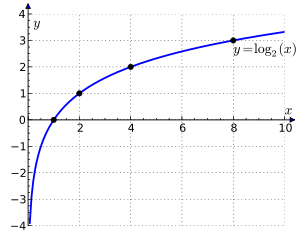
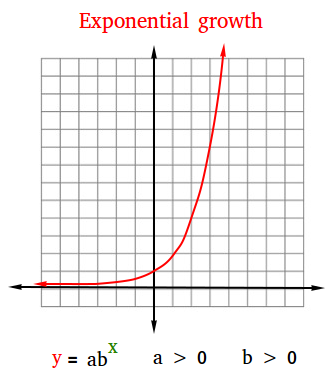
One crucial difference between the conventional and the niche-based strategy is the type of growth. In case of the former it is logarithmic growth – where it is easier to get a good well-paying job immediately after graduation but after a few years the growth may taper off. In case of niche areas there is a considerable struggle initially but after a few years when the market perceives you as specialist, the growth becomes truly phenomenal and is termed as exponential growth. ( Please refer the graphs below) You are considered as a pioneer and get a first-mover advantage.

Log_Growthexponential-growth

Conventional Approach                                                         Niche-Based Approach

Whether in business, profession or a job; there are some who go on competing  against  a vast majority in a commoditized market as if running on a treadmill and getting exhausted. On the contrary, the likes of  Christopher, Werner Brandes or Charles Darwin though not brilliant in their school days in the conventional sense were able to find their niche. Have you found yours?

Two roads diverged in a wood and I…and  I took the one less travelled by and that has made all the difference. – Robert Frost.

Inspiring Leadership

My first interaction with Deepak Parab, the CEO of Metrohm India Private Limited (a leading company in Analytical Instruments and Solutions) happened around two years ago when he called me from his Chennai HQ and said that he would like me to conduct a ‘Managerial Effectiveness’ program for his pan-India team of service managers. “Rajan, I shall ask my National Service Manager, Vinod Salunkhe to get in touch with you to discuss the further modalities.” The call hardly lasted five minutes; a client taking a quick decision in finalizing a 2-day training program was a rarity in my training career of 25 years. I could not help recollecting a MNC client who took approximately six months with more than a dozen meetings to finalize a 1-hour keynote address. (See my earlier blog titled ‘A Tale of Two Key Note Addresses’ – https://rajanparulekar.in/2018/03/29/a-tale-of-two-key-note-addresses/ )

More than the ability to take the right decisions, the leadership traits I admired in Deepak were:

  1. Focus on results: After he took over as CEO and Managing Director, Metrohm India has progressed very well under him and results have been great. They have been able to capture and maintain major market share for their products and increase the turnover and profitability multi-fold. Today, Metrohm India owns all its offices across India and these were bought in the last ten years.
  2. Retaining Talent: His core team of 30 senior managers including the COO, Branch Managers, Service Managers, Application Laboratory Manager and Product Managers are with the company for the last 20 years. The core team has remained the same for the past two decades.
  3. Creating Value through Service: Peter Drucker said that the purpose of business is to attract and retain a customer, which can be restated by the formulae below:

a. Vc > Vp where Vc is the value perceived by the customer and Vp is the value inside   your product or service. You get a customer only when the perceived value is more (short and/or long term) than what the customer pays for.

b. Vc = (Q+U+S)/P where Q is the Quality, U the Utility, S the Service and P is the price. Remember that QUS is not what the salesman claims but what the customer perceives. The four ways to increase the perceived value is either to increase the QUS or to reduce the P. Quite often desperate salespeople reduce price to create value which in turn affects profitability.

Deepak took a different approach to create value. To command a premium, he focussed on the numerator (QUS) rather than the denominator (P). Service was given prominence vis-à-vis sales. In a team of 135 executives for each sales person there are 3 service executives. Normally one service engineer is deployed for 100 instruments, with an equal share of warranty and AMC (annual maintenance contract). Today Metrohm India has 12 Offices and 12 Home Offices from where Service is provided. The home office concept for service was used to extend the reach. For example for clients in Goa, service engineers used to travel every week from Mumbai to Goa. With 250 instruments, 2 service engineers were deputed to Goa, which created value in the following ways:

  • The travel fatigue for service engineers was considerably reduced.
  • Improved work-life balance for the Service Engineers who were back to their home in the evening.
  • Cost of resident engineers was lower than with the travel and related costs.
  • Delighted Customers due to an improved response time and a lower down-time. Customer confidence in Metrohm also increased due to the now closer proximity of the Service Engineer.

Having created value for the customer in terms of QUS, Metrohm was now able to command a premium vis-à-vis the competition. There is a general tendency for companies to club sales and service to control costs, especially in the case of executives operating from home offices. However, Deepak resisted this temptation, as with dual responsibilities, executives tend to focus more on sales and ignore service. Now, dedicated service engineers in turn enhanced the perceived value!

  1. Delegation with empowerment: Ganesha Chaturthi is a major festival in Maharashtra. Deepak belongs to a small village called Hiwale in Sindhudurg District from the Konkan region. For this important festival, Deepak used to take leave for 10 days every year. However as a CEO designate, when he applied for leave now, his boss questioned the logic, considering his elevation to the new role with additional responsibilities. The major concern apart from the leave, was in Deepak being incommunicado due to poor network connectivity at his village. Deepak’s thought process was quite clear. He said, “I shall prepare my team in such a way that my help is not needed in those 10 days.” His communication to his team members went on the following lines:

– “Please take decisions. I am not going to blame you for the consequences, if found negative in posterity.”

– “Please think of the worst–case scenario. The company is not going to sink from any such decisions.”

– “All of you can learn from your mistakes and a wrong decision and its consequence can be termed as the cost of learning.”

– “If in spite of all the above, you still need my advice, please drop me a SMS. In case I go to the village market (which has a better connectivity), I shall respond.”

The discounts and pricing are controlled by the respective Managers and all are empowered to take decisions. As a normal practice at Metrohm India the senior management team does not have any extra power to give additional discounts.

5. Genuine Concern for Employees: Even though a nationwide lockdown was announced on 24 March 2020, Deepak took the call on 20th March to shut down the company’s offices across the country. Most of his team members who were at different locations then, had enough time to go back home.(Contrast this with the 4 hour time frame given by the PM which affected not only the general populace but also the millions of migrant workers!) He announced categorically that there would be no salary deduction, nor would anyone be forced to go on leave. The salary for the full month of March which normally gets paid on the last day of the month was credited on 24th

6.Creative Problem Solving: Every year the company used to invite its Pan-India sales and service team in May to the Chennai HQ for training. The month-long exercise for a team of 130 executives used to cost around ₹ 70-80 lakhs; the quarterly reviews used to be around ₹ 5-6 lakhs each. During the lockdown, the time was used for online trainings and reviews thereby saving a big cost for the organisation, while at the same time keeping the employees engaged. They also ensured that all employees are engaged and connecting with the customers, so that they feel like they are doing their routine work and no health issues crop up due to no work. In the earlier phases of lockdown, the instruments which needed attention were diagnosed remotely, thereby reducing the down time. For the Pharmaceutical industry which is a major customer (as well as the sector doing well during the pandemic), Metrohm’s service support was crucial. In a few cases, even the installation was carried out with the help of the customer along with support via a video call by the Service Engineer. Digital Platforms have been used by the organisation extensively to connect its employees and customers.

7. Effective Decision Making: Be it a minor decision of a trainer selection or major ones like shutdown or salary disbursals, an effective leader does not shy away from taking decisions.

8. Strong Ethics: Deepak shared that a strong sense of ethics and moral values are a sine qua non for effective leadership. Deepak spent his childhood in the IIT Bombay campus. His father, Raghunath Parab was a governing member of the Co-Operative Society and was entrusted the job of supervising the IIT Staff Canteen operated by the IIT Staff Co-Operative Society. As a principle, his father did not prefer his children to visit the canteen; lest it be perceived that they were availing food free. Some years down the line, when Deepak entered the canteen and when his father admonished him, he told him, “Dad, now I am working as a Technical Assistant in the Department of Chemistry and I have come here as an employee and not as your son.” Caesar’s wife must indeed be above suspicion.

Since 1982, Metrohm AG, with HQ in Switzerland is a full subsidiary of Metrohm Foundation, as the only shareholder. With neither a specific owner nor any other shareholders, part of its profits are earmarked towards charity and R&D. Being a zero-debt company, the obsessive pressure for quarterly results is absent.

rajan@paraadigm-info.com, http://www.paradigm-info.com


Virtues of Boredom

How do you conclude whether you have liked a training program or not? The trainer may be highly knowledgeable but if he is not able to engage the audience; the feedback is considered to be negative confirming you have not liked the training program.  The different techniques trainers employ to engage the audience include ice breakers, fun session, individual and group activities , case studies, role plays,  exercises etc. Particularly during the post-lunch or the graveyard session, the relevance of  activities becomes very critical. With a sense of humour coupled with interesting videos, all the stakeholders viz. the participants, the HR manager and the trainer feel happy. Such programs are relevant for topics like sales, negotiation, team building, communication etc. for conceptual understanding and are called as pragmatic programs.

Imagine a training program where there is absolutely no  audience engagement; be it the ice breakers, videos, or group activities. To add insult to the injury, the trainer talks in a drab monotonous tone; session after session. He will ask you to watch your breath and after a few days to watch sensations on your body. Your constant companion during the sessions may be boredom. And if this is not sufficient, the trainer does not even bother to take a feedback at the program conclusion.  Let us call such programs as the reflective type. Would there be any takers for such type of programs vis-à-vis the pragmatic programs discussed earlier?

I have been conducting the conventional pragmatic programs on Sales, Negotiation, Emotional Intelligence etc. for corporate clients since 1995. However the program which contributed immensely to my personal growth was Vipassana, a ten-day course in noble silence, a program of the reflective type. The essential difference between pragmatic and the reflective type is the way boredom is perceived. In case of the former, boredom is treated as a ‘bad’ or as an unwanted emotion and has to be done away with at all costs. In case of the latter (like sensitivity training ) it is treated as a valuable emotion in knowing oneself.

If you watch your mind, you will observe three types of thoughts which are:

  1. Pleasant Thoughts: These include the positive thoughts indicating happiness, success, achievement, pleasant memories etc.
  2. Painful Thoughts: These include undesirable situations like losing a job or an order leading to anxiety, anger, uncertainty etc.
  3. Neutral Thoughts: Beyond the pleasant and painful thoughts, the majority of thoughts are neutral which do not produce any emotions boredom being the major one. Human beings are programmed to chase the pleasant thoughts, run away from the painful thoughts and ignore the neutral thoughts. It is estimated that hardly 10% of the thoughts belong to the pleasant and the painful category and the balance 90% to the last category.

So the moment a feeling of boredom arises,  people generally start looking at WhatsApp,  switch the TV channel, hardly realizing that it is akin to running on a treadmill either chasing a pleasant thought or running away from a painful one and in turn getting exhausted being at the same place.

Like any other positive emotion like happiness, joy, contentment or the ‘negative’ emotions like anger, fear, jealousy; boredom has its own validity. It can make you reinvent yourself, look within and also become creative. Doris Lessing an eminent writer and Nobel Winner in Literature says, ”If you really want to do something fundamental in life; you should embrace solitude and boredom to such an extent that they engulf you.” Pablo Picasso, the great sculptor and painter says, “without solitude no great work is possible.” Beyond developing creativity, utter boredom can also lead a person to self-actualization. (Refer to the Award winning speech by the writer titled The Purpose of Life: https://www.youtube.com/watch?v=amF_V_FaSuA )

Those of you who have watched serials like Buniyad, Hum Log, Ramayan Or Yeh Jo Hai Jindagi in the late 80s will realize that the serials were not exceptional per se. Apart from a reasonably good content, one of the major reasons for their popularity was the audience’s threshold to boredom was much higher then( Doordarshan being the only choice) vis-à-vis the current times. Would you agree that with  1000+ TV  channels clubbed with internet related options like youtube, Netflix, Amazon prime etc. our threshold to boredom has come down significantly?

Can boredom help us to be more creative? While watching a Hindi movie on Netflix or Amazon prime, the moment a song sequence appears; there is a tendency to fast-forward due to our antipathy to boredom. How to deal with such a boring situation?

Think of a Hindi movie song  where the hero is carrying the corpulent heroine in his lap or on his  back and ponder over  the possibility  that the shot might have taken at least 10-15 retakes including a full day of shooting. Just visualize the fatigue and exhaustion the hero might have undergone! On similar lines when they were rolling down the hill or drenching in the rains think of the likely spinal injuries or the possibility of catching a flu.

When the hero is running around trees or performing weird postures ( a la Govinda and Karishma )in a group  of 100 extras dancing to the tune of the choreographer; simply mute the audio; you will start enjoying the scene in a hilarious way. You may also develop compassion for the hero and the heroine and realize what Buddha meant by his first noble truth that life is suffering.

Anyone while dating has undertaken such exercises to coax and cajole his sweetheart in real life?  And then you start looking at the song sequence symbolizing  the utter meaninglessness of  life as conveyed in a play called Waiting for Godot by Samuel Beckett.

It is a tragicomedy that focuses on the meaninglessness of life. It centres around two tramps waiting for someone called Godot. We are not told who or what Godot is – a man or a God who will solve all their problems; a change in their circumstances; or death. The tramps, Vladimir and Estragon, do not know who Godot is either. They meet each day near a tree and wait, experiencing cold, hunger and pain. They try to distract themselves from the endless wait by arguing over trivial things; sleeping; chatting with the only two passersby – Lucky and Pozzo.  Each night, a boy arrives to tell them that Godot will again not be coming that day but will surely come the next day.

In the end, the reader or spectator suspects that Godot represents the emptiness that the writer sees at the centre of human existence. Like the tramps, we go through life, waiting for we don’t know what. We pass the time in work and other activities; and we continue to wait; for Godot.

When we fast-forward a song sequence; we are trying to avoid boredom (like Vladimir and Estragon) hoping to complete the movie faster in spite of the predictable climax of the hero and heroine getting married against all odds and living happily ever after! (which may be a myth after all!) Instead, why not embrace boredom and start enjoying the inane song? Boredom may also lead you from the temporal to the eternal aspects of life and you start enjoying the present moment! The pragmatic programs may help you earn a living, the reflective ones- the so called boring ones may help you realize who you are! Both of them have their own validity.

P.S. If you find this blog article boring, please rest assured it has served its purpose!

The Unknown Tendulkar

He was neither a cricketing genius nor a renowned Marathi playwright.

He was born in 1909 in a poor family of a primary school teacher in Ratnagiri, Maharashtra. After completing his B.A. at Elphinstone College, he went to Cambridge on a scholarship to pursue astronomy. Drawing inspiration from Gandhi and his Dandi Yatra, he dropped out of Cambridge, returned to India and joined the freedom movement.

On Pandit Nehru’s advice, he devoted 10 years of his life for the sugarcane farmers in Uttar Pradesh. To earn his living, he started writing for newspapers. In his second attempt of further studies, he went to Gottingen University in Germany to study Aerospace Engineering. Nazis suspected his Communist antecedents and put him behind bars for a month. Then he moved to Paris. His fascination with Communism took him to Russia. For two and half years he studied photography in Russia. He survived on photography and writing for newspapers and magazines like Pravda, Izvestia and Kastyor. On his father’s death, he returned to India and was in and out of jail during the freedom movement for 20 months. Due to financial challenges, he approached Mahatma Gandhi and sought his permission in writing Gandhi’s biography. With 12 long years, moving across the country and in his impeccable English, he  completed the  8-Volume Biography: Mahatma – The Life of Mohandas Karamchand Gandhi. The first volume covers his life from 1869 to 1920 and the last one from 1947 to 1948. First published in 1951, it had the foreword of Pandit Nehru who on this magnum opus of around 4000 pages said, “It brings together more facts and data about Gandhi than any book that I know. I consider these books to be of great value as a record  of the life of a man not only supreme in his generation, but also a period of India’s history which has intrinsic importance of its own.”

Apart from the above, some of his other books include 30 months in Russia, and  Gandhi in Champaran.   Once the director of Sahitya Academy wrote to him asking for his detailed resume. This person who had around 5000 pages to his authorship, did not have even 2 pages on himself. His response was: Deenanath Gopal Tendulkar, Born: 9th October 1909 at Ratnagiri, Education: BA ( Hons)

The biography brought international fame to  DG but he still remained the simple soul as he was, all along his life, in his half-sleeved khadi shirt, a khaki half pant, Kolhapuri chappals  a Shabnam on his shoulders, sauntering  at old book shops in flora fountain and other antique shops.

A group of people came to invite him as a Key- Note speaker for an important event. After entertaining them, he said,” I generally do not like to mix with people, I do not like to go on stage, and I do not like to be photographed or want my name appearing in the newspapers.” The organizers were taken aback. One of the visitors said, “we shall go back and tell our chief and then call you over phone.” He said,” My bungalow is named as Ekaant ( Solitude ) I do not even have a telephone.”


Journalist MJ Akbar narrates an incident quoting H Y Sharada Prasad, the media advisor to Indira Gandhi. DG was awarded Padma Bhushan during Rajendra Prasad’s tenure. He sent a telegram to the President saying he would prefer to have a watch instead of a piece of paper from the government. Needless to say, he received both.

Deenanath Gopal Tendulkar (1909 -1972) a great writer, a pioneer in documentary film making, a renowned international photographer, who incidentally never had his own photograph in his lifetime, whom Pandit Nehru used to invite him over dinner, Mahatma Gandhi used to do the proof reading for his writing, today is an unknown Tendulkar.