Category Archives: Management

Putting your best foot forward- Does it work all the time?

As a startup founder, if you were to make a presentation to your potential investors, with an opening slide: Few Reasons why you should NOT Invest in our Company, what would be the outcome? You would sum it up as nothing but a disaster!

Rufus Groscom and Alisa Volkman started a company in the US called Babble which was an online magazine with blog network. The company had positioned on the new paradigm of parenting by  challenging  the dominant parental clichés. In 2009 when they approached for the Venture Capital (VC) funding, their first slide was:  Five reasons why not to invest in Babble. They received a $3.3 Mn funding.

Looks a bit counterintuitive! Isn’t it? Normally the convention is to highlight your strengths which works well when your target audience is either neutral or has a positive disposition towards your offerings. But does a typical investor look upon you in a similar way?

Just imagine when you say that you have a ‘killer idea’ and that you will reach your breakeven in the first year and  will scale up to 20x revenue in the next two years what must be going on in the investors’ mind? Rather than getting impressed, a conventional sales pitch is normally looked down with scepticism. The investor is also operating from a position of strength which is due to the funds at his disposal as well as the number of ‘killer ideas’ he has encountered in the past.  Psychologically he is tuned to find out the follies in your sales pitch. What happens when you take a counterintuitive approach of focussing on your weaknesses?

  1. You create Trust: When you put your cards on the table you look vulnerable which makes you look trustworthy. Your investor feels that if you are speaking about something wrong, there might be a lot of things you may be doing right. You are perceived with a positive intent. In the conventional sales pitch, the intent is perceived as getting the funding by hook or by crook! (for details refer Trust: The Difference that Creates the Difference, from Contextual Selling)
  2. You look smart: You may speak about your strengths but if they are hyped the investor may feel you are beating your own trumpets. However, when you critique yourself, you may be perceived as smart.

Teresa Amabile, professor of Business administration at the Harvard Business School conducted an experiment on how a writer is perceived by her audiences. A sample of a New York Times book review was taken. The book review which was primarily of a complimentary nature was modified with a critical tone; major part of the content remaining the same. Minor modifications were made from inspiring to uninspiring, tremendous impact to negligible impact etc.

People rated the ‘critical’ reviewer 14% more intelligent and having 16% greater literary expertise vis-à-vis the ‘complimentary’ reviewer. After all an amateur can appreciate art but only a professional can critique it!

  1. Objections are Pre-empted: There are two groups who have been given a task of identifying reasons for being happy.  Group A has to list three reasons whereas group B has to list for 12 reasons. Which group according to you should be happier between the two? Most of us would opt for group B.

Norbert Schwarz (Professor, Department of Psychology, University of California) in his article Ease of retrieval as information has given an interesting example on Availability Heuristics.  Also called as availability bias, it refers to the mental short cuts that come to people’s mind while evaluating and solving a problem. Group A may think the reasons of happiness can be attributed to spouse, children and the career. The available answers which were quick to find makes them happy. Group B may explore possibilities beyond the first three which may include vacation, hobbies etc. but may find it hard to reach the magical number of 12 and they start questioning themselves whether they are happy in the first place or not. So, the counterintuitive answer is A.

Looking at the Startup founder’s admission about his challenges the investor now has to struggle hard to find out new problems (as those have been already pre-empted in the first slide) and he concludes that the startup’ s problems are not that significant!

Coming back to the Babble story, a few years later Rufus and Alisa approached Disney for a takeover. The opening slide was:  Why you should NOT buy Babble? And the reasons included

  1. Poor user engagement,
  2. Only 3-page views per visit
  3. despite being a parenting website 40% of posts were from celebrities etc…

Disney bought Babble for $40 Mn.

A note of caution: Aspects like technology model, IP, revenue stream, scaling, breakeven, competition, manpower cost, future disruption etc are going to be equally important and the presenter needs to be focusing on the strengths too. The article only wishes to point out that speaking about the negatives may be also relevant at appropriate times!

Rajan Parulekar, rajan@paradigm-info.com
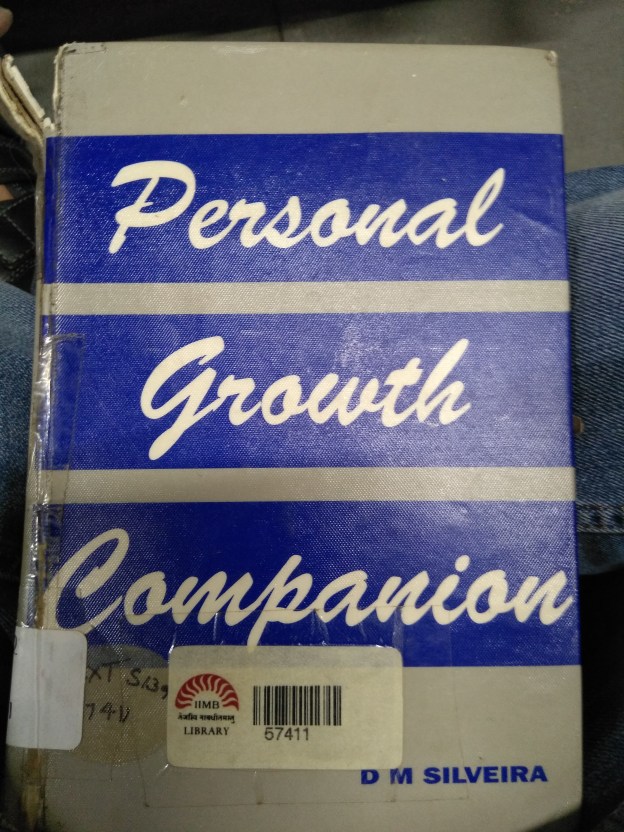
Personal Growth Companion by D.M. Silveira

Circa 2002, while visiting the IIM Bangalore library, I came across a book titled Personal Growth Companion (PGC) by DM Silveira. PGC addressed the  dilemmas faced by people and takes them through a simple process of self-assessment which paves the way for new awareness of capabilities and potential. Some of the chapter titles were: Have you met yourself recently, what is your paradigm? Do people feel good about you? It is not a typical self-help or a how-to book telling you about success or a millionaire mindset but more on introspection and reflection. It helps you through the limitations of psychological categories and transcends scientific classifications, a few sample questions to illustrate the point:

On Busyness: Am I caught in a hurry? What am I trying to tell myself and others through my tearing hurry? Is it tied with my ego? Do I lack an inner focus and am I hurrying as a compensation?

On creativity: Is my life over-organized and repetitive? Does the routine enslave me? How much of novelty and surprise is there in my life?

The elaborate questionnaire was more on reflection rather than pigeonholing you into a category like introvert, extrovert etc.  The book was written in a simple yet a profound manner.  I got literally hooked into it. I carried the book while on a trek in the Sandakphu-Phalut range of the eastern Himalayas (near Darjeeling) and the book truly lived upto its title. By the time I returned to Bangalore, I was so impressed by the book, I penned a book review. The Sunday Supplement editor of Deccan Herald replied that it could not be published as the paper had a policy of putting up the reviews of books published in the current year. PGC was published in 1996. I searched for PGC in a number of bookshops but could not succeed. In retrospect, I felt relieved the review was not published considering the unavailability of the book.

DM Silveira, the author was living in Vashi, New Mumbai. I called him over phone and asked him whether I can buy a copy of the book from him. He said, “I am happy to note you liked Companion but I have to express my apologies. I publish only one edition of my book. And the only copy is on my dining table.” That statement revealed DM’s (as he preferred to be addressed) paradigm about the triviality of success and ephemerality of phrases like ‘Million copies sold,‘ #1 on New York  Times Best Sellers List’ etc.  There were no celebrity endorsements on PGC either.

Curiosity had the better part of me. I decided to meet him at his home in Vashi. A fair, slim and bespectacled person around six feet tall with a cheerful disposition was indeed much different than my expectations.

I also came to know that DM had to his credit a book called Human Resource Development. It was acknowledged as a scholarly work and was appreciated by the practising HR professionals then. Once he narrated an interesting anecdote. Reserve Bank of India had placed an order for 200 copies. DM used to publish his books under his own company called Classic Publishers Pvt Ltd. which was based in Kandivali Mumbai. DM along with his son Nikhil had been to the RBI for delivering the consignment. As DM was carrying the boxes on his shoulder, Nikhil said,”Dad, you are the author of this book, you are not supposed to carry the boxes on your shoulders to the stores. Let me take it.”

DM started his career as a clerk in Goa Secretariat in late 60s. His boss coaxed him to go to Mumbai for completing his graduation and explore better career opportunities. Working part-time as a journalist he completed his graduation in literature. One day I asked him about his journey of authorship, he said he decided to write full-time and live in Pune for an year. He said,” Rajan it was  a tough call. Actually India Today had offered me the number 2 position, but then I insisted on #1 position. But then Aroon Purie ( founder of India Today) did not find the idea too interesting and so I am here.” For some time I thought he was pulling up a fast one on me or a case of sour grapes. The second possibility was difficult to digest for a person who earlier was the editor of magazines like Newsmag, Onlooker and later on for a newspaper called Free Press Journal.

DM was the one who coaxed me into writing a book while cautioning it to be a painful process.

Whether in person or on a mail his opening sentence used to be ‘Patrao kosso assa, chennagiddiraa? ( meaning bossy, how are you, all well, smattering of Konkani, Portuguese, and Kannada) He connected me with Union Bank of School of Management in Bangalore where I conducted a number of lectures for the executive MBA program. His recommendation to clients used to open doors with a number of corporate clients for me.

For few years while in Delhi, he used to publish a yearly book of facts called India Book. DM, writer of great books, editor of FPJ and other magazines, Gold Medallist in Masters in English Literature from Bombay University was truly a humble man.  He had no qualms interacting with a much younger and inexperienced person like me. He used to be in his elements while sharing interesting anecdotes about Piloo Modi, LK Advani  etc

On 31th March 2009 he passed away due to a massive heart attack, while brushing his teeth; just shy of two weeks of his 60th Birthday on 16th April. It is said little knowledge makes one arrogant, a little more makes one reasonable and the final knowledge makes one truly humble. DM, the maverick, belonged to that rare but a truly humble creed!


Difference between Convincing & Con-Vincing

Soumyajeet Mohanty ran Edu Solutions,  an educational consultancy service in Bhubaneswar Odisha. Initially he started Sunrise Coaching Solutions providing tuition to engineering students. As the venture did not yield much returns, he ‘moved up the value chain’ by providing  ( fake) admissions to students wishing to get into medical colleges. Continue reading

Do Sales Incentives necessarily Improve the Margins?

One of our clients in Pune had invited me to diagnose the problem of their poor margins. When I asked the VP-Sales he said,” We are facing this problem for the last three years, so last year we have launched an attractive incentive scheme, but still it is not producing results.”

Most of the sales managers intuitively feel that incentives lead to higher margins.  However the research carried out by Edward Deci and Richard Ryan at the University of Rochester and Adam Grant at Wharton say that the effectiveness of motivation varies with the task.  There are two types of tasks:  Algorithmic and Heuristic tasks. Continue reading

Volition & Motivation: The Gap between Doing and Knowing

Most of us feel that attending a motivational program will help people achieve the individual and organizational goals. Kurt Lewin and Narziss Ach have made pioneering contribution in the field of motivation. Lewin was known for his field theory as well freezing and unfreezing  concepts in changing the human behaviour and believed that motivation and volition are the same. Narziss Ach  treated motivation and volition differently.

Volition happens at three levels: Continue reading

A Tale of Two Key-Note Addresses

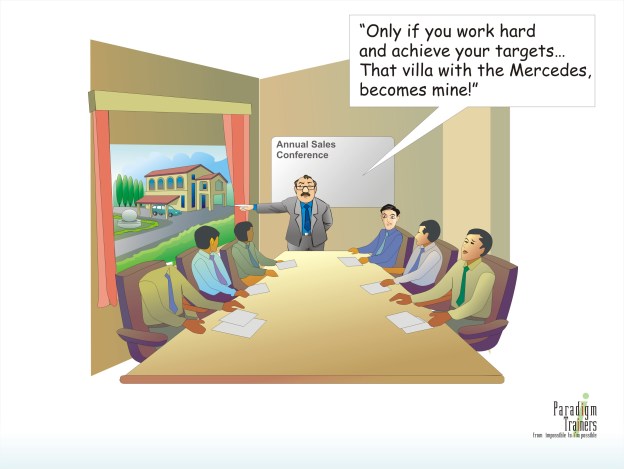
“We are having our Annual Sales Conference and we would like you to deliver a Key Note address for our Pan-India Sales Team on Value Selling.” said Ramesh, the HR Manager of an IT company over phone.

“Thanks, but how did you know about me? “ I asked. “We make our own referral checks in the market before deciding on the speaker.” said Ramesh. Continue reading

The Flip Side of Google Search

Rahul, a fresh engineering graduate,  was trying his hands at rubik’s cube. He said,” after doing google search and watching youtube videos, I have been able to crack the code. The world’s fastest player  can solve the puzzle in barely a minute. I have studied his instruction set 15 times and I am able to crack the code in approximately 4 minutes.”  What happens when you a solve a puzzle without applying your mind; relying on google search or  a guide in the first go?

In this process of solving a puzzle, I was wondering whether the goal is more important than the journey or the end is more crucial than the means? Continue reading

A Different Way of Curing Addictions (A Buddhist Perspective)

Generally we look at curing  addictions by eliminating the impact of the external environment. For example if a person is addicted to alcohol, he is persuaded to reduce the dependence on alcohol by suggestions on how alcohol is bad for health, its effect on the family, health and financial security. The patient is also exhorted to join Alcoholic Anonymous (AA) so as to reduce his dependence. These interventions work sometime but also tend to fail when a patient relapses as he is unable to resist the temptation.

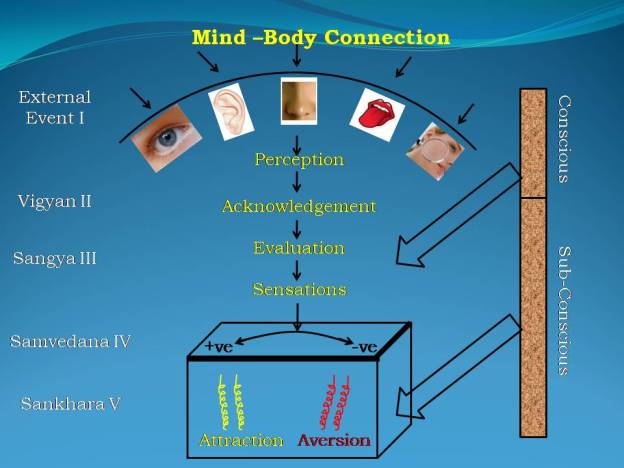
Let us look at an alternative model from the Buddhist perspective. (Refer figure). An event (stage I) that happens outside is perceived inside the body through any or a combination of the five sense organs like eyes, ears etc. Sometimes it can be only an aural input like a piece of music or a multi-sensory input like relishing delicious mutton biryani ( sight, smell, taste, partially sound )This second  stage is called as perception and acknowledgement of the external event which is a MAP and not the actual event and is termed as Vigyan in Pali. (Stage II). The moment an input is perceived,  it is immediately evaluated by Sangya (stage III) which compares the event with something similar in the memory bank. Based on the comparison the event is either pigeonholed as either good or bad. The comparison instantaneously produces a sensation (Stage IV)) on the body which is either a positive or a negative one. The positive sensation may be tingling, soothing or a similar sensation whereas a negative sensation can be an itching, pain or a similar sensation. So far so good. The journey up till now from an external event of tasting a morsel of mutton biryani produces either positive or negative sensations which do not exclusively depend on whether the biryani is good or bad but depending on how it is perceived and the corresponding sensation it produces on the body. For example, a person who loves spicy Hyderabadi Biryani may like the taste if it is comparable to the one prepared by his mother. (Evaluation – stage III) An American who is used to bland food may find the Biriyani quite pungent. The same food has produced two different body sensations:  for the former   it is positive, and for the latter it is negative.

At this juncture, the subconscious mind comes into play and depending on the type of sensation, shall either produce a bond which is either of craving/attraction or Aversion (Raaga or Dwesha Stage V). The person decides to either have the next morsel or avoids depending on the bond that is created by the subconscious mind. A simple example of biryani can be compared to Alcohol, Nicotine or any substance drug.

 Myths of Addictions:

  1. An external event is the cause of addiction: If it were so, all people who take alcohol should have become alcoholics which are not the case. People do not become addicted to an external event or stimuli but to the sensations on the body.
  2. By telling what is right people can come out of addictions: When we tell the message only reaches the conscious mind. However the subconscious mind which constitutes 90% of the mind and is more habit prone refuses to acknowledge the message given to and by the conscious mind. Quite often alcoholics know the ill-effects but the thought pattern prevents them. On the contrary the subconscious mind now starts justifying the action. Like a person says he is drinking because he had abusive parents, pathetic childhood, financial problems, spouse etc. However he does not realize that the addiction is not for the alcohol but for the craving of pleasant sensations (relaxed feeling) and the aversion of the negative feeling (turkey, shivering, irritation etc.)
  3. Happiness and Pleasure are the same: We believe that pleasure is good and pain is bad. However any event whether pleasurable or otherwise, creates misery in the long run. Let us say a person who loves gulab-jamun feels that the sweet is the source of happiness. If it were so, irrespective of the quantity, galub-jamuns should make him happy. He may enjoy the first few very much, however if continued beyond 10 or so it may produce irritation. So the pleasure was not in the gulab-jamun but in the sensations it produced on the body.

How to Bring Change:

It should be clearly understood that the  first four stages are  primarily  automatic on which a person does not have much control, which include the event(I), the perception & acknowledgement by the senses( II) the evaluation ( III) & the sensations on the body due to evaluation (IV) .However the reaction to the body sensations is within a person’s control. The bonds of attachment and aversion are continuously in the subconscious mind every moment. Taking an analogy of the hard disk of a computer, continuously the data is written by way of bonds (sankhara) which are habit forming.

If we stop creating new bonds, slowly the old ones will wither way and gradually the change starts happening.  To bring this, awareness of the mind and body plays a very important role. It is not about concentration of the mind but a simple process of choiceless awareness which helps a person see the rapid thought process happening in the mind. Simple exercise like watching one’s breath slowly makes the mind so sharp that at one stage one is able to observe the body sensations. These sensations in a day-to-day life are generally not observable as the mind is gross.

The major trap for the mind to get into is while observing the sensations. People may start hankering after the pleasant ones and despise the bad ones. At this juncture, one has to observe the sensations with equanimity developing a clear insight that any sensation: be  it positive or negative is ultimately going to create a sankhara, an impression on the mind. By developing equanimity towards any sensations; slowly the bonds get reduced in the subconscious mind. A change happens at the subconscious level which is long-lasting.

For most of us there is a gap between knowing and doing. At a cognitive level people know the terrible effects of excessive smoking, drinking. However the behaviour can change only at a  subconscious level. To summarize, the sensations on the body produce the addictions and not the external event. This profound technique has been the unique contribution of Gautama Buddha. His  technique of  Vipassana has helped a number of people to bring a behavioural change in managing anger, fear, curing phobias or come out of addictions. Experiments were carried out on the prisoners of Tihar Jail by this technique which has amply demonstrated the efficacy of the technique.

Apart from curing addictions, the above technique of choiceless awareness which provides insights into the mind-body connect can be used in curing phobias, pain, dysfunctional anger etc. Amygdala is the seat of emotions in the human brain from where anger, fear, jealousy etc emanate. The addictions which happen at a subconscious level are very difficult to eradicate by instructing the brain at a conscious level or a cognitive level. Following examples will illustrate  the change was completely or partially brought by this technique.

  1. Subconscious Anger: Ramesh P. aged 61 years is an engineer and has worked at quality control in different spheres of management. The last position he held was that of GM level at an Automobile company. With financial stability, considerate wife and two children, both well educated and well settled we would perceive that Ramesh is be a happy person. Being his room-mate in one of the training programs I could see Ramesh shouting and screaming in his sleep which used to happen  between 12 -1 PM. For first few days, I could not comprehend what he was speaking but later on I figured out it to be a few sentences of vitriolic anger against one of his former managers. Next day when I discussed with Ramesh about the incident,  he confessed that he was not aware of  such an incident but when pointed about the contents of his diatribe, he said that the incident happened around 12 years ago when his company was going through a major expansion and Ramesh was going through testing times when his immediate boss put him under tremendous pressure. Now Ramesh and his boss both have retired.  Whenever they meet,they exchange pleasantries  and are good friends. Only  when it was pointed out to Ramesh about the  latent anger he could see the impact of subconscious mind. Ramesh realized that when he resisted the negative thoughts about the past incident the negative sensations were produced on the body. By denying them he was creating more bonds of aversion ( stage V) thus multiplying his misery. Instead when he decided to be aware of the incident; slowly the impact reduced. The more you resist the more it persists!
  1. Limitation of Chanting: Swati is a housewife from a lower-middle class family and her husband is working as a supervisor in a small private firm. Due to some reason or the other, the two could not get along well. However by sheer persistence and will Swati was able to control her frustration by regular chanting of sacred mantras, making holy pilgrimages etc. A highly religious person she had managed to keep her emotional life under control. However during the Vipassana program on the  7th   day, Swati refused to continue the course. She said now the anger within her has come out so badly that she feels a great urge to kill her husband with a gun. The anger which was lying dormant was exposed, exploded  and resulted in her violet behaviour. By becoming aware, she was able to peep into the subconscious mind and get out of her anger.

You will observe that by the chanting of mantras,  Swati was feeling calm and serence  at a conscious and a superficial level.  However when she looked deep within with awareness she could see the tremendous anger.

  1. Sense of remorse reduces pain: Homi D. was a working as a fighter pilot for the Indian Air Force ( IAF) during the India-Pakistan war in 1971. He had shown exemplary courage in fighting the enemy. He was decorated with awards. During the war, while going out for a sortie most of the  pilots in a vainglorious manner used to  blabber about  the number of bombs they dropped, and the number of people those were killed by their bombings. It was taken as a measure of one’s achievement.  During the war Homi was injured badly, almost to be captured by the Pakistani army. He  had to crawl on his wounded legs for almost 5 hours to return safely to the Indian base. His right leg had been amputated and left one was hit by few bullets. He had to undergo a number of operations but still the pain was unbearable for more than two decades. He even lost his left eye and was fitted with an artificial eye. He underwent a number of treatments, however nothing could alleviate his pain. While undergoing the meditation exercise, Homi became aware  of the pain that he had caused to a number of innocent people killed due to his bombings. Till then, what he considered as  his success, was nothing other than an act of barbarity. And this sense of remorse and guilt helped Homi to reduce the intensity of the excruciating pain. Now the pain even though not vanished, has been reduced by almost 50%.

From the above three examples, you may observe that the events which had happened more than a decade back were stored in the form of sensations. However due to the automatic nature of the subconscious mind whenever this sensations appeared on the mind there  were repeated cycles of aversions which made the subconscious mind filled with aversion; which the conscious mind was not aware of. However by sheer mindfulness slowly the  bonds of aversion ( Stage V)  were reduced and the people were able to come out of their misery.

Rajan Parulekar| Bangalore | India| rajan@paradigm-info.com| +91 98450 14098


Importance of Weak Ties in Strengthening your Social Network

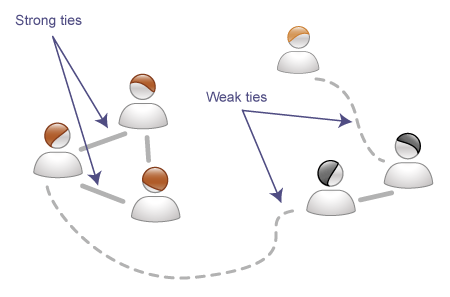
In your social network you have two types of ties:

  1. Strong Ties: These include your close friends whom you know well and with whom you interact frequently.
  2. Weak Ties: These are the acquaintances who know you superficially and your interactions with them are rare.

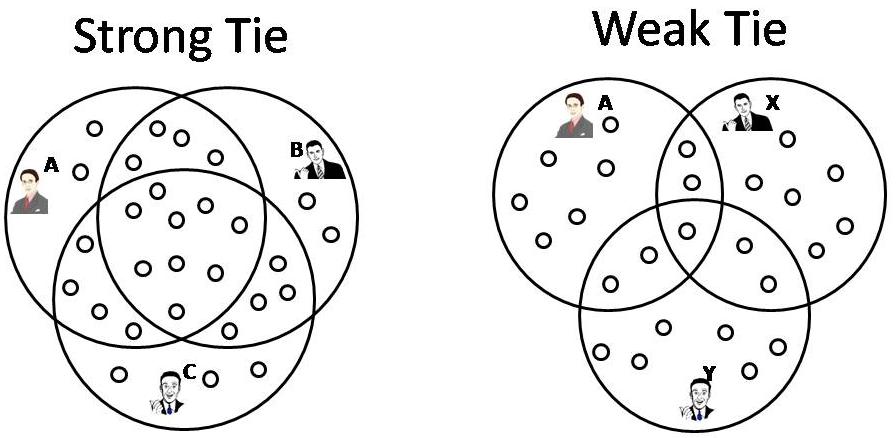
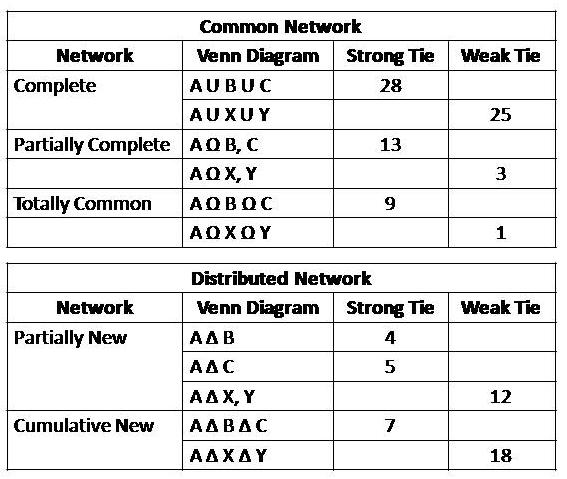
Between the two of them who should support you more in propagating your service? The intuitive answer is obviously the former,  that is the strong ties.  Let us look at a hypothetical scenario.  You (A) have strong ties with B & C with whom your total strength of the network is 28 connections whereas with X & Y you have weak ties and the total network among you is 25 connections. Which one should give you more mileage? (refer figure below)

strongweak-tie

Let us look at it mathematically.

You will observe that in strong ties there are lot of common connections which lead to a great deal of overlap. Whereas in case of weak ties, the overlap is less and the distributed network is high.

strongweak-tie_graph

You will observe that your message will spread to 7 new connections with strong ties whereas with 18 connections with weak ties.

Let us look with two examples:

  1. My book, Contextual Selling was published a few years back. I had conducted a few sales training programs for Rittal India, a leading manufacturer of IT enclosures. When Jacob Chandy, the Vice president Sales and Marketing went through the book, he immediately ordered for 80 copies. In the last 5 years I might have met him hardly 3-4 times.

I was delivering a Keynote address for Metrology Division of Carl Zeiss in 2014. After seeing the book, Mr. Wolfgang Schwarz, VP Sales based in Germany ordered for 30 copies. Our interactions over mail and linkedin are hardly 3-4 in the last two years.

I suggested Sunil my good old friend (strong tie) who was in sales about the book. He said, “I need a complimentary copy.”

  1. Last week I was conducting a program for Bruker Analytics in Mumbai. I had interacted with Dr. Shreeram Oak CEO, only once in 2012. After that meeting the second time I met him was while conducting the program.

In Mumbai I have two close friends, Amar and Ramesh (names changed) who are CEOs of companies in similar field and competing with Bruker. Both of them know me for the last 25 years. (We were working in the same company earlier ) Whenever we meet,  they regularly  complain about the poor quality of their salespeople and the need for a training program But training program to Rajan , no way!

Strong Ties:

  1. They know you too well. ( familiarity breeds contempt?)
  2. They move in almost similar circles
  3. There is a considerable overlap in their networks.

Weak Ties:

  1. They know you enough about your professional competence.
  2. More novel information about you can move into this network.
  3. There is a less overlap

The concept paper on Weak ties was developed by Mark Granovetter a Harvard Theoretician in 1972 as a part of his Ph. D. thesis. The Strength of Weak Ties is considered as a most influential sociological paper.

Quite often life is illogical and counterintuitive, do not ignore the weak ties,make the best use of them to improve the strength of your social network. Wish You a Very Happy and Prosperous New Year!

Rajan Parulekar|Paradigm Trainers Private Limited| #7, 7th Main, Binny Layout, Vijaynagar, Bangalore 560 040| T: 080 23207930, M: 98450 14098| rajan@paradigm-info.com