Category Archives: Leadership

What makes A Maverick stand apart?

“Shantaram, it’s high time you retire from the film industry” said Shankar Bhat, the owner of Prakash Pictures casually during a meeting of the Film Producers Guild. V Shantaram, the renowned director and the owner of Rajkamal Studios was taken aback. When asked for the reason he said, “Your last film, Zanak Zanak Payal Baje has been a blockbuster through which not only have you reached a pinnacle of success but the film is also considered as an epitome of creativity. You will never be able to repeat such a feat. Any subsequent film you make will be compared to this blockbuster.”

A few days later. G. D Madgulkar, a noted Marathi poet and writer narrated an experiment of an open prison and the rehabilitation of prisoners carried out by Maurice Frydman to Shantaram.

Maurice Frydman, a Polish Jew who came to India and was influenced by Mahatma Gandhi and guided the King of Aundh (Near Pune) draft the declaration for transfer of power from the king to the people of Aundh. It was during this process of giving self-governance to the citizens of Aundh, that a question came up about the prisoners. Frydman then took on the responsibility of taking care of the convicts in an open prison. An open prison is any jail in which the prisoners are trusted to complete sentences with minimal supervision and perimeter security and are often not locked up in their prison cells. Prisoners may be permitted to take up employment while serving their sentence. This provides an opportunity for criminals to reintegrate into society and withdrawal from their criminal behaviour. Without the constraints and stresses of typical incarcerations, criminals can discover more positive lifestyles through support and light supervision from the criminal justice system.

“It‘s a great plot, why don’t you make a preliminary draft on rehabilitation thro’ an open prison?”  Shantaram said to Madgulkar. After a few days while reading the draft, Madgulkar himself got bored and said “The story does not have enough material to convert into a full-fledged film. The subject is too drab and boring.”

Shantaram said,” But I see a great potential to make a classic film out of this narrative. No doubt we need to hone the script more.” Looking at Shantaram’s enthusiasm, Madgulkar had no choice but to accede to his demand.

The film Do Ankhein Barah Haath slowly started taking shape. The title connotes the eyes of the jailor and the hands of convicts. The storyline revolved around six hard-core criminals who have been jailed for heinous crimes like murder, arson, looting and rape. The conventional perception of the legal and the prison setup was to brand a convict as a life-long criminal without any scope for reform. The convicts were thus jailed in inhuman conditions typical of any jail. The protagonist of the film Adinath (played by V. Shantaram himself) feels that people irrespective whether they are criminals or not, are human beings first. There is a possibility of reform by putting them in normal environment like an open prison.

Adinath takes the permission from his senior, the Superintendent of Police (SP) to take these six convicts to a place with minimal monitoring. There are some challenging moments Adinath faces in this novel experiment. Once the inmates make a request to go to the nearest town. Adinath permits them with a caveat that they should return by the sunset. He goes through some anxious moments as the day comes to a close and gets relieved to see them back though a bit late.

The inmates are engaged in a daily routine of clearing the shrubs, digging well and plant vegetable. Within a few months the barren land is converted to a green area with fresh vegetables.  Adinath asks them to sell the produce at the village with nominal profit.  The local traders charging high rates till then get upset with the new competition.

The inmates do not return home in time. Adinath is perplexed about his decision on granting freedom. The inmates return late fully drunk. Adinath not only gets furious but also anxious about the outcome of his experiment. The next day he gets to know that the local trader has coaxed them in getting drunk and go berserk.Not able to digest the success of the farm, the local trader sends his goons and the bulls to destroy the crop. While making a valiant fight with the bull, Adinath breathes his last.

The SP who was initially a sceptic of this experiment, is now fully convinced of the transformation Adinath had brought about in the convicts. “You have served your sentence and are free to go back home.” Says the SP. The inmates decline the offer and decide to continue the work as inspired by their mentor, Adinath.

What made V. Shantaram take on such a challenging film? The seven types of motivators which define a creative personality are Pioneering Motivation, Self-Actualization, Altruism, Career Success, Hedonism. Security Motivation and Affiliation. (1)

Out of the above, the Pioneering Motivation, Self-actualization and Altruism need to be very high; Hedonism and Career Success need to be moderate and the security and the affiliation motivation need to be low for a creative personality.  

Pioneering Motivation: Do Ankhein Barah Hath was an off-beat, black and white movie sans glamour with no tricks of the trade like love triangle, expensive sets, or iconic stars.

Self-Actualization: When Shankar Bhatt asked him to retire after the phenomenal success of Zanak Zanak Payal Baje, Shantaram questioned himself and his own identity and the purpose of life. He decided not to rest on the past laurels.

Altruism: The protagonist Adinath believed in the inherent goodness of people He sacrifices his life to help the prisoners let go of the past.

Security Motivation: His scriptwriter told him that the plot was too mundane and there is not much drama to make into a full-fledged film. Shantaram thought otherwise. He looked at the worst case scenario. His earlier film Zanak Zanak Payal Baje  was a runaway hit. Shantaram was willing to write off even if this film were to flop at the box office.  .

Career Success: Intuitively Shantaram knew that the film will come out well and will be appreciated by the audiences. He did not get into the success trap of comparison with the  success of his preceding films. In a way he did not become a prisoner of his past success!

 Affiliation: This motivation is to tread the beaten path and need to be very low for a creative person. Madgulkar who was asked to write the screenplay got bored while narrating the first draft. Shantaram did not give up.

The film was premiered at Opera House in Mumbai on 27th September 1957. It was attended by the staff of Rajkamal Studios, friends, relatives and acquaintances of V Shantaram along with celebrities from the Bombay Film industry (now Bollywood). Even if the film were to be a disaster, audiences would make kind remarks about the film’s success out of courtesy. But the scene was quite different. Forget an applause, there was a total silence. Vijay Bhatt, a film a producer said, “You have said something different in this film.” Save this remark, there were hardly any comments. One could hear people whispering: had it not been for V. Shantaram, the film would hardly run for 5-6 weeks. The film reviews in the media were more towards criticism rather than praise. (2)

Do Ankhein Barah Haath ran for 65 weeks in Opera House and proved the naysayers wrong. The then Mumbai Police Commissioner had issued an unofficial dictum making the film mandatory for every policeman.

Ae Malik tere Bande Hum’, the prayer song was played in many schools and jails across the country and also in Pakistan. The film won the Best Film and the Best Direction award from the Govt of India. It was honoured with the best Foreign Film Award in the Berlin Film festival.

V. Shantaram wanted to acknowledge the contribution made by Maurice Frydman by including him in the film credits. Maurice flatly refused. 

The black-and-white film had no glamour, a drab subject and an idealistic protagonist.  Madgulkar the scriptwriter, the Staff at Rajkamal Studios, the celebrities of the film industry, or the media; none of them predicted a decent run for the film, leave aside the commercial success or the critical acclaim. Shantaram swam against the tide and showed what it means to be a maverick.

As someone has said, “if you can visualize the invisible, you can accomplish the impossible!”

References:

  1. The Fourth Eye – Pradip Khandwala, the seven indicators of creativity are discussed in detail. The different levels of motivation be it high, medium or low can be understood through the questionnaire. Blockages to creativity and the ways to enhance are also discussed.
  2. Ten Classics – Anita Padhye

Good and Great Communication

“This is our drawing room; this is the balcony and these are the wall-to -wall wardrobes.” Shantanu, a software engineer in his early 30s was explaining to his guests as I was ushered into his new 3-Bed room apartment. The Rs. 2 Cr+ plus apartment in an upmarket gated community was fitted with Italian marble, top end interiors and Alexa activated controls. As the show-around during the house-warming ceremony was taking place, I got lost in my thoughts recollecting of a person who lived a simple life in a single toom laden with books in National College, Bengaluru. H Narasimhaiah, affectionately called as HN, was a physicist, educator, writer, freedom fighter and a rationalist from Bengaluru.

Circa 2010, I was attending a training program on Effective Presentation Skills in Indian Institute of Science (IISc), in Bengaluru. There were eminent speakers and motivators which included Toastmasters who demonstrated the various facets of presentations and the techniques in using PowerPoint. There were around eleven speakers. By the time the last speaker’s name was announced; the auditorium was almost empty. It was around 5:15 PM and the last speaker was Ashis Dutta, the CEO of CCE Software Private Limited who was to speak on Developing Business in Europe. CCE Software had a good presence in Germany then. Ashish was talking in a simple conversational manner without any histrionics, voice modulation or an attempt of playing to the gallery. (There were a few listeners even otherwise in the auditorium.)  and I still recollect the last slide which said, There is no Europe. The presentation though simple to the core, conveyed a powerful message that Europe should not be taken as an entity without factoring the differences among its member countries. For exploring business opportunities, a one-size-fits-all approach may not be appropriate. Even after a decade, I still remember that presentation which was given at the fag end of the day without any fancy bells-and-whistles of PowerPoint. I do not recollect the previous speakers who were flamboyant and more eloquent vis-à-vis Ashis.

Subsequently Ashis and I became good friends. On 5th September, Ashis sent me a message about the speech which made a lasting impact on him. Thirty years back when he came to Bangalore, he heard H Narasimhaiah (HN) at the Rotary club. It was a speech straight from the heart delivered in a soft tone without any rhetoric or flamboyance. What touched him the most was HN’s simplicity, ethics and the values he lived by.  

HN, when he was 15 and being from a poor family, had to walk around 85 kms for two days from Gauribidnur to Bengaluru to take admission to National School in 1935. The next year, Mahatma Gandhi was to deliver a talk in Bangalore. The school principal selected HN to serve as an interpreter for Mahatma Gandhi to translate his talk from Hindi to Kannada. That one speech served as an inspiration for HN to adopt the Gandhian way of life.

After doing his MSc in Physics, he went to the USA and earned his Ph.D. in Nuclear Physics, came back to India and was the principal of National college from 1961 to 1972. Later on, he was the Vice Chancellor of Bangalore University. He was also known for starting the Bangalore Science Forum in 1962. He was a rationalist to the core and with Abraham Kovoor, challenged the godmen like Sathya Sai Baba, Sai Krishna and exposed their ‘miracles’. He was awarded Padma Bhushan in 1984.

What is the difference between good communication and great communication?  Normally good communication includes techniques like defining a proper structure with powerful opening, meaningful content and a memorable end to factor for the primacy and the recency effect of the human mind. The speaker also needs to have energetic voice with clear articulation, modulation, speaking rate and the right pause in emphasising a point. The body language also plays a critical role. Power Point presentation with the right font size, key points without cluttering with good contrast, animations etc are also relevant. The purpose of good communication in short is to impress the target audience and achieve the desired results; be it the closing of an order or attract funding for your business venture.  A great communication on the other hand does not have any such rules; its purpose is to express your being. Good communication is goal-based. Great communication is beyond goals and may help you find a purpose.

Good communicator knows that people forget 50% of the contents after a day and 80% after a week and thus need to use mnemonics like AIDA (Attention, Interest, Desire and Action) PPF (Past, present, Future) etc. On the other hand, Mahatma Gandhi after addressing a rally in Bengal was asked about his message. He said, “my life is my message.”

Circa 1985, after watching Attenborough’s Gandhi four Australians, quit their jobs and decided to work in the Chennai slums.

Post the training program, my participants may not remember what I said a day before. But I remember what Ashis said a decade back; he recollects what HN conveyed three decades and for HN, his one meeting with Mahatma Gandhi made all the difference for his life!

HN said, “a mediocre teacher confuses, an average teacher explains; a good teacher teaches and a great teacher inspires. “

Image Source: https://www.neskarnataka.edu.in/narasimhaiah/

Adversity and Personal Growth

In one of the LinkedIn posts, a lady CEO had shared  that her son who is in 9th standard could not trace his Physics book, just prior to the exams. His mother was in office whom the son was desperately trying to get in touch with.  The lady who was busy in some urgent meeting did not notice his call due to some urgent preoccupation. The mother was quite worried about the pain her son went through for the three hours and had a great sense of guilt for not supporting her son during such trying circumstances.

What’s better for a child? Providing everything on the platter by eliminating all the uncertainties or learning by trial-and-error and figuring it out in life? The former may be good in the short-term but is it so in the long-term too?

Seema, a lady in her late 30s, once called me over phone (at her father’s behest) for career guidance. She has done her B.Com, MBA in HR as well as a few courses in computer  programming. She has worked in top-notch software companies as a programmer and then in HR. She wanted advice about a career in corporate training. The only child of her parents, and from a well-to-do family background, having travelled widely across the globe, she was exploring options for her professional career growth.  

Her father, BK is an eminent Marathi author of around 20 books and is an editor of a prestigious Marathi magazine which he ran for 25 odd years. He spent his childhood in a 450 sq feet house, with six family members and from a lower middle class background in Mumbai.  

BK’s father was a dedicated worker for the Communist Party in 1950-70s with no regular fixed income. BK’s mother, a teacher in a municipal school, managed the household with her meagre salary. Once BK shared with me that his father hardly knew which class the children studied while the mother rarely interfered in the children’s studies.  

BK went through challenging circumstances in his childhood as well as in his professional life. At 40, after achieving relative financial stability, he decided that he would not work henceforth only to earn a livelihood. Having detected a sense of purpose, BK decided that he would devote his life for the propagation of quality Marathi Literature. Some of his books include biographies of unknown but highly accomplished personalities. Seema having lived a comfortable childhood and adult life vis-à-vis her father, still is not able to detect a purpose of life at a corresponding age.

BK was once saying, “Quite often, I come across youngsters from well-to-do families who insist that they need to have their personal space and a me-time. What do they really want? I never had such issues in my younger days; even at our 450 sq ft tenement, six people living together.”

As poet Dylan Thomas once said, ‘There is one thing that is worse than having an unhappy childhood and that is having too-happy a childhood.’

Does it mean that children from well-educated and cultured background do not succeed? Of course, they do, in terms of good qualifications, a decent job, high CTC etc. In short they ‘settle down in life’ as per the conventional standards of society.

Some of the factors for success or achievement depends on genetics/heredity, stable family background and also getting the right opportunity, aka luck.

Such children may join the best of the schools, the premium upmarket classes to get into the premium professional colleges. Does the best of the schooling make someone a genius? Lewis Terman from Stanford University and Leta Hollingworth from Columbia university refined the Binet scale to develop the IQ scale. They began identifying children who scored exceptionally well on this IQ tests and those who scored above 130 were identified as genius. Around 1500 students were mapped for their career growth. Most of them were from privileged backgrounds and achieved career and financial success. Dean Keith Simonton in his book Creative Genius terms such students as ‘gifted children.’

Out of these 1500 children there was one person in the group who did not qualify the high IQ types whose talent was overlooked who was William Shockley, the cocreator of transistor and the winner of Nobel in physics. (1)

Francis Galton in his 1869 classic Hereditary Genius defines genius in terms of ‘enduring reputation’. By this Galton meant the opinion of contemporaries revised by posterity. People who have changed the existing paradigms of knowledge, new concepts of social order or credited with pathbreaking inventions like Newton, Darwin, Einstein, Galileo, Marx, Freud, Mahatma Gandhi can be termed as genius by the above criterion. Incidentally none of them were  exceptionally brilliant applying Terman’s yardstick.

Gifted children’s parents are well educated with at least one of them being professional like a doctor, lawyer, engineer, CA etc. They have intellectually stimulating environments like book collection, visiting museums, attending music concerts etc.

Social scientists have, however, found that very few gifted children could become geniuses. There are a number of factors beyond stable home,  infrastructure and genetics which distinguish a creative genius from a conventionally brilliant person. One such factor is whether the person has faced any adversity.

Handicaps like physical or sensory disabilities helped them to reinvent themselves. Somerset Maugham, a renowned British writer used to stammer; Edison  became almost deaf by 12. Aldous Huxley, the eminent writer of Brave New World, suffered from an eye infection which made him nearly blind. (2)

In case of adversities, the correlation of creativity with parents’ bereavement has attracted considerable attention of social scientists. In an ambitious study of 699 eminent persons, it was found that 45% of lost either or both the parents before 21 which include Boyle, Newton, Pascal, Priestly, Descartes, Russel, Sartre etc. (3) For creative writers, 55% of them had lost their parent before 15 and for the British Prime Ministers it was 63% (4)

Social scientists have postulated three hypothesis why adversities maketh a man:

  1. Bereavement Hypothesis:  states the child gets into  an act of achievement to overcome emotional trauma.
  2. Development of Robust Personality:  states the child develops an inner strength to overcome obstacles. Satish Gujral was an eminent painter, sculptor, muralist and writer who was honoured with Padmavibhushan. As a child, while crossing a rickety bridge he slipped and fell into the rapids which resulted in impaired hearing for a major portion of his life. Once an interviewer asked him about the fountain of his creativity, he said, “ maybe that I need to prove my existence on a daily basis.”
  3. Divergence Development Hypothesis: Is the tendency to give up the well-trodden path and opt for the road less travelled. A person with a settled and a comfortable background has parents, close relative or a teacher for guidance. A person going through adversity or not-so-stable a home has to  create a wider circle of influence which may include meeting strangers in trains/buses, a newspaper article, gatecrashing in a company looking out for a job etc. The urge to make new friends and acquaintances in an unknown city also rises with adversity. Apart from making one street-smart,  it also helps in enhancing conventional and tacit knowledge.

Pandit Bhimsen Joshi when he was 10, left his home in search of a guru from his native place Gadag  to different places. With monetary help from co-passengers in train, first he moved to Pune and for the next three years moved around in Gwalior, Lucknow, Delhi, Calcutta. After three years of struggle, Sawai Gandharwa took him as disciple in Dharwad. Similar stories are true for Naushad, Sudhir Phadke etc.

By providing a sanitized environment to our children not only in the physical sense but also on emotional and spiritual perspective; are we enabling for their growth or otherwise?

As Seneca said, ‘I judge you unfortunate because you have never lived through misfortune. You have passed through life without any opponent. No one can ever know what you were capable of, not even you.’

References:

1. Eyesenck H.J. (1995), The Natural History of Creativity

2. Goertzel M.G. et al (1978), Three Hundred Eminent Personalities  

3. Dean Keith Simonton, Origins of Genius, Darwinian Perspectives on Creativity, p116 ( includes around 115 examples)

4. Berrington H, ( 1974) The fiery Chariot, Prime Ministers and the Search for Love, British Journal of Political Science 4, 345-69

5. Wikipedia

Image: https://www.google.com/url?sa=i&url=https%3A%2F%2Fwww.michaelrydelnik.org%2Fdealing-with-adversity-just-hang-on%2F&psig=AOvVaw37Nblx2XncrVUpe-gB-sdC&ust=1677308544701000&source=images&cd=vfe&ved=0CA0QjRxqFwoTCJDiibLLrf0CFQAAAAAdAAAAABAH

Enhancing Training Effectiveness thro’ the Law of Diffusion of Innovation

Any form of training is ultimately a change management program where the organization expects its executives to approach a problem with a different behaviour, attitude, or a skill. In a highly competitive market where customers are spoilt for choice, the main challenge for salespeople is to effectively demonstrate the value of their products and services to handle the discount issue. There are two approaches in scheduling a training program: a conventional Giving-on-a-Platter (platter) approach and a rarely practised  Earning-One’s-Stripes ( Stripes) approach. The following example will compare and contrast both the approaches.

Aristo India is a leading manufacturer of  sliding wardrobes and kitchen cabinets with HO at Bangalore.  Mr. Kuruvilla Kurian, the Sales Director had a different approach to having a Value-Selling training for his pan-India team which include:

  1. Voluntary Participation: Only those salespeople who are interested can apply for the program. In a Conventional Platter approach, attendance is compulsory as decided by the  senior management and HR.
  2. Efforts prior to Participation: Application for a training program does not guarantee enrolment. Each  applicant needs to write a 500-words essay to articulate one’s raison d’ etre. The essay was carefully evaluated by Ms. Sudipta Shetty, Head-CRM to understand the applicant’s sincerity and the originality of thought.                                  – In a platter approach, there are no efforts. Participants either click on a link to register or fill up a form for enrolment.  
  3. Post-Training Implementation: Based on their essays, a 2-day program titled Value-Selling of Premium Wardrobe Solutions was designed. During the program commencement, the participants stated the challenges which were predominantly  external factors like customers do not listen, they are price sensitive, they are interested only in discounts etc. During the training program, the participants underwent role plays simulating the  real-life situations. By the program conclusion it was shown that some of the problems had an internal locus of control for the sales team like inappropriate body language of the seller, miscommunication, lack of probing, listening etc. The videographed role plays were replayed with exhaustive debriefing.

Post training, Kuru and Sudipta decided that conducting similar role plays for each region internally  could be a better way of enhancing the learning effectiveness. Sudipta took the initiative in arranging  the same. A review session with the trainer on a virtual platform was subsequently arranged for implementation of the action plan.

  • In the platter approach, normally the program gets concluded with a standard feedback form.  

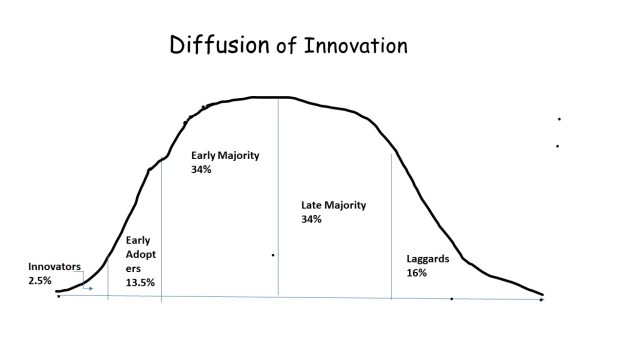
THE DIFFUSION OF INNOVATION theory describes the pattern and speed at which innovative ideas, practices, or products spread through a population which can be correlated in the present article to bringing a cultural change (in beliefs, attitude, values etc.) through training. The main players in a group are classified as innovators, early adopters, early majority, late majority, and laggards. The new ideas are adopted sequentially first by the innovators and lastly by the laggards.

  1. Innovators ( 2.5%) : They are willing to risk and accept any new ideas.
  2. Early Adopters( 13.5%) : Are already aware of the need to change and are comfortable adopting new ideas.
  3. Early Majority (34%) : They need the evidence that the innovation works before willing to adopt it.
  4. Late Majority ( 34%): They are sceptical of change and will only adopt if it has been tried by the early majority.
  5. Laggards ( 16%): Are bound by tradition and are conservative.

The characteristics of the Platter approach are:

  1. It targets the entire population irrespective of their intent and the degree of willingness to change.
  2. Being mandatory it may degenerate into an ‘event’ in  terms of food, ambience, entertainment thro fun/videos and freebies for the majority (early and late) and the laggards.
  3. A CHRO from a renowned construction company shared that their managers are interested only in branded programs from IIMs where the main motive is certification.
  4. Quite often the line managers are reluctant to nominate their reportees for the program  complaining that it affects the completion of their immediate tasks. I am not sure whether they too belong to the majority and the laggards.

How does the stripes approach differ from the platter approach? The former targets only the early adopters rather than the entire group.  It also does not link training program to certification, promotion, or increments but only to the interest and the initiative of the participant. The diffusion of training to other segments like majority and laggards is ultimately decided by the program quality and the way the early adopters spread the message.

The platter approach makes training mandatory treating all the subgroups like early adopters, late majority, laggards in the same bracket whereas the stripes approach creates a demand for training. The first batch of Value Selling program for Aristo India was targetted for the early adopters. This in turn has created so much buzz that others are willing to enrol for the second batch but only after going through the rigour of an essay and a selection process. Remember, anything that is given on a platter is never valued. The difference between the two approaches is summarized in the table below.

PLATTER VS STRIPES APPROACH

 PlatterStripes
Management ParadigmTraining is mandatoryTraining is optional
Target SegmentRandom, no specific targetEarly Adopters
EnrolmentBy DefaultSelection thro’ an  Essay
Participant MindsetReactiveProactive
Locus of ControlExternal  like certificationInternal – Job Enrichment
Efforts by HRNormalExtensive
Buy-in from the non-attendeesNot ApplicableCreates demand depending on  the program quality and the buzz.

Blindspot and Bias

The opening slides in my Value-Selling program read as follows:
The main objective of the program is to help you improve the Top-Line and Bottom-Line performance. When the training program commenced the conversation between the trainer and the participants used to be on the following lines:
T: Is the objective clear?
P: Yes.
T: Do you need any clarification?
P: No.
T: Can I go to the next slide?
P: Yes please.
As I was getting similar responses from different batches, a few programs later, I decided to check my assumptions and asked the group:
“By the way, what do the two terms mean to you?” and most of the responses ( barring a few correct ones) were as follows:
Top-Line : meeting the top boss, closing the order, profits etc.
Bottom-Line: making a cold call, meeting a purchase executive, handling objections, achieving the targets etc.
With a simple profit-and-loss statement, the discrepancy between their response and the right answer was shown. When asked about the learning from the exercise, the response was that the top-line and bottom-line correspond to revenue and profitability respectively.

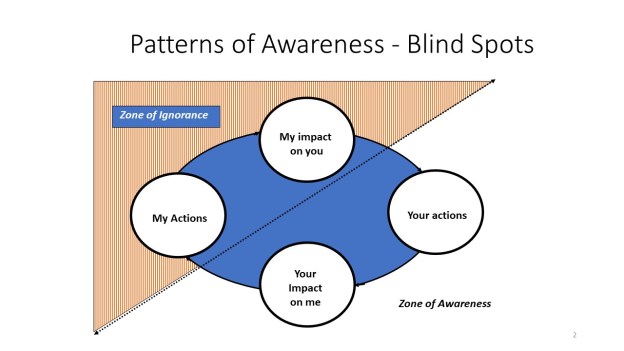
Welcome to the world of human biases, which are distinctive patterns of errors people make which are systematic in nature, wherein people may be confident even when they are wrong. The above example shows that people were not only blind to a specific concept ( top/bottom line) but were blind to their blindness too. (None of them said, I do not know)

A Chennai based petrochemicals company had set an objective to achieve a top-line of Rs. 500 crores within the next five years from the existing revenue of Rs. 62 crores in 2008.
When asked, the promoters replied that they have a basket of great products, competitive pricing, good location and a rising demand. What they did not factor were poor leadership quality (lack of trust and transparency, frequent squabbles between the CEO and MD,) high attrition rate, lack of proper systems and processes etc. External factors like the market dynamics, petroleum pricing, competition strategy etc were assumed to remain constant or were not considered while setting such a target. The company which had clocked Rs. 62 crores in 2008 managed to reach around Rs 115 crores by 2015 . As Nassim Nicholas Taleb says in Black Swan, ‘what you do not know is more significant than what you know.’

Till the 70s, it was assumed that human beings are rational animals who become irrational only under the influence of emotions like anger, fear. The subsequent research in neuroscience and psychology has proved otherwise. Irrationality is an integral part of human nature and is due to the inherent design of the human cognitive processes.

Another bias which affects decision making is the Illusion of Understanding; a variation of which is Illusion of Explanatory Depth–IOED which was coined by Leonid Rosenblatt and Frank Keil.
The illusion of explanatory depth (IOED) is the belief that we know more about the world than we do. When we are asked to explain the concept, then we become aware of our limited understanding.
Fact or process knowledge has a discrete end and can thus be described. Explanatory knowledge which is about opinions and beliefs does not have a discrete end and is difficult to explain. The interesting part is even if your explanation is not sound or comprehensive you feel you understand. You convert a target question ( difficult) to a heuristic ( easy ) question.
During one of our training programs, Pradip, a die-hard Modi Bhakt made a statement: Modi is a great leader. When asked to explain the concept he said, “ because he has many followers.”
T: Are you aware of the numbers?
P: It must be at least in crores; it is difficult to state.
T: A celebrity like a cricketer or a Bollywood hero also has followers in crores. Does it make them great leaders?
P:Forget that. He has performed well in short term and long -term.
T: What is your definition of short-term and term?
P: It can be one year and five years.
T: Did Modi get that time?
P: Yes
T: What are the indicators of performance, and do they indicate a good growth of economy?
P: Frankly speaking, I do not know.
The above is not only relevant for die-hard followers but also for bashers. Taking the converse of a statement, Modi is not a good leader, the basher may also be short of arguments after similar probing. The hatred and the polarization that is happening in the society can be reduced if we can get stumped by the level of our ignorance.

Generally, it is felt that passionate people are more knowledgeable, but the converse may be also true. Passionate people who take a vehement stand on issues like CAA/NRC, Rights of Minorities, LGBTQ, Religious Freedom, abortion etc. tend to focus on only one side of the coin which is essentially to prove a point rather than explore the truth. IOED states that knowledge of a subject might be inversely proportional to your passion and the stand you take. It is easy to state a fact or a process than explaining something in depth.

There is a thin line of demarcation between confidence and hubris. In the world of VUCA ( Volatility, Uncertainty, Ambiguity and Complexity) humility is more important than hubris.
I recollect my interaction with Narayanan, an eminent trainer from Chennai. I enquired about one of his public programs. “By the way, how did it go?” He said, “the program had to be cancelled due to poor response.” What might be the reason? He said, “frankly speaking I do not know. If someone were to ask me a question for a similar situation 20 years back; I would have confidently said the problem has to do with the timing, location, pricing etc. But today being in this field for so long; I do not know why some events succeed and some do not. However, such setbacks do not deter me, it is all a question of randomness which one must factor in life.”

Socrates made a clear distinction between knowledge and wisdom. A knowledgeable person maybe knowing things; however, he may act foolish as he may be too confident in what he knows. A wise person, on the contrary, cannot act foolish as he knows his limitations. He knows what he does not know.
Socrates said, “the one thing I know is that I know nothing.” This was not out of humility, but it was an expression of reality.

Snatching Defeat from the Jaws of Victory

Abraham Lincoln had no choice but to sack one of his army generals for losing a battle during the Civil war for his sheer stupidity when victory seemed almost certain. In his witty style Lincoln said, “He has managed to wring a spectacular defeat from the jaws of victory.”

Congress was the ruling party in Punjab with 77 out of 117 seats under the CM Amarinder Singh. The alliance of BJP and Shiromani Akali Dal (SAD) had 21 seats.

The alliance partner SAD parted ways with the BJP for the latter’s high-handed approach in dealing with its allies. Moreover, discontent was brewing  for long in Punjab due to the farmers’ protests, the bulldozing of the farm-laws in the parliament by the government, the  sudden lockdown during the pandemic which forced untold miseries  on the migrant workers.

Considering the weak opposition, victory was on the platter for the congress. No doubt, Captain Singh had his follies, he was not accessible there was discontent brewing in the party. But it could have been resolved amicably. But Rahul Gandhi thought otherwise. Navjot Singh Sidhu was thrust upon the state leadership. Captain Singh was replaced by a Charan Singh Channi who did not have much following in the state politics. And AAP created history taking its tally from 18 seats to a record of 92 seats. Is this an isolated instance of stupidity on part of Rahul Gandhi? (1)

In 2004, Manmohan Singh took over as the PM leading the UPA-1.Having completed his first term as the PM, the nation was ready for the Lok Sabha elections in 2009. What were his achievements?

From 2004-2009 the economy logged a growth of 9%, the highest rate for any plan period since independence. He stood up to the manipulations of the Left and the opposition in signing the Nuclear Deal between India and the US.

Despite these splendid achievements, the party high command had doubts of winning the election. Manmohan Singh’s photo was printed on the Election manifesto as well as on the election posters. If the party were to lose, it was the PM’s defeat. Incidentally, a Senior political journalist while speaking to Ahmed Patel confided that Rahul Gandhi was ready to be the leader of the opposition and be the agent of Change and differentiate from Dr. Manmohan Singh (2)

Lo Behold! After 1962,  Dr. Manmohan Singh had become the first PM to have been re-elected with an improved margin. Congress improved the tally of LS seats from 145 to 206. ( 9 more than what Rajiv Gandhi had achieved in 1989)

But then how was this Star Performer treated by the ‘family’? Was he given a free hand to choose his team members? For example, for the finance portfolio, Dr. Singh wanted to  induct C. Rangarajan, the former RBI governor with whom he had battled the BoP ( Balance of Payment) Crisis during the Narasimha Rao regime. Sonia Gandhi offered the portfolio to Pranab Mukherjee without consulting him. Incidentally, Pranab Mukherjee was the ‘architect’ of the retrospective tax regime ( the Vodafone case of Rs. 22,100 crores on Capital Gains and Withholding Tax which the GOI lost in the International Court at the Hague)  which was one of the factors of slowing down of India’s economy  growth rate. It also impacted India’s credibility in the international business (3)

By the time the Lok Sabha elections for 1996 were announced, the P.V. Narasimha Rao-led Government  formed by Congress had delivered one of the most  spectacular performances in a 5-year period then. India was able to overcome the BoP ( Balance of Payments)  crises. ( The foreign exchange reserves rose 12 times from 1991 to 1996) License Raj was abolished, the New Industrial Policy was launched, the insurance and the banking sector was opened to the private sector and the new telecom policy was to usher in the mobile revolution. In fact,1991 is termed as a watershed year, also called as India’s 2nd Independence.

But did the Star Performer who was responsible for delivering such an outstanding performance suitably rewarded? Forget being rewarded or being acknowledged, P.V. Narasimha Rao was humiliated not only when he was alive but even after his death. But did the Congress party or Rahul Gandhi win? Congress lost power despite the best performance delivered by the Rao Government. ( A forgotten Hero or a Ungrateful Nation?)

The three incidents discussed above prove the adage that insanity is doing the same thing repeatedly and expecting different results!

There are different approaches in helping the non-performing executives in improve  their deliverables which include coaching, mentoring, reprimanding or if nothing works, the dismissal. But then how do you deal with  star performers who are already doing well and need no interference? The cost involved when such a Star is demotivated increases exponentially when one is heading a department, an organization, or the nation. In the last instance, the damage is humongous. The article is not about Rahul Gandhi and his personality per se. but more about the orientation of a toxic leader. I come across a common refrain in my mentoring sessions that people do not change the organization but their bosses.

Do  toxic leaders like star performers? The question is not about liking and needs reframing. Can toxic leaders manage the star performers? I doubt as they are afraid of being surpassed by their subordinates which might be due to a deep insecurity and a trust deficit which increases in direct proportion to the subordinate’s achievement.

A concept called Wu-Wei can be helpful for effective leaders particularly in managing the star performers. Wu-Wei is loosely translated as ‘letting-go’ as followed in Tao-Te-Ching which denotes :

  1. An attitude of genuine NON-ACTION motivated by a lack of desire to participate in human affairs.
  2. A technique by which the practitioner may get a subtle control in pushing the envelope.

Some of you might have collaborated with good bosses  who practised wu-wei can consider yourself to be lucky. And those, the less fortunate (?)  in getting the toxic bosses- were you able to realize your potential by moving elsewhere or venturing on your own?

References:

  1. The art of snatching defeat from the jaws of victory – Capt. G.R. Gopinath ( Retd.) , Deccan Herald, 16th March 2022
  2. The Accidental Prime Minister- Sanjay Baru
  3. The Lost Decade ( 2008-2018), How India’s Growth Story devolved into Growth without a Story – Pooja Mehra

The Metaphor of Bicycle Thieves

Cycle, a Marathi film, is a story that unfolds in Bhugaon, a village in Konkan, Maharashtra, circa 1948. The protagonist is Keshav who is an astrologer whom people consulted mostly in times of distress. Keshav provided guidance about his client’s future by studying his horoscope. Quite often if the client were to be in financial distress, Keshav not only used to offer his services pro-bono but also partake of a meal with them. Being a kind and noble soul, Keshav had earned respect and goodwill in his community.

His grandfather, Gopalkrishna was an Ayurvedic doctor who was equally respected for medication and treatment of his patients. A British army officer, one such beneficiary of the doctor’s treatment; gifted Gopalkrishna his cycle while leaving India. Gopalkrishna during his final days bequeathed the cycle, distinct in its bright yellow colour, to his grandson Keshav, the protagonist of the story. 

The imported cycle was a rarity in Bhugaon, and Keshav was proud and possessive of it. Once when Keshav and his family go to watch a Marathi play, his cycle is stolen by two petty thieves, Vitthal and Tukaram. The next day, while riding in the adjoining village, the cycle develops a flat tyre. They go to the puncture shop for repairs, the shop owner recognizes the cycle and its original owner. To avoid any confusion, the thieves claim they are Keshav’s cousins and Keshav has lent the bicycle to them for a few days. Believing them, the shop owner refuses to take any fees for the repairs. On the contrary, he hands over ₹6 to the ‘cousins’ which he owed Keshav. Wherever these two thieves go, they were treated with exceptional hospitality, whether with meals, tea/coffee, or even with an overnight stay. At a school, they were invited as the chief guests, to deliver a motivational address to the students. With each passing day and with such touching incidents their conscience starts pricking. Initially, it was the fear of getting caught; but now it was the affection and love triggering guilt and shame.

In the meanwhile, Keshav was stricken with grief. The only thought which haunted him was why did he lose the cycle and how he can recover it. His wife entreats him to consult an astrologer who says, “Keshav, do you really feel I can tell you the whereabouts of your stolen cycle? People do not expect to hear the truth, but need consolation and encouragement about a brighter tomorrow when they seek counsel from an astrologer.”

While returning home, Keshav realized his approach as a soothsayer with his clients was no different. More than an astrologer, he was a psychologist, a counsellor telling people with encouraging advice like: this time is not right for youthis too shall pass, don’t get emotionally involved with things, do your best and leave the rest, handover your burden to the Almighty, he will take care of you, etc. 

Lost in his thoughts he came across a ramshackle house, walls cracked, valuables scattered all over and the rooftop blown over by a cyclone. To his surprise, he found the house owner quite composed. When Keshav enquires about the tragedy, the house owner says, “Last year when I was going through difficult times; I came to you for guidance, I still remember what you said then, don’t get stuck with things.” It was a moment of revelation for Keshav and his attachment towards his cycle. As a Zen master says ‘when my hut got burnt, I had a clear picture of the moon.’

Bicycle Thief by Vittorio Di Sica was released in 1948. Italy had gone through severe hardship post World War II and was plagued by recession, inflation, and a high rate of unemployment. The protagonist of the film is Antonio Ritchie, an unemployed youth for the last two years. After considerable struggle, he manages to get a job to paste cinema posters on poles and walls. Having a bicycle was a prime requisite for the job. Antonio manages to convince his quarrelsome but loving wife Maria to sell the bedsheets she received as a gift during their marriage, in order to purchase the bicycle. Now Antonio is all set to start his job with a bang. Within a short time, on the very first day itself, his bicycle gets stolen. Antonio is frustrated, runs from pillar to post, at last manages to trace his bicycle and nab the thief. However, nobody believes him, neither the people around, nor the police. And, for lack of evidence, Antonio is not able to regain his bicycle.

As he was walking along with Bruno, his 8-year-old son, he sees a bicycle parked alongside a wall. Antonio’s instincts get the better of him, and he attempts to steal it. To his misfortune, he gets caught and is given a sound thrashing. Bruno intervenes and saves his father from the matter getting worse. More than the thrashing, Antonio is hurt that he has cut a sorry figure before his son. On that fateful day, having lost his job, his bicycle, and his self-esteem before his son, Antonio was in total despair while returning home. Bruno while following his dad, picks up his father’s crumpled hat lying on the road; cleans and straightens it, and with a smile puts it on his father. 

Even though Bicycle Thieves by Sica was made in 1948, and Prakash Kunte’s Cycle in 2017, both films depict life in the late 40s. Italy went through the ravages of World War II, whereas India did not. The thief who stole Antonio’s cycle may have had his own compulsion, like Antonio who tried following suit.

The act of stealing a bicycle is shown from a different perspective, of how attachment to worldly things creates pain, of the pricking of their conscience, that makes Vitthal and Tukaram return the bicycle back in the village, even though not required. Keshav realizes his faith in the Almighty. He returns home with his retrieved bicycle, and he now keeps it afar. In his courtyard, he sees another bicycle. His family members and friends congratulate him for recovering the cycle. While touching the mudguard, he sees the yellow paint is wet. Everyone wants Keshav to be happy. The bicycle was just an excuse to make him happy.

One film discusses the inherent goodness, while the other is about the helplessness of people, which may be an outcome of their prevailing circumstances. Can we be judgemental about what is right and what is wrong? In a way, it is a story for all of us, where someone steals our idea or improves upon our original idea and does not give us credit for the original. In between black and white, there are multiple shades of grey. If you steal from one source, it is theft; if you steal from multiple sources, it is plagiarism or research. ‘Bicycle’ is just a metaphor!

Note:

  1. Bicycle Thieves: Is a 1948 Italian neorealist film directed by Vittoria De Sica. Considered as one of the Top 10 All-Time great films; it had  a major influence on Satyajit Ray, Shyam Benegal, Bimal Roy and Hrishikesh Mukherjee.
  2. Cycle: Is a 2018 Marathi film directed by Prakash Kunte written by Aditi Moghe and produced by Sangram Surve and Amar Pandit and was screened at Cannes Film Festival

Image Source: https://i.pinimg.com/originals/c5/6e/be/c56ebed6c368d900b30bded63548280e.gif

Socratic Method of Inquiry: The Difference between Knowledge and Wisdom

Socrates was a Greek philosopher (470BC-399BC) in Athens. He did not author any texts, but his disciple, Plato captured his thoughts in the Dialogue

The Socratic method of inquiry was a method of deep questioning which he used to have with his students on topics like beauty, justice, virtue, etc. He never gave direct answers to his questions but expected his students to figure out their own answers. 

Socrates was accused of corrupting the youth of Athens, worshipping false gods, and not worshipping the state religion. A 100-member jury was arranged to pass a verdict on his crimes. After a day-long trial, he was convicted and sentenced to death by administering hemlock, a poison. Socrates was told that he could be pardoned, provided he expressed an apology for his deeds. However, he refused to beg for his life on the following grounds:

– This is my life.

– If I had to stop doing what I am doing, I might as well stop living.

– Who knows? Death may not be so bad, as I have no idea of death.

– I am 71 and may not live much longer.

The Oracle of Delphi has delivered hundred-odd injunctions, inscribed on the temple walls, which include: ‘nothing in excess’ and ‘know thyself.’ One of the famous quotes ascribed to Socrates is: ‘An unexamined life is not worth living.’

How is this relevant to us? Most of the decisions; be it the type of education, the place to settle, the choice of spouse or career, are often not taken consciously but are either dictated by parents, society, or the circumstances. When we review the decisions, it inspires us to reconsider our most firmly held beliefs. It may also help us to appreciate other’s viewpoints. 

Circa 1975, a British Manager from GKW (Guest Keen Williams) was visiting a premier Engineering and Research Institute in Bombay (now Mumbai) to interview and select Graduate Engineer Trainees (GETs). Seven candidates from the metallurgy dept were shortlisted. For the group discussion (GD), the topic was the future of cricket in India. The GD was quite animated, the students striking off each other’s arguments with ease. After the GD was over, the interviews commenced. The manager asked the first candidate, “how much phosphorous is there in phosphor-bronze?” The student thought for a few seconds and replied it was 25%. “That is the correct answer. Thank you very much. Can you send the next candidate please?” requested the manager. After coming out, his friends asked him about the interview. The candidate replied that not only was the question a simple one, but by fluke, the answer of 25%, had turned out correct. 

The second candidate was called in and was asked the same question. Lo and behold, the student answered with the same aplomb. After leaving the interview room, the students ridiculed the interviewer for his inadequacy in not asking tough questions, vis-à-vis the IQ level of the students and the brand of their institute.

The story continued in a similar fashion for all of the seven candidates. After the interviews were over, the manager called all the candidates inside and said, “young men, during the group discussion, you were vehemently proposing your viewpoint without either considering or listening to the others’ viewpoint. Our company believes in teamwork. You belong to one of India’s premium engineering colleges. However, even after living with the same group for five years, you do not have any concern for other’s viewpoints. How will you perform in our company with such an attitude? To each of you, I asked a question on phosphor-bronze. You may be knowing a lot of things in life even otherwise. 

However, no person can know and need to know everything. I thought at least one of you would say ‘I do not know.’ Yet, all of you gave me the standard answer of 25%. By the way, phosphor-bronze is a member of the family of copper alloys. It is composed of copper that is alloyed with 0.5-11% of tin and has phosphorous in the range of 0.01-0.35%.I was not expecting a perfect answer, and a closer approximation to the actual value would have sufficed. Even if one amongst you were to express his ignorance, I would have recruited him. I am afraid I am not able to select any of you.”

Socrates made a clear distinction between knowledge and wisdom. A knowledgeable person maybe knowing things; however, he may act foolish as he may be too confident in what he knows. A wise person, on the contrary, cannot act foolish as he knows his limitations. He knows what he does not know. 

Due to his unconventional ways of self-exploration, Socrates was considered a wise man. An elderly gentleman in Athens once said, “no one is wiser than Socrates.” Rather than getting carried away by such flattery, Socrates’ analysis of the above statement was: Either all are as dumb or as knowledgeable as Socrates.

Conventional education aims at stuffing the students’ minds with information; whereas Socrates’ method of deep questioning helps develop critical thinking to question our belief system and assumptions; and so, it helps us understand the statement: ‘An unexamined life is not worth living’ leading towards the wisdom: ‘to know what one does not know.’ 

The profound statement Socrates made was, “the one thing I know is that I know nothing.” This was not out of humility, but it was an expression of reality.

A Forgotten Hero or an Ungrateful Nation?

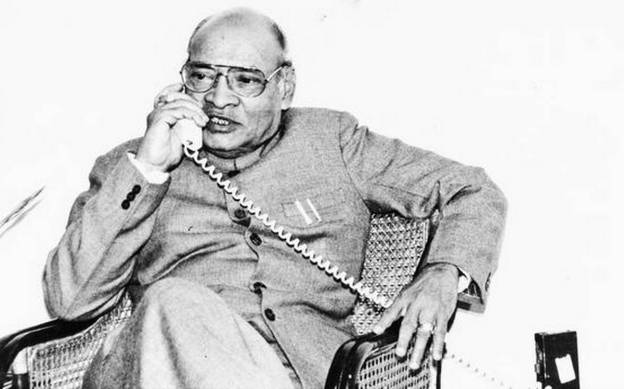
On 24th June 1991, three days after swearing-in as the Prime Minister, Prannoy Roy from NDTV while interviewing P.V. Narasimha Rao (PVN) asked him, “Hon. Prime Minister, the country is going through a major financial crisis, you are heading a minority government. You are not in the pink of health. How are you going to manage?” After a long pause, PVN, using Bismarck’s famous quote, replied, “Politics, is the art of the possible.”

PVN took oath as the Prime Minister three days earlier. For 37 of the 44 years since independence, the country was ruled by the first family of Indian politics: Jawaharlal Nehru, Indira, and Rajiv Gandhi. Barring Lal Bahadur Shastri (and Gulzarilal Nanda as an Interim PM) the Congress party handed over the baton of Prime Ministership to someone outside the Gandhi-Nehru family.

Was he the party’s first choice to be fielded as the prime ministerial candidate? The Congress coterie wanted to have Sonia Gandhi to fill the slot. Already undergoing a tremendous shock of the untimely death of her husband and with the security of her children being her major concern, 

Sonia declined the offer. Shankar Dayal Sharma, the then Vice President was the next choice who declined on health grounds. The ambitious Arjun Singh and Sharad Pawar could not muster enough support. The mantle felt on PVN only because the party leadership felt he may not last long, give or take one year! It was more of a stop-gap arrangement.

Let alone a strong lobby behind him, PVN did not even have good friends in the Congress party. The man who had no friends did not have strong enemies either, which incidentally turned out to be a plus point in his being considered for the PM’s post. Some external events also were favourable for PVN. The elections in the northern states were over before 21st May, the day of Rajiv Gandhi’s assassination; while the southern states were scheduled to vote later. The post-assassination sympathy wave helped Congress clinch142 seats out of 227 MPs from South India. Arjun Singh, one of the main contenders from Madhya Pradesh lost his claim due to the poor numbers of Congress MPs in the North. Sharad Pawar could get support from only 38 MPs from Maharashtra. For the first time, the country was to have a PM from the south. Thus, it was by accident, and a quirk of events; and not by design that PVN became the PM. His failing health was also in his favour, as his party did not expect him to complete the full five-year term.

Foreign Exchange Crisis: In June 1991, the Indian Govt had foreign exchange reserves which were sufficient for barely 3 weeks. With the fiscal deficit running at 8.2%, and the internal debt being 5.6 % of GDP, the country was on the verge of bankruptcy.

The TEAM: 

During the previous 10 years, PVN did not have any inclination towards economic issues. One thing he realized was that the economic problem, being complex and serious, a competent person must be installed as the Finance Minister. I. G. Patel, the former RBI Governor was the first choice, but when he declined, the mantle fell on Dr. Manmohan Singh. Singh was an eminent economist, and he had worked with the United Nations, been an RBI Governor, a Chief Economic Advisor, and the Head of the Planning Commission over separate tenures. A team of competent ministers and bureaucrats were put in place, which included, among others, Naresh Chandra as Cabinet Secretary, Amarnath Verma as Principal Secretary, Montek Singh Ahluwalia, and others. 

Crucial Decisions: 

To overcome the serious economic challenges, the minority govt. had to take some quick short-term decisions. One such decision was to pledge the country’s entire gold reserves, while another was the devaluation of the rupee. The long-term decisions included the New Industrial Policy. 

  • Pledging of Gold:

To save the country from bankruptcy, the government had no choice but to pledge gold from its reserves. In the first phase, it was pledged through the State Bank of India on 4th July. In subsequent phases, it was done directly by RBI on 7th, 11th, and 18th July. Overall, 46.91 metric tonnes of gold was pledged to the Bank of England. On 10th July the media received the news. As usual, there was a hue and cry in parliament. Dr. Manmohan Singh explained that it was a fait accompli, and the decision was taken with due diligence and positive intent. However, in the international markets, India’s credibility rose, as financial institutions felt the country was making serious course corrections. That month, India received a loan of USD 221 Million.

  • Rupee Devaluation: 

Apart from the fiscal mismanagement by previous governments, the foreign exchange reserves were getting depleted due to the Gulf war. Saddam Hussein had attacked Kuwait, and the rising oil prices coupled with reduced remittances from overseas Indians started showing a strain on the foreign exchange front. 

Inadequate exports were the other major reason. The exchange rate of $1= Rs. 17.90 was not only high, but it also did not reflect the market reality. Indian products and services were expensive in the international market, thus affecting export earnings. This anomaly needed an immediate correction. 

Within 10 days of assuming office, on 1st July, the Indian Rupee was devalued against the US Dollar, Japanese Yen, Deutsche Mark, and the British Pound by 7-9%. The second devaluation was scheduled for 3rd July. The opposition, including the communists, were staunch critics of devaluation. There was stiff resistance in the ruling dispensation too. Devaluation was perceived as affecting the self-esteem of the country, as well as the government being in collusion with ‘capitalist’ institutions like IMF, World Bank, etc. PVN was under tremendous pressure and informed Dr. Manmohan Singh to stop the second one. When the finance minister contacted C. Rangarajan, the Governor of RBI, the latter said the decision has already been taken by 9 am. The horse was unbolted. To make the bitter truth palatable, the devaluation was renamed as exchange rate correction. The stock markets bounced back with full vigour and the economy started showing signs of recovery. By 1992, the INR exchange rate to the USD moved from 17.9 to 24.5. Subsidy for exports was cut, and to improve exports EXIM scrips were introduced, wherein exporters would get concessions for importing specific goods. This policy framework was done by Montek Singh Ahluwalia and P. Chidambaram, and the decision for this was taken within a day by PVN. 

  • The New Industrial Policy: 

Another major decision was the New industrial Policy which was crucial to economic recovery. PVN had kept the industries portfolio with him. Dr. Manmohan Singh wanted to present the New Industrial Policy as a part of the budget. However, the bureaucrats in the Industries ministry wanted the policy to be presented separately. Sensing that it will be faced with stiff opposition in the parliament, PVN played a smart game. His deputy, P.J. Kurien, (the State Minister of Industries) after the zero hour, requested the speaker of the Lok Sabha to permit him to place the New Industrial Policy before the house. A crucial document that paved the way for liberalization, scrapping the MRTPC act and the license Raj, was presented without much fanfare or debate. The chief architect, PVN did not utter a single word during the presentation. (He who knows does not speakHe who speaks does not know… Lao Tzu) 

Expert committees were formed to introduce fundamental changes in enabling sustained and accelerated growth in the economy. Raja Chelliah led a committee for Tax reforms, and M. Narasimham a committee for Banking Reforms. Their recommendations were accepted; tax rates were rationalized and private banks were allowed to function. 

Allowing private players to enter the banking sector was another major decision. Under normal circumstances, there would have been long debates challenging such a major decision. After all, any major change attracts a great deal of resistance. A great leader can spot an opportunity in a problem. The country was going through tumultuous times after the Babri Masjid demolition in December 1992. As BJP was cornered, no party was in the mood to rock the boat. The banking sector was opened to ICICI, HDFC, AXIS, and other banks without much fanfare or debate. In 1993 the aviation sector was opened, and in 1994 the new Telecom policy was launched, paving the way for a mobile revolution. 

When he took over as the PM in June 1991, the country had foreign exchange reserves equivalent to Rs. 3000 Crores. While addressing the nation from the Red Fort on Independence Day in 1994, PVN proudly announced that this figure had reached Rs. 51,000 Crores and the country had averted a major financial crisis. 

Aristotle’s characteristics of Greek tragic heroes mention them as being virtuous, long-suffering, and having a tragic flaw. PVN was a polyglot with fluency in 10 languages. With his sharp intellect, he could fathom problems from multiple perspectives. He appointed competent ministers and bureaucrats to handle complex issues. If needed, he took quick decisions, be it the Rupee devaluation, or the New Industrial Policy. What looked impossible, a Herculean task, he achieved through the dictum, ‘politics is the art of the possible.’

He had to face monumental challenges: here was a man who had formed a government without a majority, there was no real support from within his party which had elected him as a leader, he had no cordial relationship with the first family, and opposition parties were baying for his blood with a series of no-confidence motions. He was aging, and at 70, he was suffering from diabetes, blood pressure, and had undergone a bypass surgery a year before he took over as the PM. He had to suffer it all alone. 

One of the tragic flaws that he could not resolve was the dilemma of accepting the diktats of the first family (unlike his protégé who succeeded him much later) or being a total rebel to walk his path.

Pamulparti Venkata Narasimha Rao passed away on 23rd December 2004. No other person within a short span of five years has brought in such sweeping reforms in the country. Forget the opposition parties, the Congress party disowned him. It was ensured that his corpse was neither brought to the Congress Party Head Office nor cremated in Delhi, and sadly, neither was any monument constructed in the capital for this great leader. The humiliation did not part him even in his death.

References

  1. Raoparv – Prashant Dixit
  2. To the Brink and Back, India’s 1991 Story – Jairam Ramesh
  3. 1991, How PV Narasimha Rao made History- Sanjay Baru
  4. Wikipedia 

Image Source: https://www.google.com/url?sa=i&url=https%3A%2F%2Fwww.thehindu.com%2Fopinion%2Fop-ed%2Fpv-narasimha-rao-the-subversive-insider%2Farticle31939743.ece&psig=AOvVaw2T3v0CnnHzRFt8-FK08HSv&ust=1624530907623000&source=images&cd=vfe&ved=0CAcQjRxqFwoTCJjHrbDHrfECFQAAAAAdAAAAABAk

Ethically Speaking

“Wishing you many happy returns on your sixtieth birthday,” so saying, I called my friend, Mahesh. He replied, “Rajan thanks for the greetings, but to be frank, my birthday is on 5th December and not today, on 2nd April. For the purpose of saving one academic year, this date of 02nd April was indicated by my father on my school admission form.” The above is not an isolated event, it happened frequently.

During the Chemistry lab period in the PUC days, there were experiments on identifying an element defined by sequence; by performing the dry test, wet test, and then the confirmatory tests. The demonstrator used to tell us ‘during exams, don’t waste time on the first two tests; go straight to the confirmatory test, and if you get time, do the previous ones. Bypassing the system with false birth certificates or taking short cuts was the name of the game.

Engineering Drawing was one of the time-consuming subjects in college. Unlike the CAD/ CAM environment today, where designs are made on computers, we had to make elaborate engineering drawings. Each assignment made on an A2/A3 drawing sheet needed an elaborate setup of a drawing board, mini drafter, T-square, compass, divider, set square, etc. It used to take around 2-3 hours to complete an assignment. The practise of GT (Glass Tracing) among hostelites was quite common. The GT procedure was simple. An assignment completed by a sincere student was glass traced by other students. A table lamp was kept in a bucket covered with a glass sheet; the blank sheet was aligned over the completed sheet. The lit lamp helped the student trace the original and the assignment could be completed in no time. The general consensus among the student fraternity was that the guy who took all the effort to complete the drawing in the 1st angle, 3rd angle, and a sectional view, was an idiot, while the people who copied it in one-fifth the time were intelligent and smart.

In one humorous instance, one guy was so ‘meticulous’ that apart from tracing the drawing, he copied the name and the roll number of the original student! The scene is no different today, for several agencies offer ready-made projects for engineering students for a fee.

A certain lecturer used to share with his colleagues, his life-long ambition of becoming a Vice-Chancellor (VC) of a university. Over a while, he moved up the hierarchy of senior lecturer, reader, and finally became a professor. A post for a VC was advertised in the papers. He applied but came to know that, more than merit, caste and money played an important role in the recruitment for this position. He managed to raise around Rs 3 crores for this, yet he was shocked to see the post eventually going to the highest bidder.

Much later, an advertisement appeared for another VCs post. This time, he knew the crucial role of politicians and middlemen. He developed contacts, moved heaven and earth to raise around Rs. 5 crores; despite being questioned by his friends, from an ethics and ROI perspective. The attempt for this second time to the post also eluded him. He committed suicide later.

I used to believe that such respectable positions need not be advertised but were filled by selecting eminent people with exceptional credentials. As Nirad Chowdhury wrote in the Autobiography of an Unknown Indian, an Indian’s faith in a bribe is infinite and unshakable. It is an infallible remedy for all workday inconveniences.

Academicians have used the terms ethics and morality interchangeably. Some people think that morality is personal and normative whereas ethics indicates the standards of good and bad as decided by community settings. It can be also looked at from a perspective of means and the ends. People have their own yardsticks in justifying their actions. As Robert Pirsig writes in the Zen and The Art of Motorcycle Maintenance, and what is good, Phaedrus, and what is not good – need we ask anyone to tell us these things? The three examples to illustrate the point are:

  1. Ratan Tata used to say, “Why should I spend time with bureaucrats in Delhi? They are supposed to do their work and I am supposed to do mine.” On the other hand, (the late) Dhirubhai Ambani had a different take. “You offer naivedya to God while visiting a temple. Why not deal with bureaucrats on a similar line?”
  2. The Karnataka Vidhana Soudha has an inscription on its façade: ‘Government’s work is God’s Work.’  I overheard a babu saying, “Anyway it is God’s work. Why should I?”
  3. A departmental store was run by two partners for 30 years. The 2nd generation was to take over the business. The first partner’s son who had passed out from an elite management institute asked his father, “We have learned all the aspects of running a business, the one topic I am not clear is about ethics. Can you elaborate on the same? The father explained, “it is quite elementary. Imagine a lady buys a dress for Rs. 1000 and while paying at the billing counter she inadvertently pays Rs, 2000. Now my son, the question of ethics comes, should we tell our partner or not.”

My niece Rupali Patil teaches in an upmarket public school in Whitefield, Bengaluru. She narrated some interesting anecdotes while conducting on-line examinations. The students are asked to keep the laptop at a specific angle to ensure they do not look at any material on their lap while writing answers. Parents are requested not to walk around or prompt the students while answering the question papers. Some parents have written papers themselves. One audacious father dared to sit underneath the table and prompt the answers. When asked how it was detected, I gleaned that the student used to normally score 10 out of 50, but scored 40 in that exam; he subsequently boasted to his friends how his father had helped him.

While websites like exam.net are used to ensure that students do not lose their focus on the screen, or use the second browser to get answers, by looking down; ingenious means are used to work around the system.

The school being in Whitefield, Bengaluru the following conjectures were thought of:

  1. Considering the location and the school fees, is it safe to assume that a majority of student’s families belong to the upper middle class, well-educated with Graduate/Post Graduate degrees?
  2. Is it safe to assume that the parents are working in renowned MNCs (Indian or International) with well-established guidelines on Vision, Mission, Values, and Ethics policies?  If so, should there be a divergence in behaviour between the professional life of a manager vis-à-vis that of a parent?

Education can be perceived as an end to realize one’s potential, or it can be simply a means to get a job in earning a livelihood. The former makes us look holistically at life, whereas the latter makes it transactional. Philosopher Immanuel Kant says that a rational human being is an end in himself and not a means to achieve something. When our attitude and behaviour are oriented towards means, quality becomes the main casualty.

Abraham Lincoln in his letter to his son’s headmaster wrote:

“Teach him if you can that a dollar earned is of far more value than five found.In school teach him it is far more honourable to fail than to cheat.Teach him to have faith in his own ideas, even if everyone tells him they are wrong!”

On a personal note, now when I call my friends, with trepidation I first ask “Before wishing you birthday greetings, is today your actual or official birthday?”

We set our own standards: “Jahaan hum khade rahtey hain; wahin se kataar shuru hoti hai!” – Wherever I (honorific) stand, the queue starts from there!.

Jai ho ‘Atmanirbhar’ Bharat!

References:

  1. Welcome to a world-class university education : M. Gautam Machiah, Deccan Herald, November 15, 2020
  2. Some midterm answer scripts leave teachers stumped: The Hindu, November 26, 2020
  3.  Image: https://www.123rf.com/photo_54708808_stock-vector-compass-rose-isolated-on-white.html